
New Mars rover can 'swim' through sand like desert lizard
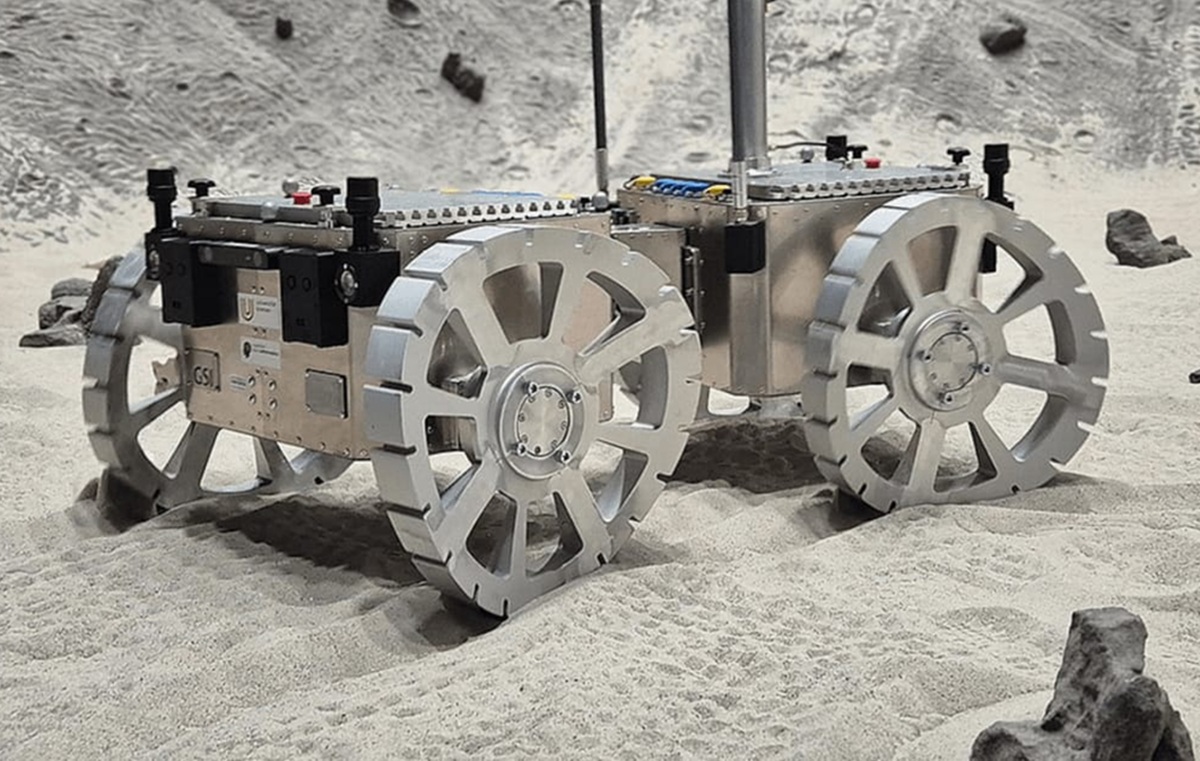
To effectively explore Mars, rovers must navigate challenging sandy terrain. In response, German engineers have developed a new rover that moves using a ‘swimming’ technique in sand to prevent getting stuck.
The unique design is inspired by the African sandfish (Scincus scincus), a desert lizard native to the Sahara that can dig and move beneath sand like a fish in water. This movement is considered one of the most unique locomotion methods in the animal kingdom and could aid future Mars exploration.
A video released by the University of Würzburg shows the silver-coloured, mini-fridge-sized rover moving across a sand arena designed to mimic Mars’ surface. Unlike conventional rovers with standard rotating wheels, this rover’s four wheels cut through sand using an eight-shaped motion pattern.
The robot can move forward several metres, turn, and return to its starting point stably.
“These wheels mimic the sandfish’s interaction with the ground, generating longitudinal and lateral forces,” said researcher Amenosis Lopez from the University of Würzburg.
He added that the rover’s wheels leave sinusoidal traces on the sand surface.
While space rovers are typically associated with round wheels or treads like those in the film WALL-E, such designs are not ideal for Mars’ extreme, sandy conditions.
Sand behaves uniquely as both solid and liquid. Mars’ terrain features steep slopes, uneven surfaces, and soft sand areas that easily trap rover wheels.
Nature, however, has already found a solution through the Sahara sandfish.
Despite its name, the sandfish is actually a skink lizard. On the surface, it walks like a regular lizard using its small legs. When burrowing into sand, its body moves in strong undulating waves to propel itself beneath the surface.
X-ray imaging revealed that the sandfish’s body movement closely resembles that of a fish swimming in water, generating thrust while reducing sand resistance.
In 2011, Georgia Tech engineers also created a robot based on the sandfish’s movement. Their research showed the lizard’s wedge-shaped head helps it “float” and move more easily through sand.
The latest rover development team claims their new wheel design is more stable than conventional round wheels when traversing sandy terrain.
While conventional wheels tend to shake and lose direction, the oscillating wheels on the new rover maintain stable movement.
However, the technology did not succeed immediately. Initial rover models were too heavy, causing them to sink into the sand during tests.
Researchers subsequently redesigned the rover by widening the wheels and reducing overall weight for more effective movement.
Despite its promise, the technology requires significant development before being used in NASA’s Mars rover missions. Scientists must improve rover control and address slippage in real-world terrains that are far more complex.
Additionally, future rovers must carry scientific instruments and other payloads.
Beyond technological innovation, this rover design demonstrates how nature and evolution can inspire modern engineering solutions for exploring the solar system’s most extreme environments. (Popular Science/Z-2)