
New Hubs for Judol and the Mekong Scam
Two Japanese nationals, Yuria Kikuchi and Shikaura Midori, were at the centre of uncovering an international online scam and ‘judol’ network in Indonesia. The pair were reportedly abducted while travelling in Surabaya and Bali in mid-April. The National Central Bureau (NCB) Interpol Indonesia and Surabaya Police Criminal Investigation Directorate (Polrestabes) who pursued them uncovered deeper facts.
‘Indeed they were abducted, and she was forced to work as a scammer,’ said Brigadier General Untung Widyatmoko, Secretary of the NCB Hubinter, to detikX.
Kikuchi and Midori were located in a rented house on Jalan Dharma Husada Permai VIII Blok N-318 in Surabaya in early May 2026. The house was rented by an Indonesian national identified only as E.
During a raid, several electronic devices were found that are suspected to be tools for online fraud. At the house, police arrested three Chinese nationals, four Japanese nationals, and two Indonesian nationals believed to be involved in international online scam networks.
From there, officers obtained information about another scam network base at Jalan Embong Kenongo, No. 24, Surabaya. This house was used by 32 Chinese residents to conduct online scams. It was empty when raided; only E remained at the residence.
The suspects fled, but Surabaya Police managed to trace them to a hotel in Surabaya. Six Chinese nationals were arrested then. Police also arrested 19 other foreign nationals suspected to be part of an online scam network at Kaza Mall, Surabaya.
‘Then we obtained information about other networks in Bali, then Bogor, then Surakarta, Sukabumi, Batam, and Jakarta,’ Untung explained.
In Bali, police secured 26 foreign nationals and four Indonesian nationals suspected of involvement with an online scam network at a guesthouse in the Kedonganan area of Kuta. Among the detainees, four were from China, four from Taiwan, one from Malaysia, four from Kenya, and 12 from the Philippines.
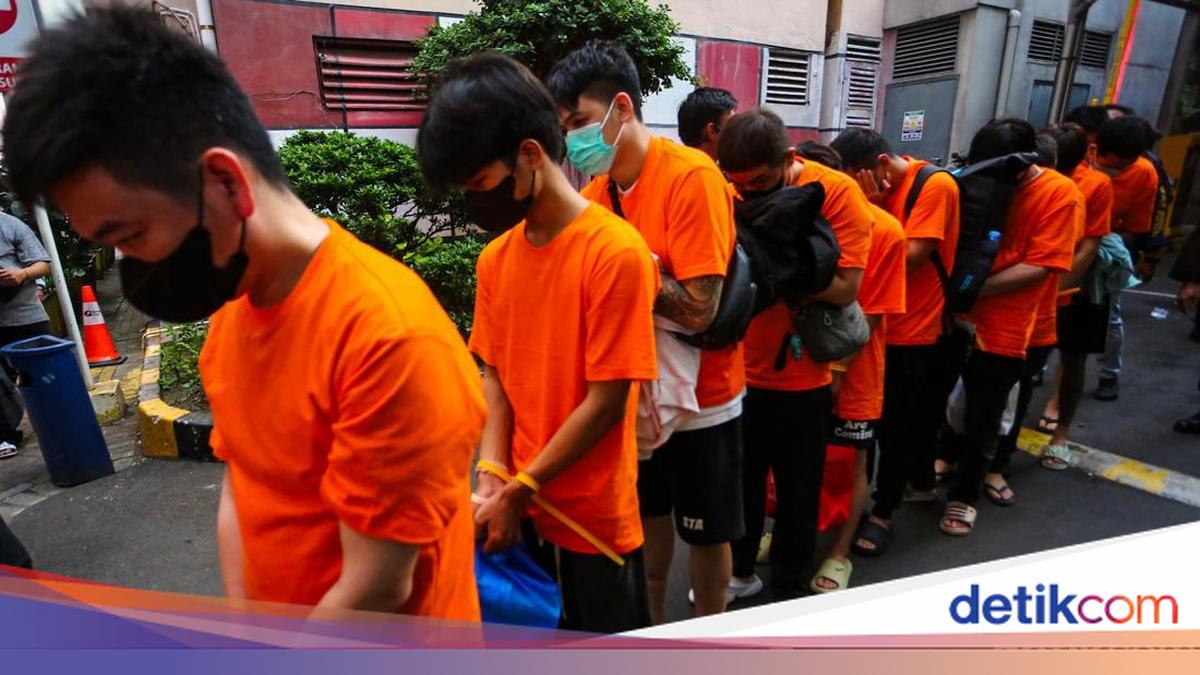
Dirtipidum Bareskrim Polri, Brigadier General Wira Satya Triputra, announced the breakthroughs into the judol case in the Hayam Wuruk office complex, West Jakarta, on Saturday (9 May 2026).
In this disclosure, Bali Police uncovered a number of training manuscripts related to various police scenario drills that are suspected to be used for fraud. These documents included transcripts of training scripts about weapons, major narcotics, and other forms of crime portrayed within the scripts.
‘There were already forms of training present; transcripts of training scenarios regarding weapons, narcotics, and other forms of crime are included in the scripts,’ said Bali Regional Police Criminal Investigation Directorate (Ditreskrimum) Chief Kombes I Gede Adhi Mulyarman as quoted by detikBali on Wednesday, 13 May 2026.
In Bogor, police found similar evidence after raids at three houses in the Sentul City area. There were Japanese police badges, communications devices, computers, and signal boosters and jammers. A total of 13 Japanese nationals were detained in the operation.
The network of cyber criminals was also dismantled in Surakarta, Sukabumi, Batam, and Jakarta. More than 500 people were detained across raids on the scam and judol headquarters.
Untung Widyatmoko disclosed that the majority were involved in scams; only one site served as the operational HQ for judol, namely at Hayam Wuruk, West Jakarta.
‘Varied scams. Love scams, romance-based frauds, and investments. Investment schemes are closely tied to Ponzi schemes as well,’ Untung said.
The crimes of this network are difficult to trace using conventional investigative methods. Most of them do not use conventional banks or local banks to receive funds. Most funds flow directly to international banks and are converted into crypto assets, including Tether (USDT).
‘Their IP addresses are always from outside Indonesia. That is how they hide their activities,’ Untung explained.
Given this pattern, Untung suspects that hundreds of foreign nationals arrested are part of an international network that previously hosted operations in Mekong River surrounding countries, including Cambodia, Vietnam, Myanmar, Laos, and Thailand. Some appeared well-trained and quite knowledgeable about how online scams and judol operate. They arrived in Indonesia not empty-handed but with sophisticated technologies prepared to mislead authorities.
Many arrived in Indonesia after the large-scale crackdown on scam and judol bases in KK Park Myawady, Vietnam, and O’Smech along the Cambodia–Thailand border. After those operations, the network spread to seek new nests for continued activity, including in Indonesia.
‘They have even reached Dubai, South Africa, and many other countries, including in the Middle East and Eastern Europe, and even Latin America,’ asserted Untung.
Cyber security expert Pratama Persadha of CISSReC assessed that the shift of scam and judol hubs from Indochina to Indonesia is due to gaps in digital monitoring in the country. Cross-agency oversight involving the National Cyber and Encryption Agency (BSSN), Immigration, financial institutions, and digital-spaces and property oversight bodies remains far from optimal.
Moreover, Indonesia is seen as a fertile market for cybercrime hubs given its large population and improving internet penetration. The rapid growth of digital transactions also makes Indonesia a highly potential ground for online fraud.
Some of the hundreds of foreign nationals suspected of involvement in cross-border online gambling operations were being escorted out of a building in the Plaza Hayam Wuruk area when the raids concluded.