
New Criminal Code and Criminal Procedure Code Pose Challenges for State-Owned Enterprises
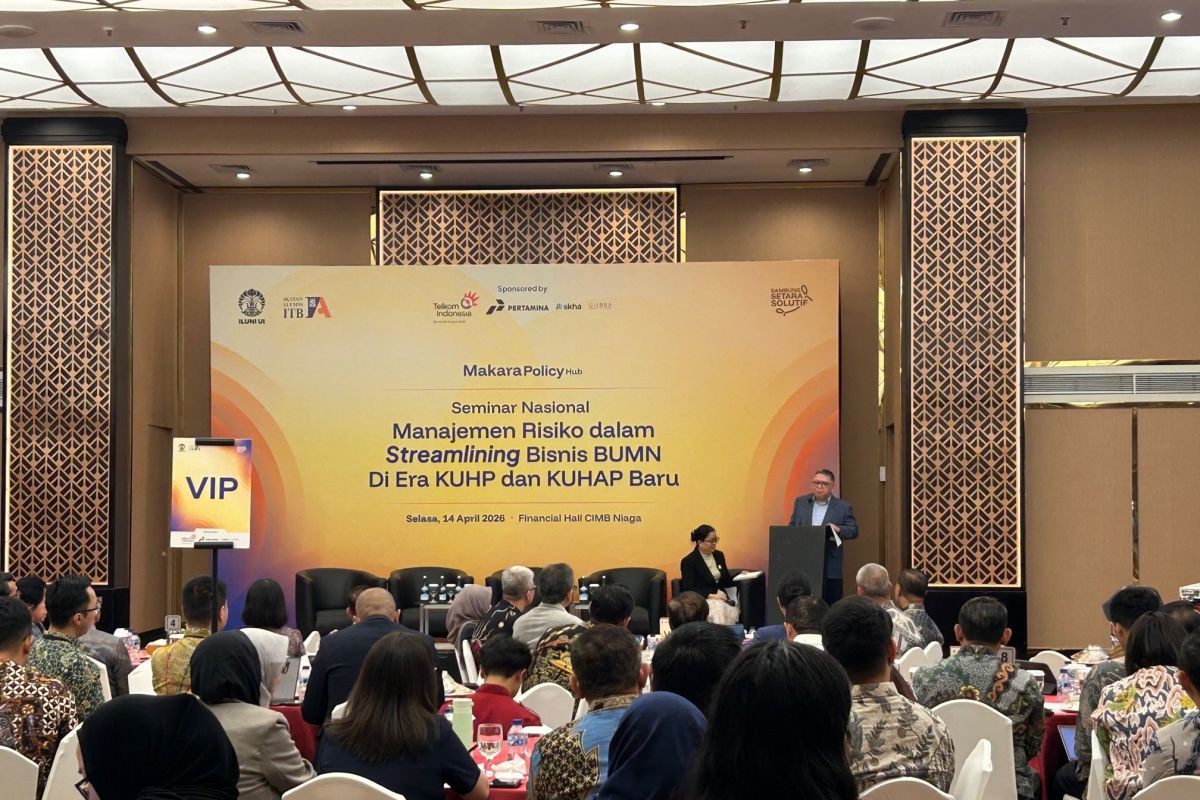
Jakarta (ANTARA) - Deputy Attorney General for Civil and State Administrative Affairs of the Republic of Indonesia Attorney General’s Office, Prof Narendra Jatna, stated that the existence of the new Criminal Code (KUHP) and Criminal Procedure Code (KUHAP) creates new challenges for State-Owned Enterprises (BUMNs) in carrying out their business.
“What is the difference between the new and old KUHP? There is none! Both are criminal, only the legal school of thought has changed,” said Narendra at the national seminar “Risk Management in Streamlining BUMN Business in the Era of the New KUHP and KUHAP” in Jakarta on Tuesday.
In his presentation, Narendra conveyed that BUMNs cannot solely rely on the business judgment rule (BJR) when facing criminal law oversight.
According to him, the fundamental change involves an in personam and in rem approach. The new KUHP encourages not only imprisonment of individuals but also seizure of assets.
“The most fundamental thing is what differentiates BUMNs from ordinary limited liability companies. BJR cannot simply be invoked by BUMNs,” he stated.
He mentioned that BUMNs need to pay attention to international standards such as UNCAC and OECD regarding internal controls, anti-bribery mechanisms, and transparent decision-making. For instance, under UNCAC standards, private corruption is also considered corruption.
In the era of the new KUHP, he said, what needs to be considered is not only national legislation but also good business practices and sound accounting.
Compliance and risk mitigation hold a more important position than fear of the new KUHP and KUHAP.
In contrast to Narendra, Supreme Court Justice of the Criminal Chamber Achmad Setyo Pudjoharsoyo stated that the Supreme Court recognises BJR as a legitimate protection, but it should be noted that immunity under BJR is not absolute.
“There are two similar cases where one is subject to criminal penalties and the other is not,” said Setyo.
He noted that BJR protects directors and management as long as decisions are taken in accordance with applicable provisions.
Responding to this difference, Professor of Criminal Law at the Faculty of Law, University of Indonesia, Prof. Harkristuti Harkrisnowo, stated that guidelines from the Supreme Court are important.
This is reflected in cases where a company is the defendant but its management is punished, and in other cases where management is the defendant but the company is punished.
“What is concerning is that the Supreme Court has not yet determined when it concerns management, when it concerns BO (beneficial owner), and so on,” said Tuti.
UI Alumni Association Chairman Pramudiya, as the organising committee, stated that the new KUHP and KUHAP open up various alternatives for resolving criminal issues. This differs from the old KUHP, which was oriented towards imprisonment and fines.
In this forum, it is hoped that all participants can share the same view on how to conduct good business in Indonesia, to avoid over-criminalisation, especially since the business conducted is part of government policy.
“From various materials presented here, the hope is that they can serve as input and be used together as a basis for discussion with all stakeholders,” said Pramudiya.