
National Police Chief's Term of Office Challenged at Constitutional Court
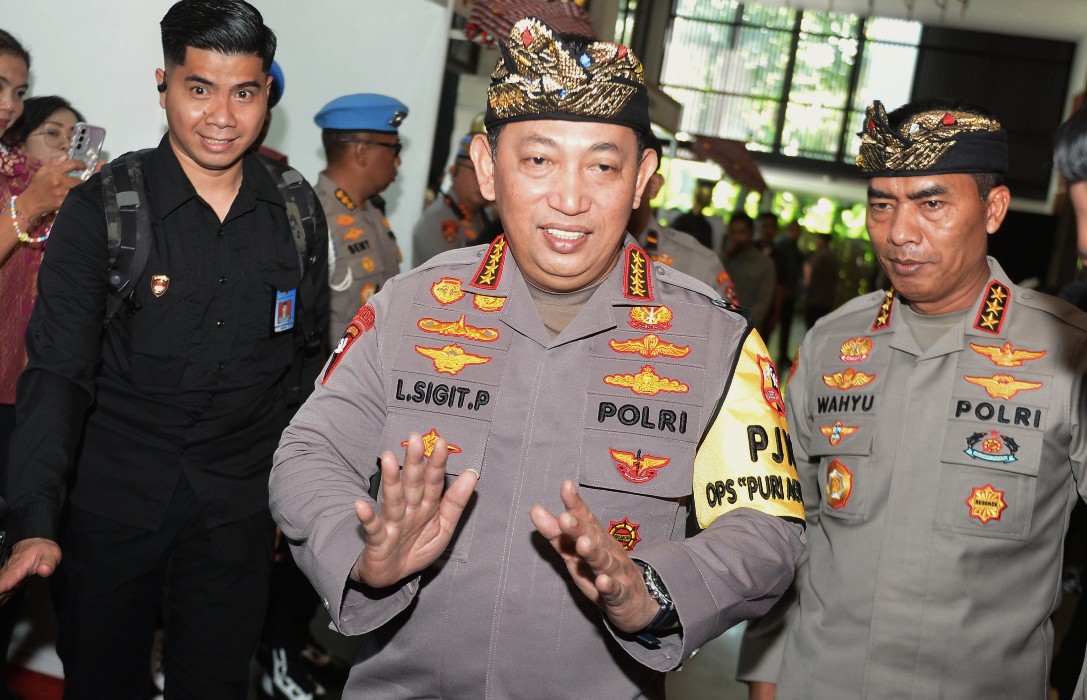
The Executive Director of Amnesty International Indonesia, Usman Hamid, has provided remarks concerning the tenure of the National Police Chief (Kapolri) which is currently being challenged at the Constitutional Court (MK). Usman contends that the problem of the Kapolri’s lengthy tenure is not merely a matter of regulation within the National Police Law, but rather stems from political decisions made by the head of the executive.
According to Usman, the National Police Law was originally drafted with the assumption that a Kapolri would not serve for an extended period. However, current reality demonstrates prolonged tenure due to politically-charged appointments made in the interests of the president.
“This position has been held by Listyo (Sigit Prabowo) for a long time not because of a problem with the law, as this is not a political office. The cause is the executive head at the time promoting him too early with a leap over several ranks,” said Usman when contacted on Monday (9 March 2026).
Usman emphasised that the appointment of National Police leadership should be based on substantive reasons that prioritise institutional interests and the public good. He warned of significant risks if appointments are based solely on personal proximity between the President and the prospective Kapolri.
“If it is only because of the closeness between the executive head and the prospective Kapolri, that is the problem. As a result, this position becomes vulnerable to politicisation by the executive head,” he stressed.
He argued that the positions of Kapolri and Military Commander-in-Chief are non-political posts whose independence must be protected from interests of power. Usman believed that future improvements should focus not only on limiting tenure in the National Police Law, but also on regulating presidential authority in selecting the Kapolri. This aims to minimise subjectivity that could damage professionalism within the National Police and Armed Forces.
“What really needs to be regulated is the President, so as not to politicise non-political positions such as Kapolri and Military Commander-in-Chief,” he concluded.
Previously, provisions concerning the mechanism for appointment and dismissal of the Kapolri under Law Number 2 of 2002 on the State Police of the Republic of Indonesia (National Police Law) were formally challenged at the Constitutional Court. The petitioner questioned the absence of clear tenure limits for the holder of the highest command position in the National Police.
The case, numbered 77/PUU-XXIV/2026, was filed by a student and citizen named Tri Prasetio Putra Mumpuni.
In proceedings, Tri Prasetio argued that Article 11 of the National Police Law contradicts the 1945 Constitution because it only regulates technical mechanisms without establishing a fixed term period. According to him, the absence of such limits creates legal uncertainty and makes the Kapolri position highly dependent on retirement age, presidential discretion, and political constellation.
“Such a design creates normative uncertainty and opens space for the concentration of power in a single figure for an indefinite period not determined constitutionally,” said Tri Prasetio.
He believed that without firm limits, this strategic position is vulnerable to politicisation and undermines the principle of the rule of law and checks and balances between the executive and legislative branches.
In his petition, the petitioner asked the Constitutional Court to declare Article 11 of the National Police Law constitutional on condition that it is understood with firm time limits. Tri proposed that the Kapolri’s tenure be limited to a maximum of five years and only be renewable once with the approval of the House of Representatives.
He also asked the Constitutional Court to order the House of Representatives and President to revise the regulation within a maximum period of one year from the date of the decision.
Regarding the petitioner’s legal standing as a civilian and student, Constitutional Court Judge M. Guntur Hamzah provided remarks on the legal standing or constitutional position of the petitioner.
“There needs to be evidence so that the connection with the norm being tested is visible. Is the harm experienced related to the figure of the Kapolri or the institution?” asked Guntur.
Similarly, Constitutional Court Judge Daniel Yusmic P. Foekh asked the petitioner to provide more convincing arguments.
“Is this relevant to the Kapolri position? This must be provable so that there is a connection or is this merely the petitioner’s concern,” added Daniel.
The Constitutional Court rejected the challenge regarding limiting the tenure of the National Police Chief under Law Number 2 of 2002. An unlimited tenure for the National Police Chief has the potential to create cult of personality and diminish professionalism within the National Police.