
National Police Chief Inspects Kalikangkung Toll Gate; Traffic Management for Mudik Based on Data-Driven Approach
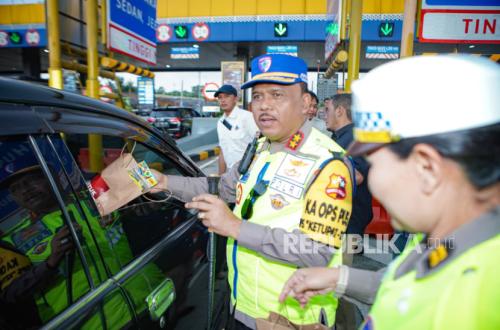
SEMARANG — Chief of the National Police Traffic Corps (Kakorlantas) Irjen Pol Agus Suryonugroho accompanied National Police Chief Listyo Sigit Prabowo in inspecting security preparations for the 2026 Eid mudik exodus at Kalikangkung Toll Gate on Monday, 16 March 2026.
The inspection was conducted to ensure that traffic management at one of the crucial junctions on the Trans-Java route operates optimally, particularly as vehicle movements increase during the mudik period.
Agus stated that Operasi Ketupat (Operation Ketupat) is not merely a traffic security operation but also a humanitarian operation involving various state stakeholders to guarantee public safety during the Eid mudik momentum.
“Operasi Ketupat is not limited to traffic matters. We certainly escort the mudik and return traffic flows, but all state stakeholders are present to ensure security during both the social and spiritual moments of our community,” said Agus.
He explained that security measures in Operasi Ketupat cover two main aspects: field-level security operations and public traffic safety campaigns. He outlined five main security clusters during Operasi Ketupat.
These clusters include toll routes and their dynamics, national arterial roads and alternative routes, transport hubs such as ports, airports, stations, and terminals, places of worship including Eid prayer and takbiran locations, and tourism areas.
According to him, the visit to Kalikangkung aimed to directly inspect readiness of mudik traffic security at one of the critical points on the Trans-Java route.
Additionally, the inspection was conducted to ensure that all security systems, traffic management schemes, and public services operate optimally. “Our main principle is simple: every mudik traveller must reach home safely,” he said.
Kalikangkung Toll Gate is a critical control point for national mudik traffic flow as it functions as the gateway to Central Java from the western direction. Therefore, traffic management at this point is conducted in an integrated manner among the National Police, Ministry of Transportation, Jasa Marga toll operator, and local government.
“Every traffic management scheme is implemented based on data and inter-agency coordination,” Agus asserted firmly.
In managing this year’s mudik traffic, the National Police has also prepared various dynamic Traffic Management and Engineering (MRLL) scenarios to be applied situationally based on actual field traffic conditions. Several schemes prepared include contraflow, local one-way, and national one-way systems.
Based on evaluation results and coordination with various parties, the peak mudik traffic flow is estimated to occur on 18 March. However, if congestion parameters are met earlier, traffic management schemes will be implemented sooner.
According to Agus, a first-phase one-way system will be applied from kilometre 70 to kilometre 236. This scheme has been expanded from the previous year, which only extended to kilometre 188. “If congestion persists, the scheme will immediately be extended to kilometre 414,” he said.
Additionally, he directed the Central Java Regional Police to prepare local one-way schemes in the Greater Semarang and Solo agglomeration areas should vehicle volumes increase on 17 March.
The Kakorlantas also highlighted traffic flow management towards Yogyakarta, including utilisation of functional toll roads in the Prambanan area. This arrangement is important to ensure that vehicle flows from Surabaya, Jakarta, and Semarang towards Yogyakarta remain controlled.
On another note, this year’s mudik traffic security is also supported by modern technology utilisation. Traffic monitoring is conducted through command centres, digital traffic counting systems, CCTV networks, and drone monitoring.
This technology enables officers to monitor traffic conditions in real time so that any situational changes can be responded to immediately.
Beyond personnel readiness, Agus emphasised that the success of mudik traffic security also heavily depends on public discipline.
He urged mudik travellers to prepare their journeys well, ensure their vehicles are in prime condition, avoid driving when fatigued, and comply with instructions from field officers. The National Police, together with all stakeholders, will continue working maximally until the return traffic concludes.
Beyond field-level security, the National Police has prepared a free mudik and return programme initiated by the National Police Traffic Corps. To date, approximately 20,000 participants have registered to join the programme, particularly from Central Java, East Java, and West Java.
“We want to ensure that people can undertake their mudik journey with a sense of safety, comfort, and happiness with their families,” concluded Agus.