
National Nutrition Agency claims Rp6 million daily incentive for nutrition service units is strategically sound to prevent fiscal waste
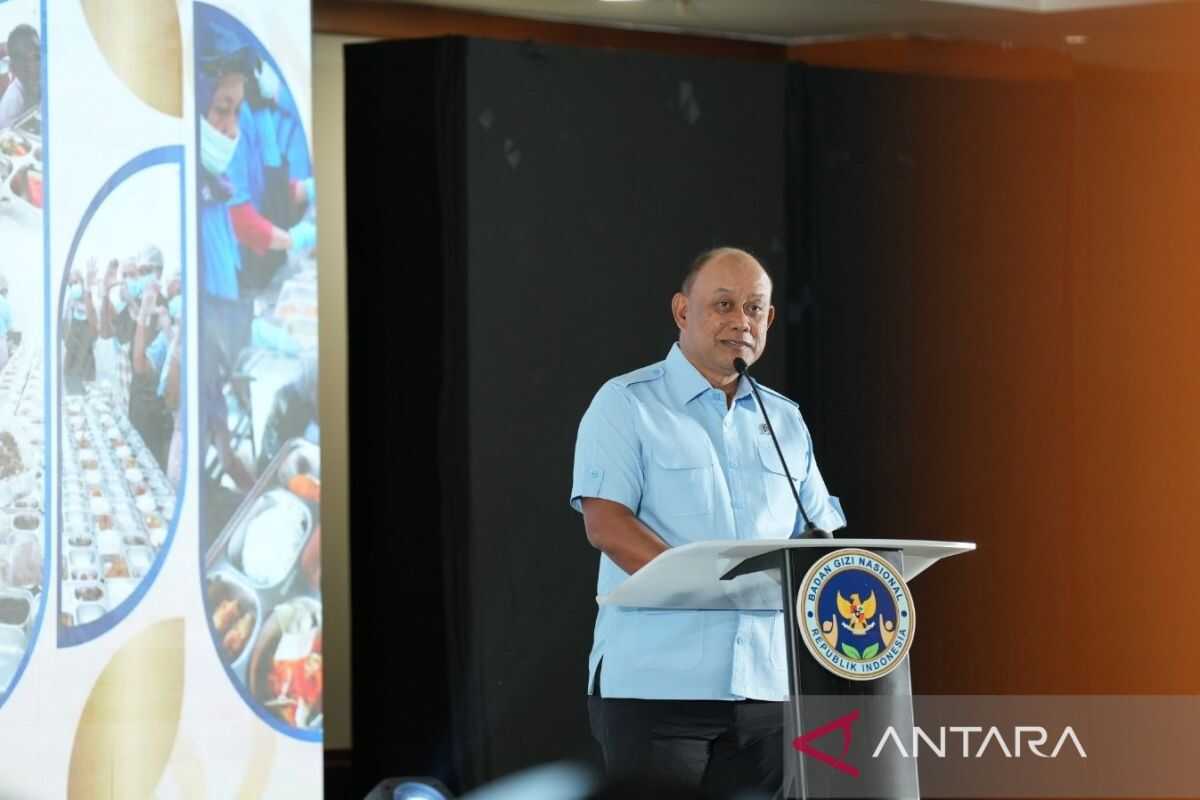
Jakarta — The head of the National Nutrition Agency (BGN), Dadan Hindayana, has stated that the Rp6 million daily incentive for Nutrition Fulfilment Service Units (SPPG) is strategically sound for preventing fiscal waste in the state budget.
Dadan made this statement in response to circulating concerns that the SPPG facility policy constitutes wasteful government spending. According to him, the scheme is instead an efficient and low-risk strategy for the state.
“There are several fundamental principles in this partnership scheme. Firstly, the Rp6 million per day is not development funding from the state budget, but rather part of the service payment mechanism for the SPPG that has already been operating. All physical development processes are conducted with independent investment by partners,” he stated in an official statement in Jakarta on Friday.
He added that partners bear all risks entirely, ranging from construction risk, operational implementation, evaluation, to natural disasters. For example, when one SPPG facility in Aceh was affected by flooding and sustained damage, losses became the sole responsibility of the partner rather than BGN. Partners are obligated to rebuild without additional burden on the state budget.
“As in Aceh when the SPPG was swept away by floods, the partner lost out, not BGN. They had to rebuild. So we transfer total risk to the partner, which is why I say the Rp6 million is highly efficient because BGN does not spend a single rupiah on maintenance, repairs and other matters,” he said.
“I observed recently that the SPPG built by Pondok Pesantren Persis was excellent, constructed with Rp3 billion in funding. I am confident that if that were built with state budget funding, it would be worth Rp6 billion, so we are already over 50 per cent more efficient,” he explained.
Additionally, the aspect deemed most strategically advantageous is the speed of execution. Through the partnership scheme, representative buildings can be completed within approximately two months.
“Buildings as impressive as those built by Persis, the police, or other places can be constructed within two months, finished. If using the state budget, how would it go? First, you must appoint a consultant. How many months for planning? Two months. Then send correspondence to the local government to request land use, how many months? One month. Then once the land is secured, upon surveying it turns out to be unsuitable, what happens? It must be relocated,” said Dadan.
“When relocated, what happens? You must seek permission from the Ministry of Finance to shift the location, another month. All finished. What is done next? Tender. How long for tender? 45 days. Meanwhile, the partner who builds completes it within 45 days,” he added.
Currently, BGN records 24,122 SPPG units, all constructed through the partnership scheme and operational. Average construction reaches 50 SPPG units per day. This achievement serves as evidence that the partnership approach is capable of delivering significant acceleration whilst maintaining budgetary efficiency and accountability.
BGN therefore affirms that the Rp6 million daily facility incentive policy for SPPG is not wasteful spending, but rather a strategy to ensure nutrition fulfilment services operate rapidly and efficiently whilst minimising the state’s fiscal risk, whilst upholding sound governance principles.