
National Mining Sector Proves Waste Management Programmes Support Environmental Sustainability
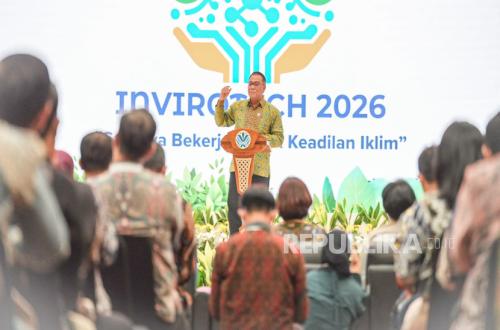
Industry players in the mining sector continue to prove that mining operational areas can become innovation spaces for implementing circular ecosystems that benefit environmental sustainability. At the opening of the International Environment Technology and Innovation Expo and Conference (Invirotech) 2026, Environment Minister Jumhur Hidayat stated that businesses have a vital role in promoting the adoption of clean technology and accelerating the circular economy to address various environmental challenges. According to him, technology and innovation must be part of tangible solutions supporting both industrial and environmental sustainability. Through exhibitions, discussion forums, coaching clinics, workshops, business matching, and various other educational activities, INDO ENVIROTECH serves as a platform to see how technology can address real environmental problems. “The business world has an important role in applying clean technology, improving environmental compliance, and accelerating the circular economy,” Jumhur said at the opening of INDO ENVIROTECH 2026 in Jakarta. He added that the technology developed must provide tangible benefits for the environment. “Technology must help industry meet its environmental obligations,” he said. In practice, a number of mining industry players have begun implementing waste management programmes that are not only oriented towards compliance but also creating added value for the environment. One example comes from MIND ID Group member PT Aneka Tambang Tbk (ANTAM) through the Smart Waste Bank programme, which integrates community-based waste management. Through a structured system of collection, sorting, and processing, waste collected by the community can be converted into Logam Mulia gold savings. Organic waste is processed into various useful products such as compost, kasgot, biocleaner, and maggots. Throughout 2025, the programme recorded the absorption of approximately 63 tonnes of inorganic waste, making a positive contribution to reducing waste in the surrounding community environment. Another initiative is run by MIND ID Group member PT Bukit Asam Tbk (PTBA) through the Bara Agro Circular Programme, which optimises non-productive land formerly used for illegal mining activities into an integrated agricultural area. This programme applies the 9R concept and an integrated circular system, where waste from one activity is utilised as input for another. For example, quail manure is processed into organic fertiliser for plantations, while maggots produced from organic waste processing are used as animal feed and fishery feed. Another MIND ID Group member, PT Freeport Indonesia (PTFI), developed the Joint Transformation Centre, a recycling-based waste processing facility built through collaboration with community foundations around the operational area in Gresik, East Java. Through this programme, wood and iron waste from smelter construction activities are processed into products such as tables and chairs, which are then distributed to support social programmes, including for orphans and community empowerment activities. This minimises construction waste discharged into the environment. These various initiatives demonstrate that waste management in the mining sector plays a role in reducing environmental impact, whilst also being capable of creating sustainable economic and social benefits. This approach simultaneously reaffirms that the mining industry and environmental sustainability are mutually supportive and can be implemented through appropriate innovation and collaboration.