
National Interests: Who Defines Them, Who Benefits
In every discussion about foreign policy, the term “national interest” almost always emerges as a seemingly final explanation. It acts as a keyword that closes debates: once something is labelled a national interest, it is considered legitimate, rational, and beyond question.
However, in practice, national interest often becomes the source of debate itself. It is not always singular, not always clear, and almost always open to interpretation. What one party views as a primary interest, another might see as a policy choice that can still be negotiated.
Therefore, national interest has layers. Some are fundamental—concerning security, sovereignty, and the state’s survival—which cannot be compromised. Others are more flexible, adjustable to circumstances. Some are relatively fixed, but others change with leadership dynamics, domestic pressures, and global developments. In other words, national interest is not just about what is important, but also about the context and who defines it.
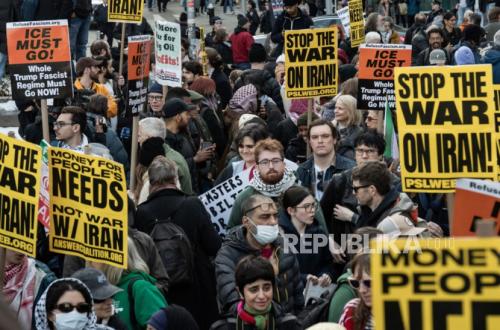
The United States’ involvement in escalating conflict with Iran, closely intertwined with Israel’s interests, provides a relevant illustration. Officially, Washington cites familiar goals: preventing nuclear proliferation and maintaining regional stability. In classical terms, this can be understood as part of security interests.
However, upon closer examination, the interests of the United States and Israel are not entirely identical. For Israel, Iran is often seen as an existential threat demanding a maximal response. The United States, at least in its policy tradition, tends to pursue more limited objectives—risk control and medium-term stability.
This difference may seem subtle, but in foreign policy practice, it is highly determinative. In alliance relationships, non-overlapping interests often create space for tug-of-war. At some point, a country’s policy can shift—gradually but surely—from serving its own interests to accommodating its ally’s priorities.
This is where the domestic dimension of the United States becomes crucial. Support for Israel is not only strategic but also has a strong political base domestically. Organised interest groups, including the pro-Israel lobby, play a role in shaping policy direction and public narrative. Studies by John Mearsheimer and Stephen Walt demonstrate how this influence operates in Washington’s decision-making process.
However, this influence does not stand alone. It intertwines with other factors, including leadership style. In the context of President Donald Trump, observers note a tendency towards a more personal, intuitive approach that sometimes deviates from established institutional logic. Such an approach is often linked to the “madman theory”—a strategy relying on uncertainty to increase pressure.
This approach can be effective in certain situations but also carries risks. When uncertainty becomes a pattern rather than a tool, the room for miscalculation widens—especially in highly sensitive conflicts like those in the Middle East.
When alliance factors, domestic influences, and leadership style converge, the result can be policies not entirely explainable within a rational national interest framework. This is where criticism emerges. Some observers see symptoms of policy capture, where policy formulation is disproportionately influenced by certain interest groups, resulting in policies that do not fully reflect broader public interests (OECD, 2017).
However, simplifying this issue as mere dominance by one side is unhelpful. The US-Israel relationship still has real strategic dimensions: alliance credibility, power projection, and regional influence. The problem is not the existence of these interests, but their balance.
When a policy begins to reflect another party’s priorities more than the core interests of the state itself, critical questions become inevitable: is what is being pursued still a national interest, or has it shifted to something else?
For Indonesia, the lessons from this dynamic are important. The preamble to the 1945 Constitution provides clear direction on our national interests. However, translating those principles into concrete policies always requires clarity and critical distance.
Because ultimately, national interest is not just about what we pursue, but also about what we guard against displacement.
And perhaps that is the true test: not when we declare national interests, but when we can ensure—with calm—that what we defend truly belongs to us.