
National Forum of MPR/DPR Leadership and Minister of Political and Security Affairs Discusses Indonesia's Geopolitical and Economic Conflicts
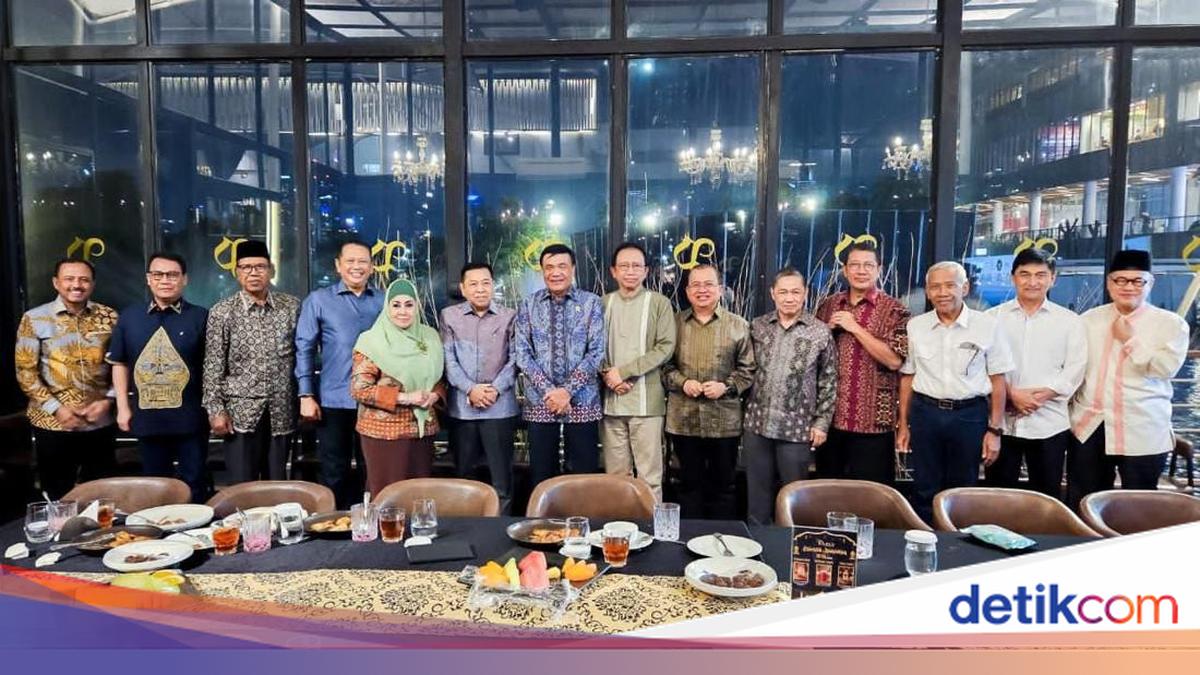
Members of the National Forum comprised of leaders from the People’s Consultative Assembly and House of Representatives from 1999–2024 met with Minister of Political and Security Affairs General (Retired) Djamari Chaniago at Parlement House Senayan yesterday. The meeting discussed various issues ranging from the global geopolitical situation, national political stability, state fiscal matters, to challenges in government communication with the public.
The discussion was conducted in a warm and critical manner because the prominent figures present had previously held positions at the centre of state decision-making during different periods since the reform era. This made the perspectives that emerged not merely reflections of the past, but also offered solutions to the various problems facing Indonesia currently.
“The state currently needs thoughts from national leaders. Threats from within and outside the country must be anticipated with clear perspectives from those who have previously led state institutions. One of our tasks is to help calm the people so they do not become trapped in excessive worry,” said House of Representatives Member Bambang Soesatyo in his statement on Monday (16 March 2026).
Highlighting Geopolitical Competition and National Fiscal Concerns
In the discussion, the figures highlighted how current global dynamics have become increasingly complex. Geopolitical competition between major world powers such as the United States, Russia, and China is reshaping the power map of the Indo-Pacific region, which has direct implications for Indonesia.
At the same time, national fiscal conditions are facing pressure due to increased state spending needs, ranging from national development programmes to modernisation of main weapons systems. Data from the Ministry of Finance shows that in recent years the state budget deficit has continued to be in the region approaching the safe limit of 3 percent of gross domestic product, making careful fiscal management essential.
“Going forward, the government should consider raising the budget deficit ceiling to above 3 percent of gross domestic product (GDP) to make fiscal space more flexible in dealing with increasingly pressing economic situations for the state budget. Cooperation between state institutions is also very necessary so that various public issues can be resolved quickly and in a coordinated manner,” said former House of Representatives Chair Setya Novanto.
The issue of democracy and the electoral system also became an important focus in the meeting. Participants assessed that public trust in the democratic process must be continuously strengthened through improvements to electoral regulations and enhanced quality of political representation in parliament.
Based on data from the electoral commission, voter participation in the 2024 General Election reached approximately 81 percent. This figure demonstrates high public enthusiasm. However, various public criticisms regarding the mechanism for channelling political aspirations show the need to improve the system so that democracy becomes more substantive.
“Many people feel their aspirations have not been optimally explored in the current electoral system. Therefore, electoral regulations need to be discussed again seriously, for both central and regional elections,” said House of Representatives Chair 2004–2009, Agung Laksono.
Pushing for Strengthening Government Public Communication
Beyond electoral political issues, the forum also highlighted the importance of government public communication amid a national situation viewed as increasingly complex. The figures assessed that the public requires clear, consistent, and easily understandable explanations regarding various state policies. Without effective communication, government policies that are actually good are often misinterpreted and trigger public unease.
“The country is currently facing many challenges. Therefore, the public needs to be calmed through good communication. The government requires figures capable of bridging state policy with public understanding,” said House of Representatives Chair 2009–2014, Marzuki Alie.
Forum participants also proposed that the government enhance the effectiveness of the presidential spokesperson function. According to them, amid the torrent of digital information and global political dynamics, the public requires an official information source capable of providing explanations quickly, measurably, and reassuringly.
Without good communication coordination, various officials often issue their own statements from different perspectives, creating confusion among the public.
“The government needs to have a spokesperson who is strong, credible, and able to explain policies clearly to the public. Amid the torrent of information and various speculations that develop, the presence of a government spokesperson is very important to provide measured, comprehensive explanations that do not generate speculation in public discourse,” said House of Representatives Member 2009–2024, Melani Leimena Suharli.
In the discussion, participants also highlighted the increasingly strong influence of global geopolitical dynamics on national economic stability. Tensions in various regions, particularly in the Middle East and Eastern Europe, impact energy supply chains, flows of international trade, and movements of global investment.
This situation demands developing countries, including Indonesia, to be more adaptive in formulating economic and diplomatic strategies to maintain fiscal stability, strengthen energy resilience, and retain investment attractiveness amid increasing global uncertainty.
“Global geopolitics is an important premise that determines the course of current governance. Conflicts in various regions can affect investment, trade, and state revenue. Therefore, Indonesia needs to adjust its economic strategy to be able to survive in an uncertain global situation,” explained House of Representatives Member 2004–2009, Anis Matta.
The figures also emphasised that national stability must be maintained through strong coordination between state institutions. Indonesia’s state system that adheres to the principle of checks and balances provides room for each state institution to monitor and complement one another.