
National Food Agency Confirms Beef Prices in Market Still Align with Government Guidance
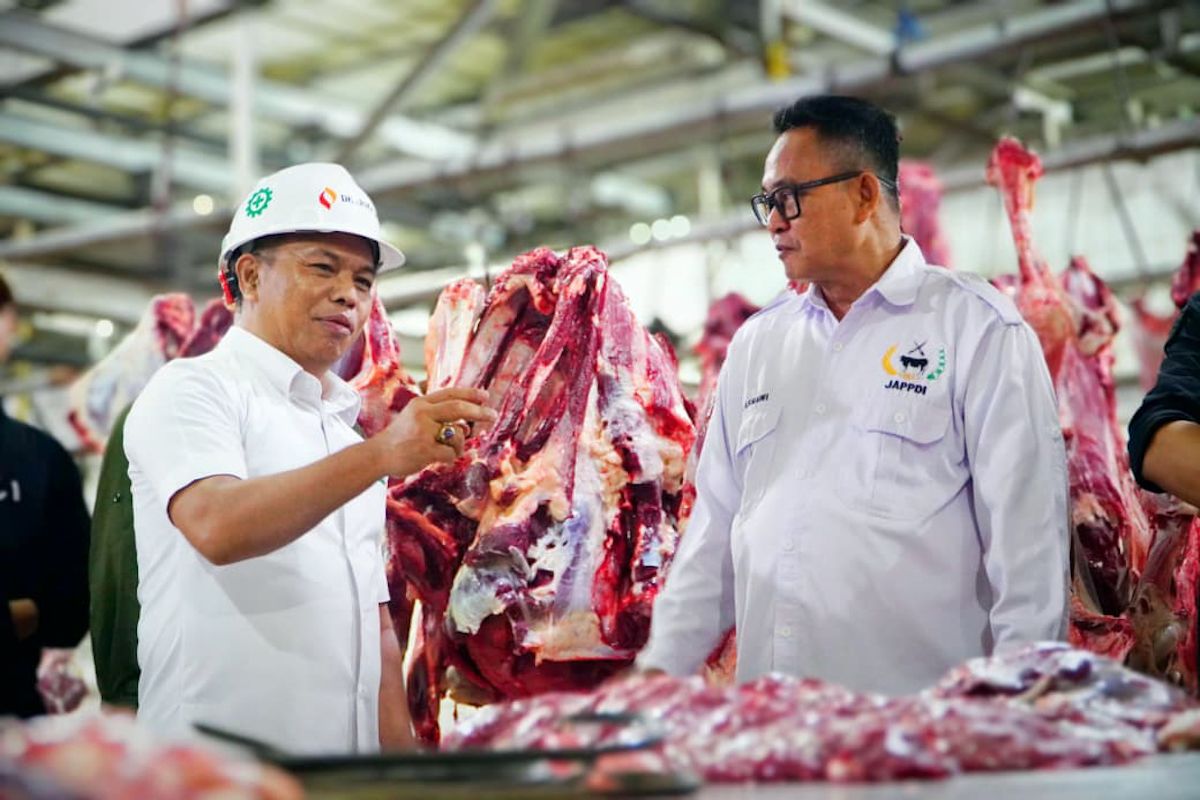
Jakarta – The National Food Agency (Bapanas) has confirmed that beef prices at the consumer level currently being sold in the market remain in compliance with the government’s established price guidance (HAP), following reports of price increases for this commodity.
I Gusti Ketut Astawa, Deputy for Food Availability and Stabilisation at Bapanas, stated that information about beef prices exceeding the HAP at various markets generally refers to premium-grade beef without fat layers.
“Reports regarding beef prices at several markets that are said to exceed the HAP at consumer level refer to premium-quality beef,” Ketut said in Jakarta on Friday.
He explained that the HAP provisions for beef set by Bapanas refer to standard-quality beef that still has slight fat attachments, not lean beef.
“There are reports (that beef) costs Rp160,000 per kilogramme. They say it has increased, although they call it premium. So the Rp160,000 is premium quality. We do not regulate that,” Ketut stated firmly.
According to Ketut, in accordance with National Food Agency Regulation Number 12 of 2024, the HAP at consumer level for beef falls within the price range of Rp105,000 to Rp140,000 per kilogramme.
For fresh hind quarter, the maximum is Rp140,000 per kg; fresh front quarter is Rp130,000 per kg; and frozen front quarter is Rp105,000 per kg.
“What the government regulates is the price of standard beef, namely hind quarter that still has a small amount of fat, which is not lean meat, with a maximum price of Rp140,000. So we ask the Food Violation Task Force in the regions to demonstrate to the public that beef priced at Rp140,000 indeed exists,” Ketut added.
He affirmed that the government would continue to tighten oversight across all market lines to prevent food prices from fluctuating excessively.
“Oversight is being intensified because we are in a critical period. This week is particularly critical. Tomorrow, the day after, and then Saturday, Sunday, Monday, until Wednesday, these are the peak days when demand increases will occur,” he said.
Based on data from the Central Statistics Agency (BPS) through the first week of March 2026, beef reported a rise in the Price Development Index (IPH) across 90 regencies and cities. However, upon further analysis, most prices still remained within the consumer-level HAP corridor.
“After we analysed it again, it turned out that 32 regions were above price, and 58 regions were below price. Meaning, the regions that are above price can actually be controlled,” Ketut added.
Head of the Police Food Task Force Brigadier General Police Zain Dwi Nugroho revealed that nationally, the number of provinces experiencing IPH price increases has started to decline. Nevertheless, the Food Violation Task Force will continue to intensify monitoring.
“From the IPH, comparing the first week of March with the fourth week of February 2026, there has been a decrease from 26 provinces in the fourth week of February 2026 to 23 provinces in the first week of March 2026, or a decrease of three provinces,” he said.
“This includes the impact of the monitoring activities we are conducting, which has resulted in this decrease,” Zain added.
Bapanas noted that during the period from 5 February to 11 March, 47,217 monitoring activities had been carried out. The Food Violation Task Force has issued 705 warning letters, coordinated stock-filling activities 1,494 times, issued recommendations to revoke business licences 2 times, issued recommendations to revoke circulation permits 4 times, and conducted law enforcement 6 times.