
National Energy and Mineral Resources Sector Post Opens for Ramadan and Eid al-Fitr 2026, Energy Supply Assured Safe
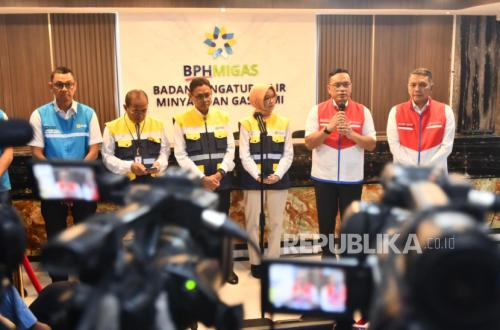
JAKARTA – The National Coordination Post for the Energy and Mineral Resources (ESDM) sector, serving as a centre for monitoring and coordinating energy services to the public ahead of the annual exodus during Ramadan and Eid al-Fitr 2026, has been officially opened by the government through the Ministry of ESDM.
The post is expected to serve as a reliable information hub regarding fuel, liquefied petroleum gas (LPG), electricity, and geological disaster risk information during Ramadan and Eid al-Fitr. The post will operate for 20 days from 12 March to 31 March 2026 at the BPH Migas building.
The post’s opening was symbolically inaugurated by Deputy Minister of ESDM Yuliot Tanjung at the BPH Migas building in Jakarta on Thursday, 12 March 2026.
Yuliot stated that the National ESDM Sector Post serves as a coordination hub amongst relevant agencies and an information centre for the public and stakeholders to obtain necessary information. “Nationally, the availability of fuel and LPG for the needs of Eid al-Fitr 1447 Hijri is very adequate.”
Erika Retnowati, Head of the National ESDM Sector Post for Ramadan and Eid al-Fitr 2026, emphasised the importance of inter-agency coordination to ensure the post operates smoothly and provides useful information to the public.
“This synergy is of course not only amongst internal post members, but also synergy with other stakeholders, such as the Police Traffic Corps, regarding restricted routes or traffic congestion points,” said Erika.
During the Ramadan and Eid al-Fitr period, BPH Migas alongside Pertamina will deploy 125 fuel terminals, 7,885 fuel stations, and 72 LPG distribution centres, with additional facilities in high-demand regions.
Projections of fuel demand dynamics during the post’s operation period show petrol is estimated to increase approximately 12.0 per cent compared to normal conditions, whilst diesel is projected to fall approximately 14.5 per cent.
Meanwhile, aviation fuel demand is estimated to rise 2.8 per cent and kerosene to increase approximately 4.2 per cent compared to normal operations. For LPG, the Directorate General of Oil and Gas alongside Pertamina will deploy 40 LPG terminals, 757 distribution centres, and 6,662 LPG agents.
National LPG stock resilience is projected at 12-15 days’ supply. Stock levels will be maintained stable during the Ramadan and Eid al-Fitr period, supported by agents and LPG distribution points operating on 24-hour standby, particularly in high-demand regions.
On the same occasion, Pertamina confirmed the availability of national energy supplies, particularly fuel and LPG, remain in safe condition during the Ramadan and Eid al-Fitr 1447 Hijri period.
To ensure smooth energy distribution during this period, Pertamina has also activated a Ramadan and Eid al-Fitr Task Force operating from 9 March to 1 April 2026.
Pertamina’s Chief Executive Officer Simon Aloysius Mantiri stated that Pertamina continues to strengthen operational readiness and public services to ensure energy needs during Ramadan and Eid al-Fitr are adequately met.
“Pertamina ensures fuel and LPG stock availability remains in safe condition ahead of Ramadan and Eid al-Fitr. We also continue to ensure public services operate optimally through energy distribution networks spread across Indonesia,” said Simon during the National ESDM Sector Post opening ceremony in Jakarta on 12 March 2026.
Additionally, Pertamina has prepared various supplementary services in priority regions, namely areas expected to experience increased energy consumption during the Ramadan and Eid al-Fitr period.
“Several additional services we have prepared, including Pertamina Delivery Service motorists who can deliver fuel during road congestion, as well as tanker vehicles positioned at strategic points to ensure energy distribution continues smoothly,” Simon added.
Furthermore, Pertamina continues to strengthen national energy infrastructure, including exploring potential cooperation in building energy storage facilities to enhance national energy resilience.
Regarding the vessel situation in the Arabian Gulf region, Simon emphasised that Pertamina continues to monitor developments and coordinate with various parties.
“Currently there are two vessels that have resumed operations, namely Pertamina International Shipping (PIS) Rinjani and PIS Paragon, which serve the non-captive market with destinations to Kenya and India, so they are not directly related to Pertamina’s domestic energy needs,” explained Simon.
Meanwhile, two other Pertamina vessels remain in the Arabian Gulf region, namely Pertamina Pride and Gamsunoro.
“Pertamina’s primary priority is ensuring the safety of ship crews and security of cargo being transported. We continue to coordinate with the Ministry of Foreign Affairs and relevant authorities to ensure the situation remains conducive so that vessels can resume operations safely,” said Simon.
As a precautionary measure against global geopolitical dynamics, Pertamina continues to diversify energy supply sources from various regions worldwide. In addition to the Middle East, energy supplies also come from Africa, the Americas, and other regions to ensure the sustainability of national energy supplies.
“With government support and full stakeholder engagement, Pertamina remains committed to ensuring smooth energy distribution and maintaining energy supply resilience for Indonesian society,” Simon stated.
Pertamina, as a leading company in energy transition, is committed to supporting the Net Zero Emissions target by 2060 and continues to promote programmes with direct impact on achieving the Sustainable Development Goals (SDGs).
All such efforts align with Pertamina’s transformation focused on governance, public service, business and environmental sustainability, implementing Environmental, Social & Governance (ESG) principles across all business lines and Pertamina operations.