
NASA's DART mission successfully alters asteroid's orbit for the first time in human history
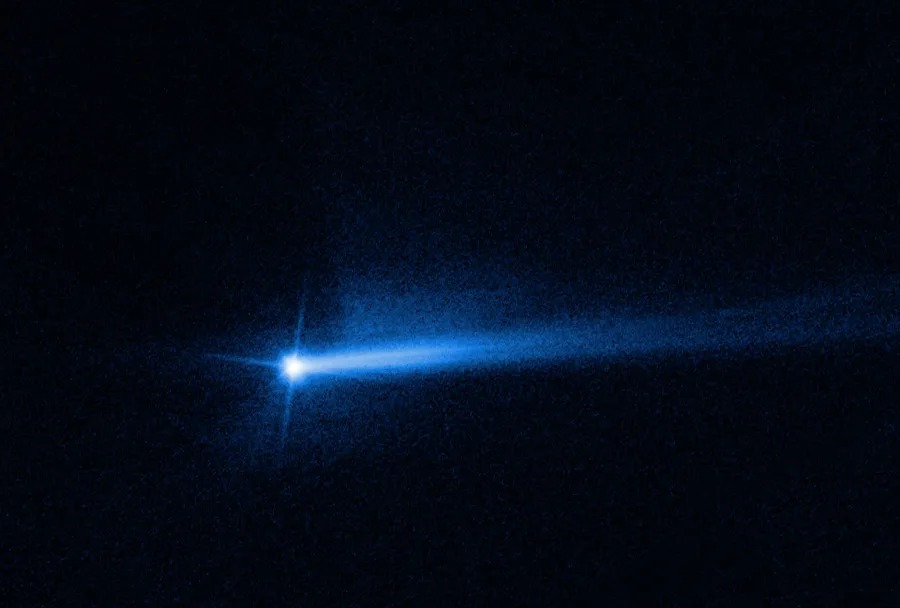
Scientists at NASA’s Jet Propulsion Laboratory (JPL) have confirmed an extraordinary achievement in planetary defence. The Double Asteroid Redirection Test (DART) mission, which deliberately collided with the asteroid Dimorphos in September 2022, has been shown to have permanently altered the orbit of that object.
Because Dimorphos is gravitationally bound to the larger asteroid Didymos, the impact not only changed the small body’s trajectory but also shifted the orbit of the entire binary system as it travels around the Sun. This phenomenon marks the first time in human history that a human-made object has been able to alter the path of a celestial body in space in a measurable way.
What is DART?
DART, the Double Asteroid Redirection Test, is the first space mission designed, built, and operated by the Johns Hopkins Applied Physics Laboratory for NASA’s Planetary Defence Coordination Office. The mission’s core is to test kinetic impact technology to see if we can deflect an asteroid that could threaten Earth.
Thomas Statler, chief scientist for small bodies in NASA Headquarters in Washington, emphasised the significance of the finding: ‘This is a small change to its orbit, but given enough time, small changes can accumulate into significant deflection.’
The mechanism behind the orbit change involves the momentum transfer principle. When the DART spacecraft struck Dimorphos, the impact hurled a large cloud of rocky debris out into space. The ejecta provides an additional thrust on the asteroid, akin to rocket propulsion.
Research indicates that the orbital period of Dimorphos around Didymos shortened by 33 minutes. The collision expelled so much material that it also altered the orbital period of the binary system around the Sun by about 0.15 seconds.
According to the study’s authors, the debris ejected effectively ‘doubles the strength’ of the energy transfer from the spacecraft itself. Rahil Makadia, lead author of the study from the University of Illinois at Urbana-Champaign, explained that the binary system’s orbital speed changed by around 11.7 micrometres per second.
He added, ‘Over time, such a tiny change in an asteroid’s motion can make the difference between a dangerous object hitting or missing our planet.’
To measure this precision, researchers had to track stellar occultations — moments when the asteroid passes in front of a star and blocks its light briefly. Observations relied heavily on good weather and expeditions to remote locations.
Although the Didymos–Dimorphos system posed no threat to Earth before or after the collision, the experiment provides crucial data on risks and how to address them in the future. The key to successful planetary defence remains early detection.
NASA is therefore building the Near-Earth Object (NEO) Surveyor mission, a next-generation space-based survey telescope dedicated to finding objects that are hardest to detect, such as dark asteroids and comets that do not reflect much light. With the ability to detect threats long before they approach, humanity could deploy kinetic impactors like DART to make the necessary course corrections.
Tabrakan DART dan asteroid Dimorphos tidak hanya menggeser orbitnya, juga berdampak kompleks.
NASA has confirmed that asteroid 2024 YR4 will not strike the Moon in 2032 following the latest observations from the James Webb Space Telescope. See details of its safe trajectory here.
James Webb Space Telescope (JWST) captures stunning details of spiral galaxy NGC 5134. See how cosmic dust and young stars shape life cycles in space.
NASA Artemis! Breakthrough! Researchers use laser 3D printing to sculpt lunar regolith into sturdy structures on the Moon.
Latest research reveals surprising phenomena on icy moons such as Enceladus and Miranda. A drop in pressure due to melting ice could trigger underground oceans to boil.
Astronomer captures the first ‘astrosphere’ image of the star HD 61005. The discovery reveals secrets of our Solar System’s past when it was young.