
Nadiem Denies Directing Use of Chromebooks in School Laptop Procurement
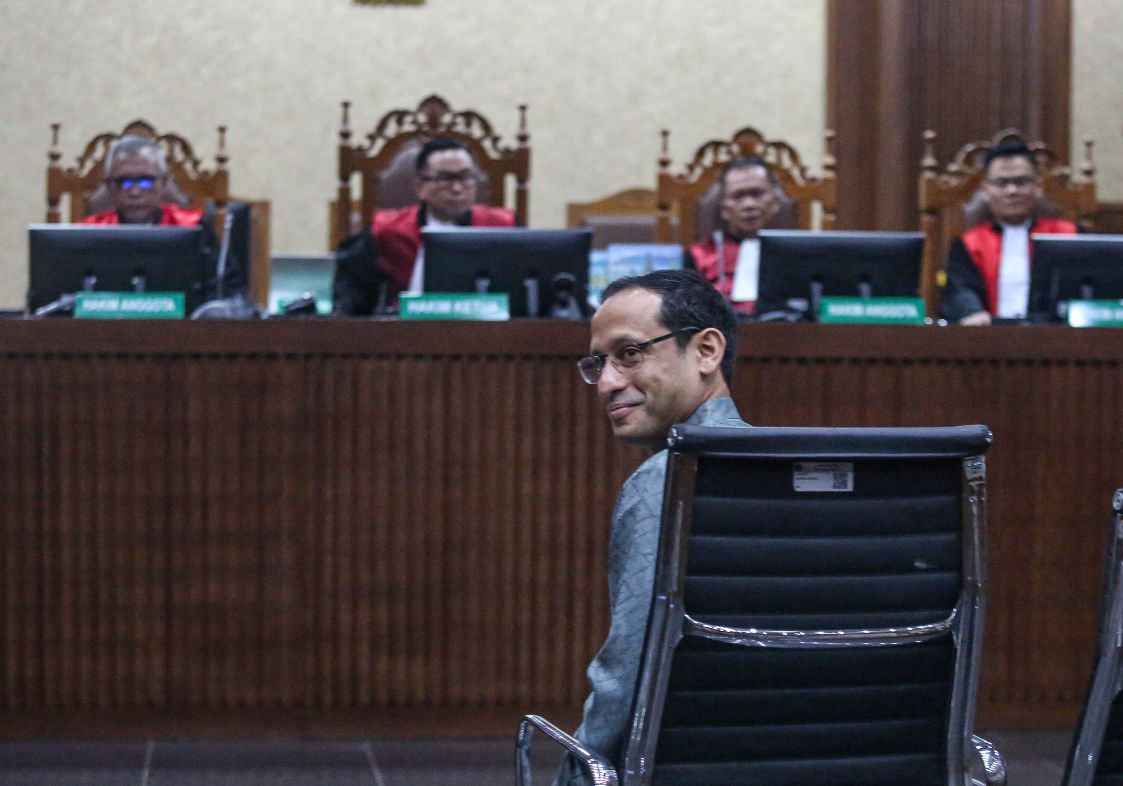
Continuation of the trial into the procurement of Chromebooks for schools within the Ministry of Education, Culture, Research and Technology has disclosed details regarding the involvement of former Minister Nadiem Makarim. In a hearing held on Thursday, 5 March, witnesses stated that there was no instruction from Nadiem directing the use of Chromebooks in the information and communication technology (ICT) device procurement for schools.
Fiona Handayani, a former Special Staffer to the Minister for Strategic Issues, said there was never any discussion about ICT procurement or Chromebooks before Nadiem assumed office. ‘There is not a single discussion about ICT procurement or Chromebooks in the Core Team WhatsApp group before Nadiem became minister,’ she told the court.
Similarly, Ibrahim Arief, a former individual consultant at the Directorate General of Higher Education, said the initial discussions by the technical team related to hardware exploration for schools, not specifically Chromebooks. ‘I was asked to conduct exploration regarding hardware for schools. Even the early slides were headed ’tech hardware for schools’, not ‘Chromebook for schools’. A number of the early slides also focused on Linux-based laptops,’ he noted.
According to Ibrahim, in the executive summary of the discussed presentation, Nadiem questioned why there was a Windows-Chromebook combination in the options presented. ‘Yes, Minister asked in the executive summary why there is a mix of Windows and Chromebook. Why not Windows entirely?’ he said.
Only one time
Meanwhile, Nadiem Makarim, in his evidence, stated that his involvement related to Chromebooks was limited to one meeting on 6 May 2020. At that meeting he recommended a mix of devices: 14 Chromebook units and one Windows-based laptop for each school. However, according to Nadiem, the decision that subsequently led to a dominance of Chromebooks in the ICT device procurement was made by the technical team at the directorate and director-general level. ‘I variously urged consideration of why not all Windows. Indeed on 10 August I also conveyed by message that Windows laptops should be considered if Chromebook supplies were insufficient,’ he said.
He also asked a technology company Google to provide explanations in court to ensure the process was open. ‘I hope Google can speak openly to prove that all this is legal, open, and transparent,’ he added.
Fiona Handayani added that the policy-making process was conducted with transparency in mind. The policy discussions involved the Inspectorate General for supervisory purposes and included the assessment team, PAUD-Dasmen, and the technology team tasked with drafting the device specifications. She said the procurement was carried out in coordination with the Government Goods/Services Procurement Policy Agency (LKPP) using an e-catalog system deemed more accountable.
Nadiem’s legal adviser Ari Yusuf Amir said the witnesses’ statements indicate that the procurement process was conducted in accordance with procedures. ‘In essence, the witnesses emphasised that there were no procedural errors. Everything was subject to review. Initially Windows was considered, but after cost calculations it proved far more expensive, so Chromebooks were chosen for efficiency,’ Ari stated.
Co-investment scheme
The court also scrutinised the 30% co-investment scheme with Google. Witnesses explained that this scheme formed part of the company’s Corporate Social Responsibility (CSR) under the Partner Service Fund (PSF). The funds, according to witnesses, were not paid to the ministry but used to support improving education through teacher training and device-use training for users in schools.
Nadiem regards Google’s CSR programme as being misperceived as corruption. He hopes Google’s testimony in court will clarify that the programme is an open support for improving education quality in Indonesia.
Nadiem has been charged with corruption causing state losses of Rp2.18 trillion, including the procurement of technology-enabled learning resources such as Chromebooks and CDMs in the 2020, 2021 and 2022 financial years, not in line with procurement planning and principles. The acts are alleged to have been committed jointly with three other defendants in separate trials, namely Ibam, Mulyatsyah, and Sri Wahyuningsih, and Jurist Tan, who is currently a fugitive.
In detail, the losses to the state include around Rp1.56 trillion linked to the Ministry and Culture, Research and Technology’s digitalisation programme, and US$44.05 million (approximately Rp621.39 billion) relating to the procurement of CDMs that were unnecessary and of no use in the education digitalisation programme.