
Mystery of the Missing Giant Star Solved: Webb Telescope Identifies Supernova Progenitor
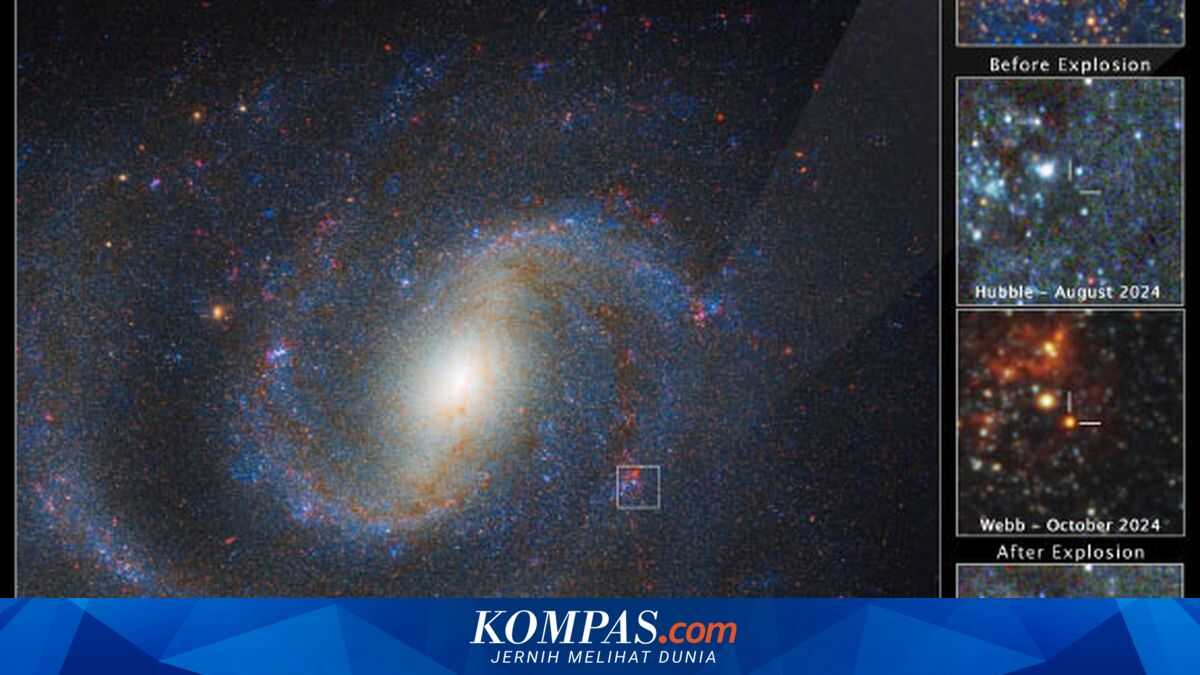
In a groundbreaking achievement for modern astronomy, scientists have successfully identified the progenitor star of a nearby supernova. This discovery was made possible by the advanced capabilities of the NASA/ESA/CSA James Webb Space Telescope (JWST), which can penetrate the thick cosmic dust that has long obscured observations.
The supernova in question, named SN 2025pht, was discovered on June 29, 2025, in the spiral galaxy NGC 1637. Shortly after the explosion was detected, astronomers around the world turned their telescopes to study the phenomenon.
Instead of focusing solely on the recent explosion, a team of researchers from Northwestern University, led by astronomer Dr. Charlie Kilpatrick, chose a different approach. They investigated old observational archives from before the supernova, in order to identify which star had actually exploded.
In the images, the researchers found a red supergiant star whose position was exactly the same as the location of the SN 2025pht supernova today.
“We have been waiting for this moment for a long time – a supernova exploding in a galaxy that had previously been observed by Webb,” said Dr. Kilpatrick.
“We combined data from Hubble and Webb to fully characterize this star for the first time.”
Surprisingly, the star turned out to be extremely unusual.
“This is the reddest and dustiest red supergiant we have ever seen explode as a supernova,” said Aswin Suresh, a graduate student at Northwestern University.
In theory, the most massive stars that explode as supernovae should be very bright and easily identifiable in pre-explosion images.
However, in practice, many supernovae do not have a clear, bright star candidate in the pre-explosion data. Astronomers have wondered: where do these massive stars go?
One hypothesis suggests that very massive, old stars are also very dusty. If they are shrouded in large amounts of dust, their light can be dimmed to the point of being undetectable by ordinary telescopes.
The Webb telescope’s observations of SN 2025pht provide strong support for this hypothesis.
“I have long supported this interpretation, but even I did not expect the results to be so extreme in SN 2025pht,” said Dr. Kilpatrick.