
MUI Urges Indonesian Government to Withdraw from Board of Peace Following US-Israeli Attack on Iran
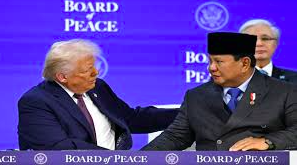
The Indonesian Ulema Council (MUI) has formally urged the Indonesian government to withdraw from the Board of Peace (BoP) following military strikes by the United States and Israel against Iran on Saturday, 28 February.
In a religious advisory (Tausiyah) issued on Sunday, 1 March, MUI questioned the role of the United States, which it views as holding a central position in managing the Palestinian conflict through the BoP. MUI contends that fundamental questions arise regarding whether this strategy genuinely aims at achieving just peace or instead reinforces an inequitable security architecture that buries Palestinian independence.
“MUI therefore urges the Indonesian government to revoke its membership in the BoP, as it is seen as ineffective in realising true Palestinian independence,” according to MUI’s official statement.
The advisory, numbered Kep-28/DP-MUI/III/2026, was signed by MUI Chairman KH Anwar Iskandar and Secretary-General Buya Amirsyah Tambunan.
MUI also highlighted actions by US President Donald Trump, accusing him of orchestrating joint attacks with Israel against Iran, triggering a regional war involving various powers both directly and through proxy forces.
Beyond political positioning, MUI called upon Muslims worldwide to increase qunut nazilah prayers and pray for Allah’s assistance and protection for Muslims facing hardship, oppression, or calamity.
“MUI calls upon the United Nations and the Organisation of Islamic Cooperation for maximum steps to halt war and respect international law. MUI believes that war will bring global harm,” the statement read.
The US and Israeli attacks on Iran reportedly resulted in the death of Iran’s Supreme Leader, Ali Khamenei. MUI expressed deep sorrow over the incident.
“MUI expresses profound condolences over the death of Iran’s Supreme Leader Ali Khamenei as a result of the Israeli-American attack on Saturday, 28 February. We express our condolences and pray that he becomes among the inhabitants of paradise, Amen,” it stated.
MUI condemned the Israeli attack supported by America, deeming it contrary to humanitarian values and the preamble of the 1945 Indonesian Constitution—specifically the commitment to uphold international order based on independence, lasting peace, and social justice.
Regarding Iran’s retaliatory strikes against several Gulf nations, reportedly targeting military installations, MUI stated it understood these actions as a response to prior attacks. According to MUI, such retaliatory measures are justified and protected under international law.
“Therefore, to prevent wider escalation, America and Israel must cease their attacks on Iran, as these attacks violate Article 2 (4) of the UN Declaration,” MUI stated in the third point of its advisory.
MUI assessed the series of attacks and retaliations as serious escalation with potential to drag the Middle East into broader open conflict.
“This situation must not be viewed as an isolated incident, but rather as part of a larger geopolitical configuration. It is the duty and responsibility of all nations to realise peace so as to provide maximum protection to civilians,” it emphasised.
Furthermore, MUI suspected strategic motives behind the attacks—specifically a systematic effort to weaken Iran’s strategic position in the region whilst limiting its support for the Palestinian independence struggle.
Regarding the Israeli-Palestinian conflict, MUI urged various nations to serve as peacemakers to stop military attacks that could become instruments of political pressure to secure Israel’s regional dominance over Palestine.