
Mudik Traffic Jams Triggered by Toll Transaction Bottlenecks, Not Just Surge in Vehicle Numbers
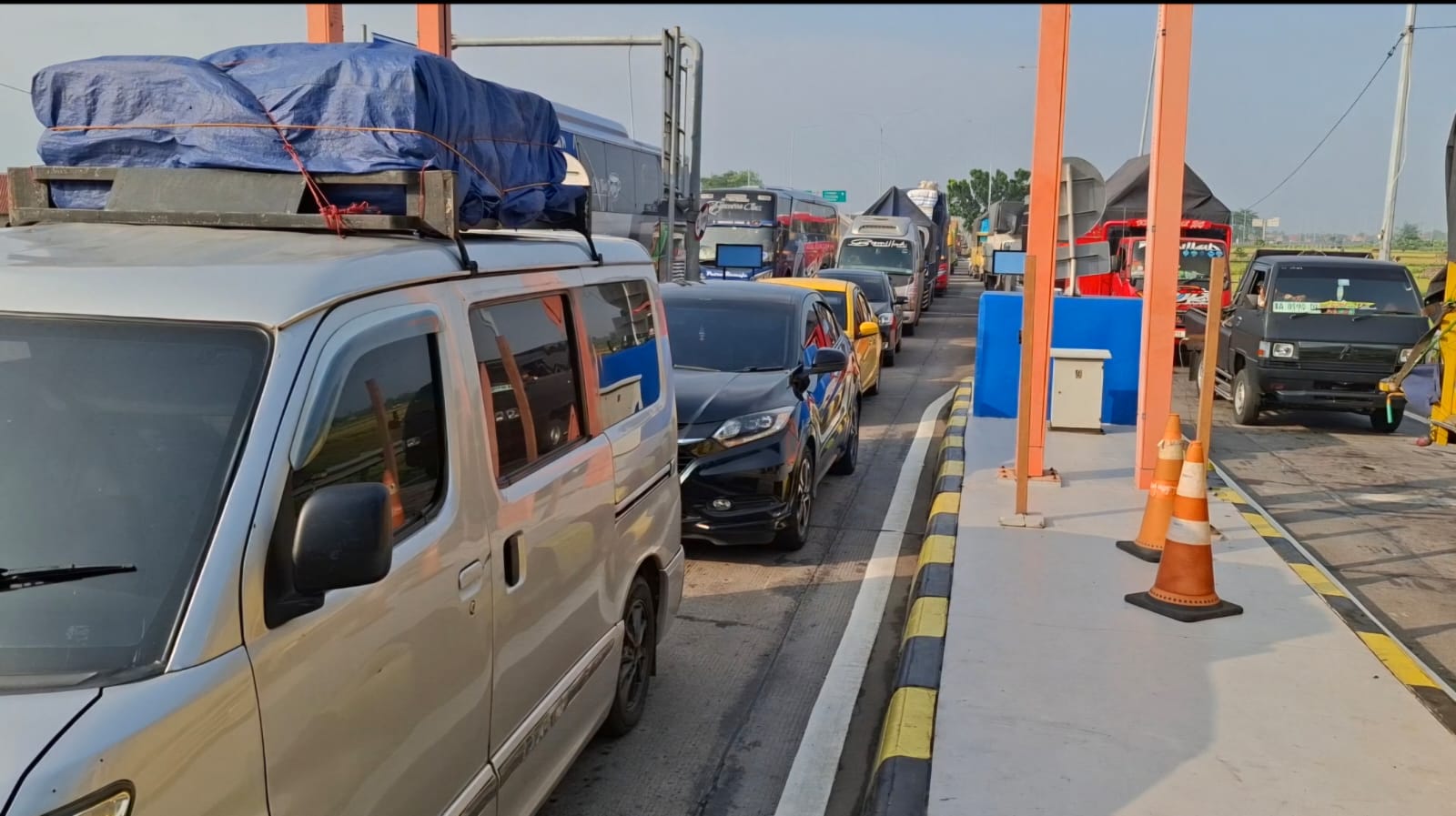
Long queues at toll gates during the mudik rush have once again occurred this year, underscoring that the core issue is not merely the surge in vehicle numbers, but structural impediments in the toll gate transaction system. The e-money tapping-based payment system is considered a critical point that significantly reduces road capacity.
Transportation observer from the Road Transport Safety Polytechnic (PKTJ) Tegal, Anton Budiharjo, explained that in traffic theory, toll gates act as a “bottleneck” or capacity constriction point where vehicles must slow down or stop.
“With a service time per vehicle of around 4–5 seconds, when traffic volume increases two to three times during mudik, queue accumulation becomes inevitable,” said Anton on Thursday (19/3/2026).
Anton noted that even a few seconds’ difference in peak flow conditions can develop into long queues that spill over onto the main lanes. The impact disrupts traffic flow systemically, with congestion not only at toll gates but also propagating to preceding road sections.
According to Anton, solutions to this issue should be divided into short-term and long-term categories. In the short term, operational optimisation is the primary step, such as adding toll booths, including satellite booths at critical points like Cikampek Utama and Kalikangkung. Additionally, traffic engineering such as contraflow, lane management, and open barrier policies during peak flows are deemed effective in reducing queues. He also emphasised the importance of adding mobile readers and managing vehicle distribution to rest areas to avoid build-ups at single points.
“Structurally, the most effective solution is to eliminate stopping points on toll roads. The core problem lies in the friction point at toll gates. If this is removed, traffic flow can become free flow,” said Anton.
He advocated for the implementation of a contactless and stop-free payment system or Multi Lane Free Flow (MLFF) as a long-term solution. This system allows vehicles to pass without stopping, thereby increasing road capacity without physical expansion.
“As a transitional stage, implementing Single Lane Free Flow before full MLFF rollout. By eliminating barriers at toll gates, traffic flow is expected to run more smoothly and reduce classic congestion during the mudik season,” advised Anton.
In principle, Anton explained, MLFF operates by automatically detecting vehicle movements. The planned implementation in Indonesia will be based on the latest technology, namely the Global Navigation Satellite System (GNSS) connected to smartphone applications.
Through this system:
• Vehicles will be detected automatically,
• The system will match with the toll road network,
• Tariffs will be calculated based on distance travelled,
• And balances will be deducted electronically via the application.
On the other hand, monitoring will also use ANPR (Automatic Number Plate Recognition) cameras. These cameras can detect and read vehicle licence plates with high precision, even at high speeds (up to 100–150 km/h), and in various conditions such as rain, night, or daytime.
In addition to ANPR cameras, there are supplementary sensors serving as verification and control mechanisms.
The entire MLFF process runs in real time without stopping vehicles. Thus, toll gates for tapping transactions are no longer needed. Vehicles can pass freely (free flow) without stopping, eliminating payment point barriers. “However, its effectiveness still heavily depends on two main factors. First, the accuracy of the vehicle identification system,” stated Anton.
According to Anton, resolving these challenges involves not only the Ministry of Public Works but also various other stakeholders involved in developing the barrier-free toll payment system. “Therefore, the refinement process requires cross-agency coordination,” he stressed.
Public Works Minister Dody Hanggodo stated that the MLFF project is fundamentally progressing despite previously facing several issues that needed resolution with relevant parties.
“MLFF is still in process. There were some technical and non-technical problems, but they’ve all been sorted out. However, since it involves many parties, it naturally takes time to tidy up,” said Dody during a media gathering for Lebaran 2026 mudik preparations at the Ministry of Public Works Pendopo, Jakarta, on Friday (6/2/2026).
Dody affirmed that system testing will continue. The next testing phase will ensure technological readiness before broader implementation.
“MLFF is a barrier-free toll payment system that allows vehicles to pass without stopping or slowing down at toll booths. This technology is expected to improve traffic smoothness while reducing vehicle queues on toll roads,” explained Dody.
MLFF was initiated 10 years ago, precisely during Hungarian Prime Minister Viktor Orbán’s visit to Indonesia in 2016. The project is being handled by a Hungarian technology company, Roatex Ltd., through its subsidiary, PT Roatex Indonesia Toll System (RITS). Funding for the MLFF project is fully sourced from the Hungarian government, amounting to US$300 million or equivalent to Rp4.65 trillion.
However, its effectiveness still heavily depends on two main factors. First, the accuracy of the vehicle identification system. Second, the strength of field law enforcement. Vehicle identification will rely on an integrated system, both through ANPR camera monitoring and strong back-office system support.
“Without these two elements—namely identification accuracy and enforcement—”