
MSCI Maintains Indonesia's Stock Exchange in Emerging Market Category, OJK Emphasises Reforms
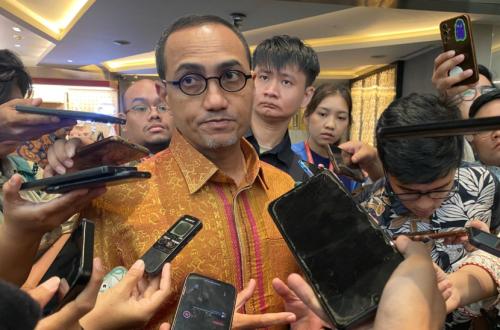
The Financial Services Authority (OJK) has revealed that the Morgan Stanley Capital International (MSCI) index rebalancing announcement is a consequence of the ongoing integrity reform process aimed at improving the atmosphere of Indonesia’s capital market. According to OJK, the impact of the MSCI announcement will only last in the short term.
“We view the MSCI rebalancing announced today as part of the short-term consequences of the integrity reform process we are implementing,” said the Executive Head of Capital Market Supervision, Derivative Finance, and Carbon Exchange at OJK, Hasan Fawzi, at the Indonesia Stock Exchange (BEI) building in Jakarta on Wednesday (13/5/2026).
Hasan explained that the MSCI rebalancing announcement is evidence of the transparency, openness, and credibility of Indonesian stocks. MSCI also maintained Indonesia’s emerging market status. Although it appears negative due to several stocks being removed from the MSCI Global Standard Index list, Hasan views it as a momentum for improvement and a foundation for a better Indonesian capital market in the future.
“The momentum of this announcement and index adjustment we hope will form a new baseline, a new basis as our starting point to increasingly present the quality of listed stocks on the exchange in the future. Of course, we hope that our stocks will increasingly become the choice of investments for investors. We will guide several stocks that have proven potential,” he explained.
IHSG Weakness is Normal
Following the MSCI index rebalancing announcement in the MSCI May 2026 on 12 May 2026 New York time or 13 May 2026 Indonesian time, the Composite Stock Price Index (IHSG) moved lower.
The IHSG opened down 94.96 points or around 1.38 percent to the level of 6,763.94 on Wednesday morning. Based on data at 14:35 WIB, the IHSG was still correcting in the range of 6,736-6,737.
In response to the IHSG weakness, OJK assessed it as still within normal limits and not showing investor panic. Because the performance of frequency, volume, and transaction value of stock trading today was deemed still in normal condition.
“The frequency, volume, and transaction value of securities were also quite good earlier. On average, there is no difference, normal compared to previous days. This shows there is no panic selling or one-way reaction in the form of selling stocks without being balanced by buying strength,” said Hasan.
The still controlled IHSG as a result of the MSCI announcement is seen as evidence of the short-term consequences of the Indonesian capital market integrity reform initiated by OJK together with the Indonesia Stock Exchange (BEI) and other Self-Regulatory Organisations (SROs).
“This is certainly a consequence that we have calculated and anticipated from the beginning,” he said.
Amid the weakening index, Hasan views the current valuation of Indonesian stocks as relatively attractive. Hasan mentioned that the price to earnings ratio (PER) of the IHSG is now much lower compared to when it reached its all-time high in mid-January 2026. Even regionally, the average PER of Indonesian stocks is below other stock exchanges at around 16 times.
“So this also shows that we actually hope our investors will selectively take advantage of this momentum to enter the market and choose the best stocks that prospectively can continue to improve their performance in the future,” he said.