
MPR Research Body Holds FGD, Discusses Democracy and Sovereignty Strengthening
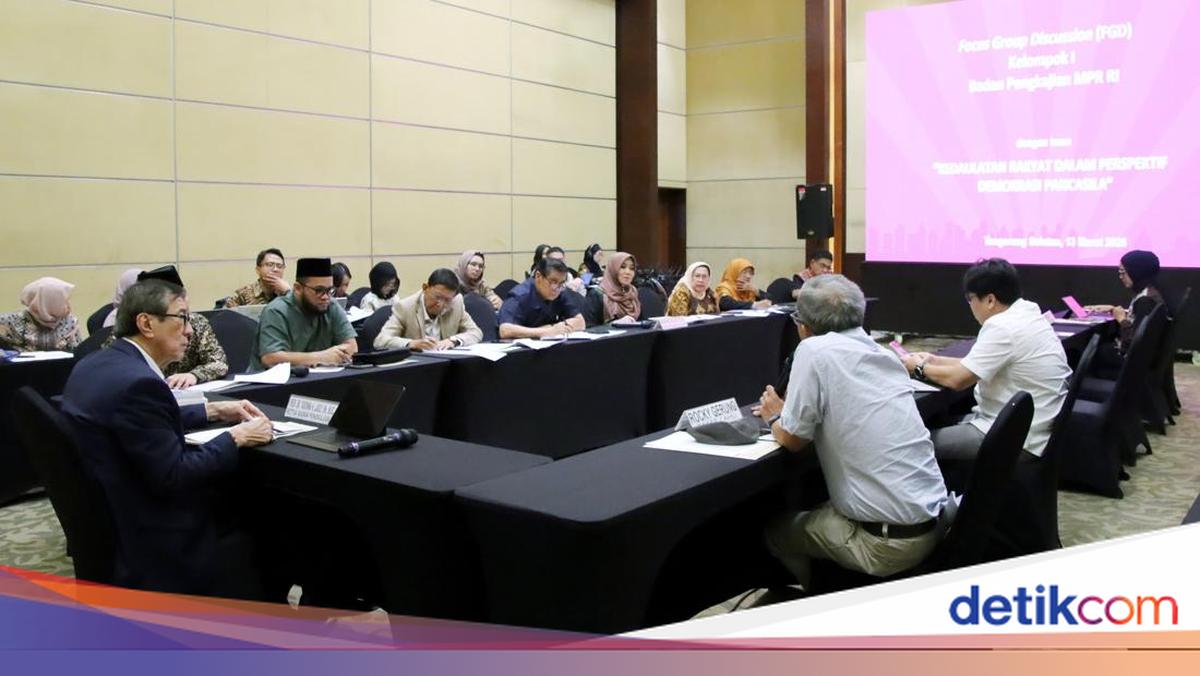
Group I of the MPR Research Body held a Focus Group Discussion (FGD) with the theme “People’s Sovereignty in the Perspective of Pancasila Democracy” in Tangerang Selatan, Banten.
In his opening remarks, Chair of the MPR Research Body Yasonna H Laoly explained that studies on people’s sovereignty had been conducted in various regions, including Jakarta, Surabaya, and Medan. The objective was to evaluate whether the current democratic system truly reflects the principles of Pancasila democracy as mandated by the constitution.
“We want to revisit, following the reform and constitutional amendments, whether our current democracy truly realises people’s sovereignty as expected,” said Yasonna in a written statement on Sunday (15 March 2026).
Yasonna highlighted the changing quality of parliament since the beginning of the reform era. According to him, the legislative institution’s oversight function over government operated very strongly during the early reform period.
“There has been a decline in parliamentary quality. In the early reform period, the checks and balances mechanism truly operated strongly,” said this member of Commission XIII of the House of Representatives.
“Yet the principle of power oversight is an important prerequisite for creating good governance,” he added.
Furthermore, Yasonna also touched upon increasing public anxiety resulting from various political dynamics and law enforcement developments.
“We do not want a management of fear. There should be no impression that criticism or public anxiety is met with pressure,” said Yasonna.
According to Yasonna, various events that appear minor can trigger larger social tensions if not handled wisely. For this reason, Yasonna considered it important to present critical thinkers in the discussion to provide clear perspectives.
“We intentionally invited speakers who think critically, not merely offering praise. The goal is to produce enlightening thinking,” said Yasonna.
The discussion was part of a series of studies by the MPR to formulate ideas related to strengthening Indonesia’s democratic and constitutional systems in the future. The results of the discussion will be compiled and discussed further in the MPR’s official forum.
“This is still the initial discussion stage. Later we will summarise it and bring it to broader discussions,” said Yasonna.
Principle of People’s Sovereignty
In his opening presentation, political academic and observer Rocky Gerung emphasised the importance of restoring the basic orientation of state life to the principle of people’s sovereignty.
Historically, the concept of people’s sovereignty emerged earlier than the formulation of Pancasila democracy, as the idea developed from the tradition of modern political thought born from the French Revolution.
Therefore, said Rocky, in democratic practice, no institution, whether state, party, or military, should obstruct people’s sovereignty as the highest principle in state life.
“No single institution in democracy should obstruct people’s sovereignty. The military should not obstruct people’s sovereignty, the state should not replace it, and parties should not cancel it,” said Rocky.
“Sovereignty is inherent in the people, and everything else is merely a technical derivative of that principle,” he added.
Rocky also explained that of the five pillars of Pancasila, two principles historically and philosophically have the most fundamental position in building democracy: just and civilised humanity and social justice for all Indonesian people.
Both principles are considered universal and cannot be cancelled by any political development. These principles can even be tested using modern justice theory frameworks such as John Rawls’ ideas, which emphasise priority for the most vulnerable groups in society.
“Ideologically and historically, only two values in Pancasila are truly universal and perennial: just and civilised humanity and social justice. These two principles should form the basis of every state regulation and policy,” said Rocky.
Furthermore, Rocky also highlighted the importance of rebuilding the tradition of deliberative democracy in Indonesia, which is democracy based on rational argumentation and exchange of ideas.
Democracy should not be understood merely as government by the people, but must become government by reason through people’s participation.
For this, political education and leadership cadre development must emphasise ethics, intellectual capacity, and critical thinking ability before considering electability alone.
“Leaders should be filtered through three stages: first, ethicability; second, intellectuality; and finally, electability. Without ethics and thinking ability, electability will only produce power dealers, not leaders who guide the nation,” said Rocky.
People as Highest Source of Power
Meanwhile, Professor of Sociology at Jakarta State University (UNJ) Prof Dr Robertus Robet outlined the concept of people’s sovereignty, which is a basic principle in modern political theory that places the people as the highest source of power in the state.
Robertus referred to the thinking of sovereignty theorists such as Jean Bodin, who called sovereignty “the highest, absolute and perpetual power in a state.”
According to Prof Robertus, when the state recognises people’s sovereignty, then all other forms of power rest below the people.
However, in the practice of modern democracy, that sovereignty often appears tangibly only during elections.
“People’s sovereignty is like something we cannot see its form directly, but we feel it at the time of elections,” said Prof Robertus.
Prof Robertus also compared several sovereignty concepts from classical thinkers. Besides Jean Bodin, he mentioned the social contract theory from Thomas Hobbes, which views the state as the highest power to avoid social chaos, as well as Jean-Jacques Rousseau’s concept of “general will.”