
Mount Semeru erupts seven times on Thursday morning, eruption height reaches 700 metres
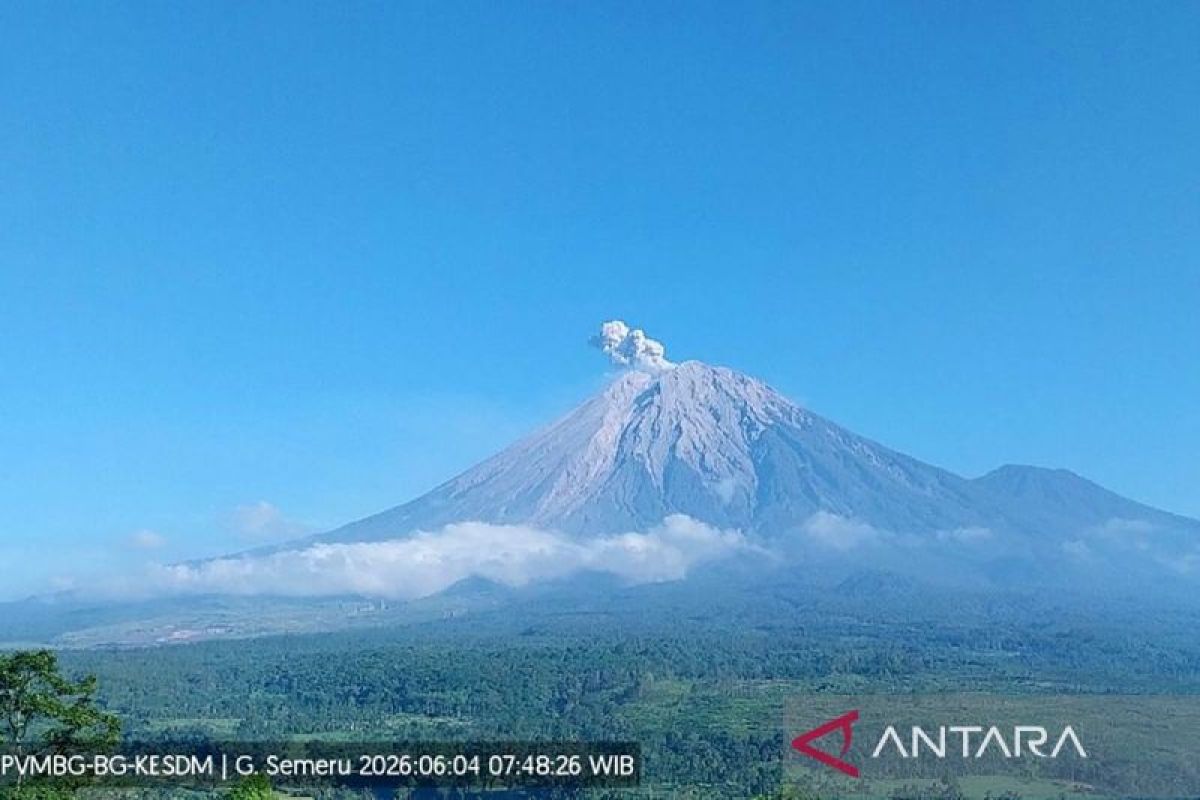
Mount Semeru, located on the border of Lumajang and Malang regencies in East Java, erupted seven times with eruption heights ranging from 400 to 700 metres above the peak on Thursday, from 00:34 to 08:00 local time.
The first eruption occurred at 00:34 local time, with no visible eruption.
“The seventh eruption occurred at 07:47 local time, with the eruption column reaching approximately 700 metres above the peak, or 4,376 metres above sea level,” said Sigit Rian Alfian, officer at the Mount Semeru Observation Post, in a written report received in Lumajang.
According to him, the ash column was observed to be white to grey in colour with thick intensity towards the southwest. The eruption was recorded on the seismograph with a maximum amplitude of 21 mm and a duration of 124 seconds.
“Then, three times of emission earthquakes with an amplitude of 3-7 mm, and a duration of 47-49 seconds, and one distant tectonic earthquake with an amplitude of 34 mm, S-P 20 seconds and a duration of 78 seconds,” he said.
Sigit explained that the volcanic activity of Mount Semeru is currently at Level III (Alert) status, with a recommendation that the public not carry out any activities in the southeast sector along Besuk Kobokan, within a radius of 13 kilometres from the peak (eruption centre).
“The public is prohibited from carrying out activities within a radius of five kilometres from the crater/peak of Mount Api Semeru because it is prone to the danger of rock (incandescent rock) projectiles,” he said.
He urged the public to be aware of the potential for hot clouds, lava flows, and lahars along the river/valley that originates at the peak of Mount Api Semeru.
“Especially along Besuk Kobokan, Besuk Bang, Besuk Kembar, and Besuk Sat, and the potential for lahars on small rivers that are tributaries of Besuk Kobokan,” said Sigit Rian Alfian.