
Mount Semeru erupts, accompanied by pyroclastic flows
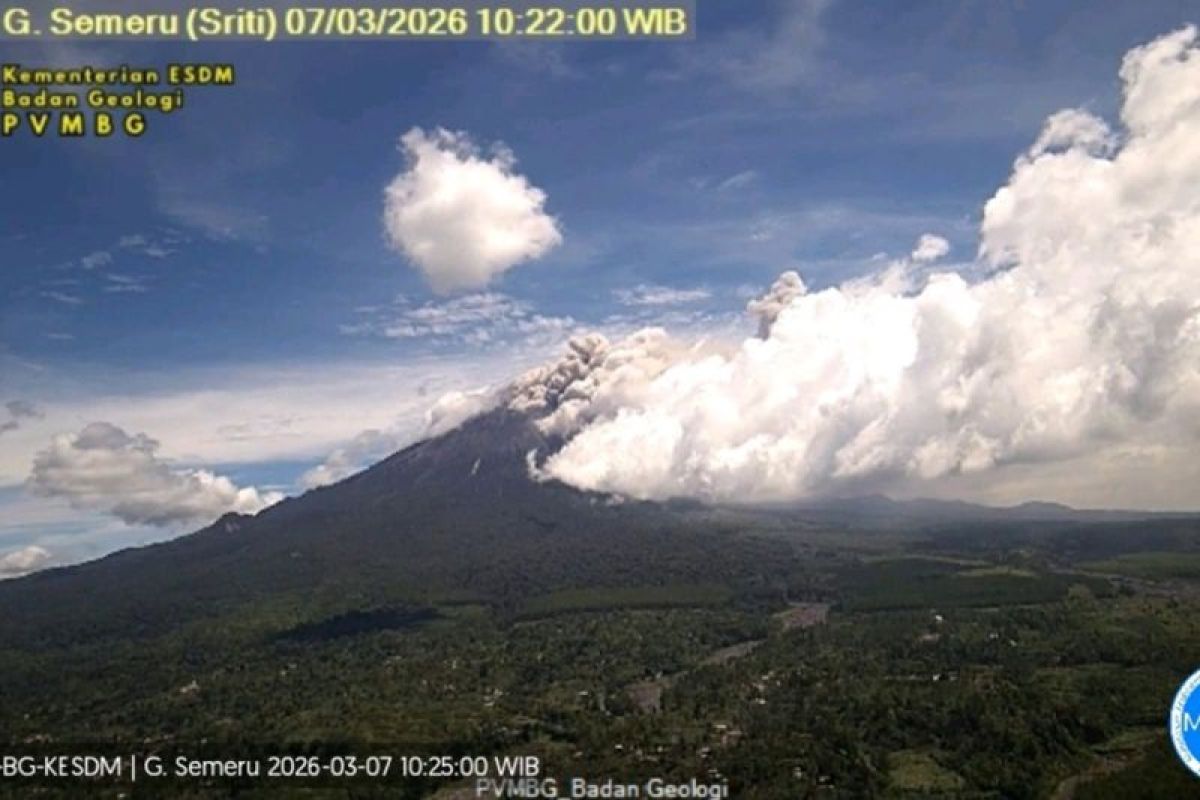
Jember, East Java (ANTARA) — Mount Semeru, standing 3,676 metres above sea level, erupted on Saturday accompanied by a pyroclastic flow (APG). ‘An eruption of Mount Semeru occurred on 7 March 2026 at 10:20 Western Indonesia Time (WIB), but the height of the ash column was not observed,’ said Sigit Rian Alfian, an officer at the Semeru Volcano Observation Post, in a written report received in Lumajang. According to him, the eruption of the volcano, which lies on the border of Lumajang and Malang regencies in East Java, was recorded on the seismogram with a maximum amplitude of 12 mm and a duration of about 4 minutes 35 seconds. ‘The eruption consisted of a pyroclastic cloud with an uncertain travel distance because the volcano was shrouded in fog. It was directed to the southeast (Besuk Kobokan),’ he said. Based on the officer’s notes, Mount Semeru experienced nine eruptions on Saturday, the first at 00:23 WIB and the ninth at 10:20 WIB, accompanied by a pyroclastic flow. Sigit explained that Mount Semeru is currently at Status Level III (Siaga) with a recommendation not to carry out any activity in the southeast sector along Besuk Kobokan, up to 13 km from the summit (eruption centre). ‘Beyond that distance, the public should avoid activities within 500 metres of the riverbank (the river embankment) along Besuk Kobokan because there is potential for the flashover of hot clouds and lava flows up to 17 km from the summit,’ he said. He also urged residents not to conduct activities within a 5 km radius of the crater/summit of Mount Semeru due to the risk of volcanic rocks being ejected (bombs). The public should also be vigilant for potential pyroclastic flows, lava flows, and lahars along river valleys that originate from the summit of Mount Semeru, especially along Besuk Kobokan, Besuk Bang, Besuk Kembar, and Besuk Sat, as well as the potential lahars in smaller rivers that are tributaries of Besuk Kobokan.