
More Than Just Loans: LPEM FEB UI Research Proves AdaKami Funding Drives National Economy
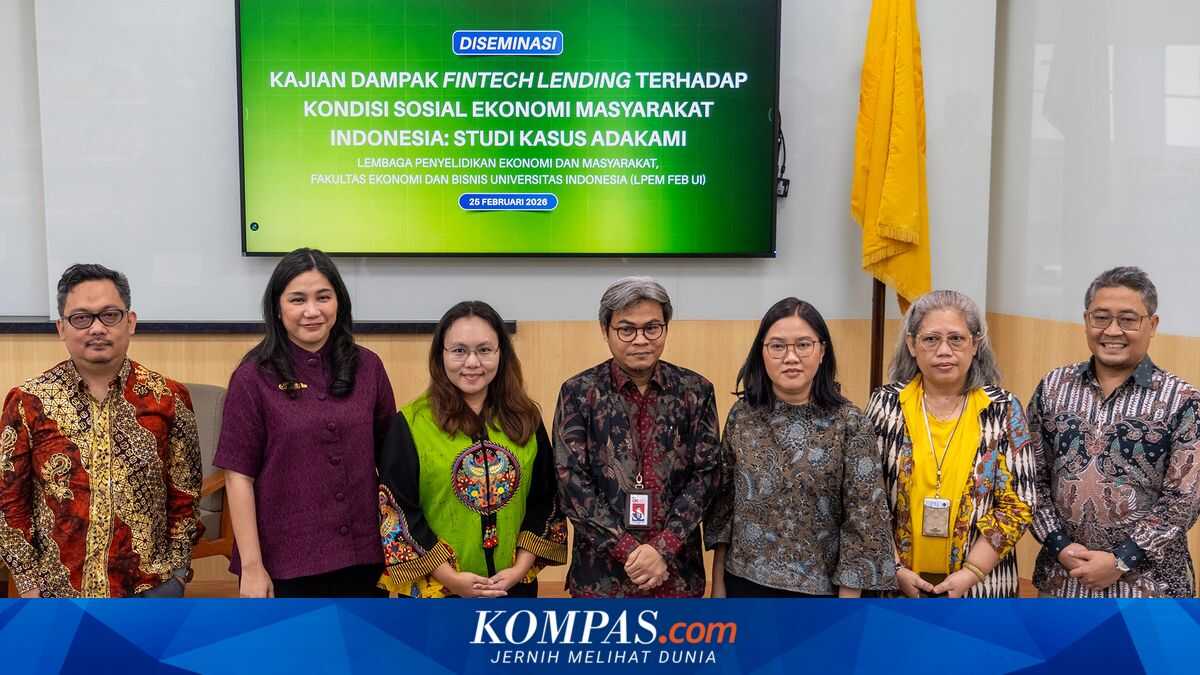
KOMPAS.com – The licensed online lending platform, AdaKami, is making a tangible contribution to the national economy.
Based on the latest research from the Institute for Economic and Social Research (LPEM) at the Faculty of Economics and Business, University of Indonesia (FEB UI), the funding disbursed by AdaKami in 2024 contributed to Indonesia’s Gross Domestic Product (GDP) by IDR 6.95 trillion to IDR 10.96 trillion.
This figure is generated through the multiplier effect of loan disbursements across various sectors, ranging from financial services to trade and education.
For comparison, this contribution is equivalent to the entire GDP of the island nation of Tonga in 2024, which was recorded at IDR 9.38 trillion. This figure reflects the significant economic activity driven by AdaKami’s financing.
The data was obtained through a primary survey conducted from October to November 2025, involving 615 respondents in seven Indonesian provinces with the largest number of AdaKami users. The survey was conducted using a combination of direct interviews and self-administered questionnaires.
LPEM FEB UI noted that the economic activity triggered by AdaKami’s funding provides added value to 185 sectors of the national economy.
The three sectors with the largest impact include other financial institution services (21.34 percent), government education services (10.03 percent), and trade excluding cars and motorcycles (9.30 percent).
This impact is not limited to the financial sector but extends to other sectors directly or indirectly.
In addition to its contribution to GDP, AdaKami’s loan disbursements have also created job opportunities for 47,000 to 78,000 people across 17 industrial sectors.
Specifically, the wholesale and retail trade sector accounts for the largest share (19.84 percent), followed by education services (18.63 percent), and agriculture, forestry, and fisheries (15.11 percent).
Deputy Head of LPEM FEB UI, Mohamad Dian Revindo, explained that this multiplier effect works by strengthening the demand side.
“The disbursement of financing drives the ripple effect through increased household consumption, both routine and non-routine, which then drives the retail, wholesale, transportation, manufacturing, and even primary sectors,” he said in a press release received by Kompas.com on Wednesday (February 25, 2026).
Dian added that support for the real economic sector occurs through strengthening the demand for productive goods and services, which triggers economic activity and production, at least in the short term.
In other words, every rupiah borrowed and spent by AdaKami users circulates back into the economic cycle and creates a domino effect that reaches far beyond the initial transaction.
AdaKami’s contribution to