
More Prosecutorial than the Prosecutors
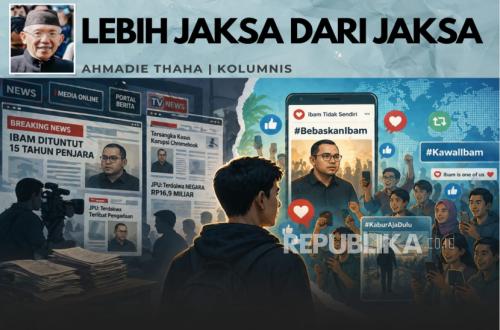
In a nation that prides itself on being democratic, there is one creature that quietly changes shape: the media. Once called the fourth pillar of democracy, it now sometimes feels like a boundary fence — not protecting the public, but rather limiting the public’s perspective. The case of Ibrahim Arief — Ibam — caught up in the Chromebook project whirlpool, suddenly becomes a kind of large mirror. A mirror that reflects the face of our media today: blurred, biased, and sometimes appearing to join in the judgement before the judge’s gavel falls. This stems from a large-scale educational laptop procurement affair, where a technical consultant — not an official, not a budget holder — ends up in the defendant’s seat, facing heavy prosecution, even though trial facts indicate no flow of funds to him. Data recently released by Ismail Fahmi from Drone Emprit is not just numbers. It is like a social X-ray: revealing cracked bones in our information ecosystem body. During the period from 23 March to 22 April 2026, Drone Emprit recorded 11,426 mentions and 13,140,377 interactions regarding Ibrahim Arief across six channels: Twitter/X, Facebook, Instagram, YouTube, TikTok, and online media. These figures show that this case is not just an ordinary legal news item — it is a wave of national-scale public attention. What is interesting and important to understand is the sharp polarisation between mainstream media and social media. Online media published positive news at 33.9%, negative at 46.9%, neutral at 19.2%. Social media: positive 85.5%, negative 10.6%, neutral 3.9%. In mainstream media, reporting more often amplifies official statements — JPU demands, suspect designations, state loss figures from BPKP — so the narrative reaching the public is predominantly negative towards Ibam. Voices of defence, mitigating facts, or technology industry context relatively rarely get equal space. However, on social media, the emerging story is very different. Positive sentiment (defence) dominates up to 92.2% on Twitter/X, 94.7% on Instagram, and 83.3% on TikTok. What needs to be noted: bot analysis shows an average score of only 1.29 out of 5, with 80.98% of accounts in the “very organic” category. The account creation year graph also shows a normal distribution from 2009 to 2025. This indicates that those accounts are not a pattern of manufactured accounts, which are usually concentrated in certain periods. In other words, the defence of Ibam on social media is not the result of buzzer engineering. It is the organic voice of the public, especially from the technology community and private professionals. Mainstream online media, with all its reputation and history, instead more often presents negative narratives against Ibam. Meanwhile, social media — often accused of being wild and uncontrolled — is filled with organic defence voices, not the result of buzzer engineering. Ironic? No. This is more like an irony that has long been cultivated, and now bears abundant fruit. The question is, why does mainstream media tend to be “more prosecutorial than the prosecutors”? This question is like opening the door to an old warehouse full of secrets. Inside, we find a pile of unromantic realities: business pressures, dependence on advertising, power relations, to subtle but deadly self-censorship. Even a media manager “confided” — that idealism today is like an antique item. Displayed, admired, but not used. The media, which once lived from public spirit, now often has to survive from contracts and partnerships. At this point, news is no longer just information. It becomes a product. And like all products, it follows market laws. What sells is what is dramatic, firm, that “dares to punish” in narrative. The prosecutor speaks — that is news. The demand is read — that is a headline. State loss figures are mentioned — that is clicks.