
Moon Escapes Threat From 'City-Killer' Asteroid 2024 YR4, James Webb Space Telescope Confirms Safety
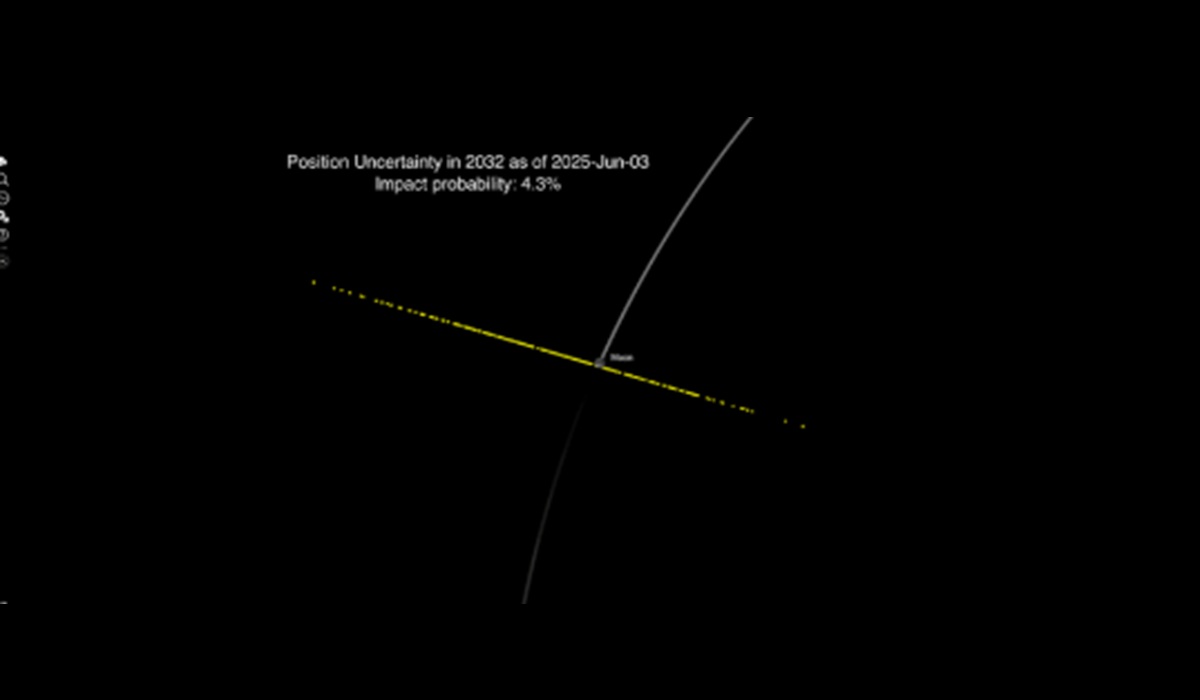
The Moon is confirmed to be safe from a catastrophic collision with the ‘City-Killer’ asteroid, scheduled for 2032. This assurance came after the James Webb Space Telescope (JWST) undertook a new, highly detailed observation of the object using its sensitive infrared instruments on 18 and 26 February 2025.
JWST succeeded in mapping the trajectory of the asteroid 2024 YR4. Based on this data, NASA scientists revised the prior estimate and reduced the Moon impact probability from 4.3% to zero. Although deemed safe, the asteroid will still pass extremely close, at just 21,200 kilometres from the Moon’s surface, closer than the orbits of several artificial satellites around the Earth. Meanwhile, 2024 YR4 is predicted to pass Earth at a distance of hundreds of thousands of kilometres in six years’ time.
This success owes to the extreme sensitivity of JWST. Since spring 2025, the asteroid has been effectively unobservable from Earth or other space observatories, except via JWST’s lens.
“The challenge is immense,” said a representative of the European Space Agency (ESA). “Using one of the most complex machines ever built by humanity to track an object barely visible at millions of kilometres, and then predict its position accurately for almost seven years into the future.”
NASA added that JWST’s image of 2024 YR4 is among the faintest asteroid observations ever recorded in the history of astronomy.
Discovered in late 2024 by the ATLAS survey, the asteroid measures between 53 and 67 metres in diameter, comparable to the height of the Leaning Tower of Pisa. The nickname ‘City-Killer’ was given due to its ability to wipe out a city with a yield equivalent to 500 Hiroshima bombs if it struck Earth.
Initially, the object was considered the most hazardous asteroid ever found with a 3.1% chance of colliding with Earth. However, as more data from JWST came in, the risk to Earth dropped to zero, though the Moon collision probability briefly remained at 4.3%.
Prior to the risk being declared zero, astronomers speculated about large impacts on the Moon. Some suggested the explosion might be visible from Earth with the naked eye, while others warned of debris showers that could trigger meteor storms on our planet.
Now, with Earth and the Moon deemed safe, 2024 YR4 remains an interesting target for scientists to test planetary defence models. NASA plans to resume monitoring this asteroid with JWST in 2028 when it again approaches in a safe orbit. (Live Science/Z-2)