
Monster El Niño 'Godzilla' to Hit Indonesia from April? Insights from BMKG and BRIN
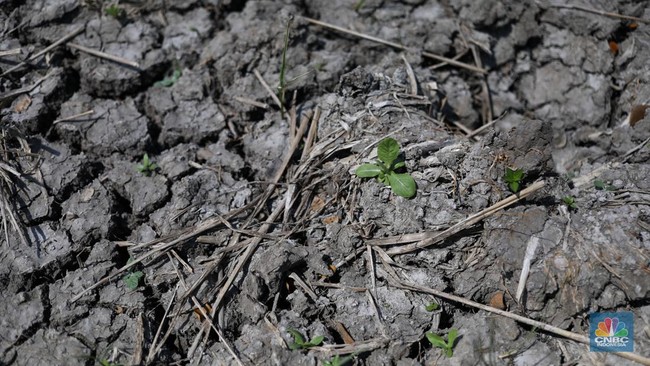
Indonesia is predicted to face the El Niño climate phenomenon this year. This means the arrival of El Niño during the dry season period will intensify the drought.
BRIN even predicts that the intensity of this year’s El Niño will be very strong. It is even named El Niño Godzilla and capable of triggering significant climate anomalies. It is said that this condition has the potential to make the dry season longer and drier, especially in western and southern Indonesia.
“El Niño is a phenomenon of warming sea surface temperatures in the equatorial Pacific Ocean. The El Niño phenomenon, including the potential for a strong ‘Godzilla’ variation, causes the dry season in Indonesia to become longer and drier,” wrote Researcher from the Centre for Climate and Atmospheric Research at BRIN, Erma Yulihastin, quoted from the official Instagram post @/brin_indonesia, cited on Wednesday (8/4/2026).
It is stated that several global models indicate that El Niño will begin to develop from April 2026. At the same time, the positive Indian Ocean Dipole (IOD) phenomenon is also expected to occur and strengthen the drought impacts in Indonesia.
The impacts of these two phenomena can be seen from the shift in cloud formation patterns. Rainfall activity is expected to be more concentrated in the Pacific Ocean, while Indonesia experiences a lack of clouds and rain.
“Cloud and rain formation is concentrated over the Pacific Ocean. Conversely, the Indonesian region experiences minimal clouds and rain,” she wrote.
In addition, the positive IOD, marked by cooling of sea surface temperatures around Sumatra and Java, further exacerbates the decline in rainfall, particularly in western Indonesia.
Strong Dry Season, BMKG Provides Explanation
Separately, the Meteorology, Climatology, and Geophysics Agency (BMKG) predicts there is a chance that El Niño in Indonesia will develop into a strong El Niño.
BMKG notes that by the end of March 2026, 7% of Indonesia’s Seasonal Zones (ZOM) have entered the dry season. This number will continue to increase significantly.
BMKG’s forecast indicates that most regions of Indonesia will begin entering the dry season in April, May, and June 2026.
So, what about the chances of El Niño this year?
Deputy for Climatology at BMKG, Ardhasena Sopaheluwakan, revealed that there is a possibility of the El Niño phenomenon developing in the second semester of this year.
According to him, up to the end of March 2026, the El Niño-Southern Oscillation (ENSO) and Indian Ocean Dipole (IOD) conditions are still monitored in the Neutral phase.
“However, climate modelling shows that ENSO may develop into the El Niño phase in the second semester of 2026,” said Ardhasena in the same press release.
“At present, BMKG’s prediction for the intensity of El Niño is in the weak to moderate category with a 50-80% probability, and noting a small possibility (less than 20%) that this phenomenon will develop into the strong category,” added Ardhasena.
Although the development of El Niño intensity is still being monitored, Ardhasena emphasised that the 2026 dry season will be drier.
“BMKG emphasises that the 2026 dry season is predicted to be drier and last longer compared to the normal average, also as a contribution from the natural climate variability in the Indonesian region,” said Ardhasena.
“Facing these conditions, BMKG urges the public to remain vigilant through precise steps that can be taken by all parties,” he said.
He urged policymakers and all parties to refer to official and credible climate development information from BMKG through various information channels. And to take anticipatory steps in various sectors and communities.
Prediction Accuracy
On the other hand, Ardhasena reminded to be careful in interpreting current prediction data. The reason is the spring predictability barrier phenomenon—a drastic decrease in the accuracy of weather and climate model predictions for ENSO when the Northern Hemisphere passes through the spring period (March, April, May).
He explained that the accuracy of El Niño predictions produced during the March-April period is generally only reliable for forecasts up to three months ahead.
Therefore, he stressed, expertise is needed in understanding the multi-factor interactions that cause the birth of El Niño conditions as well as their teleconnection impacts on the Indonesian region.
“For that, BMKG needs to continue monitoring data updates periodically and assessing their developments,” said Ardhasena.
“The confidence level regarding the intensity of El Niño will be higher in the May 2026 prediction results. Statistically, predictions in May have better reliability to cover climate conditions up to six months ahead,” he concluded.