
MKMK Declares It Lacks Jurisdiction to Hear Three Complaints of Ethics Code Violations Against Adies Kadir
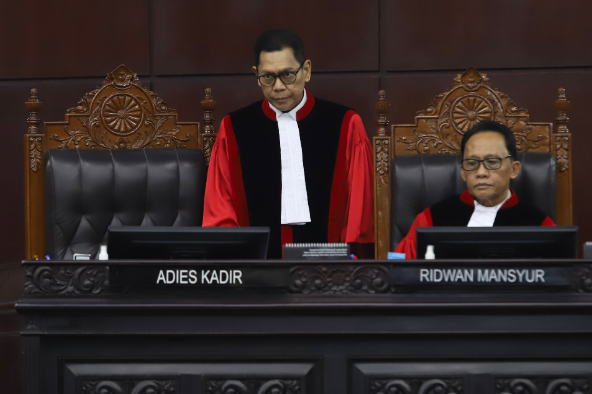
Jakarta—The Majelis Kehormatan Mahkamah Konstitusi (MKMK) has said it is not authorised to examine three reports alleging ethics violations by Constitutional Court Judge Adies Kadir. The ruling was read at a session at the Constitutional Court Building in Jakarta on Thursday, 5 March, in relation to three complaints submitted, including one by academics affiliated with the Constitutional and Administrative Law Society (CALS).
Chairman I Dewa Gede Palguna stressed that the complaints fall outside the remit of the body because they concern Adies’s nomination by the DPR, at a time when he had not yet held status as a constitutional judge.
‘Deciding, stating, the Majelis Kehormatan is not authorised to examine, adjudicate, and decide the report a quo,’ Palguna said as he read the ruling.
In its reasoning, MKMK said it respects the limits of the nominating institutions for constitutional judges—the DPR, the Supreme Court (MA), and the President. However, MKMK also cautioned on the importance of transparency and accountability in the process of selecting a candidate for the constitutional bench.
Adies’s path to the bench has previously sparked controversy. A day after his swearing-in, he was reported by dozens of law professors, lecturers, and practitioners affiliated with CALS for alleged ethics violations and breach of judges’ conduct in the nomination process.
CALS representative Yance Arizona said the report was filed to safeguard the integrity of the institution.
‘We filed this report because there is strong evidence of ethical violations related to the integrity of Adies Kadir, who has just officially become a MK judge,’ Yance said. He argued that the nomination process was not transparent and did not align with integrity principles. He highlighted the cancellation of Inosentius Samsul’s appointment, previously agreed by Commission III of the DPR and finalised at a plenary meeting in 2025 as a replacement for Arief Hidayat. On 26 January, that process was annulled and Adies Kadir subsequently appeared as a candidate without a proper fit and proper test, yet was approved by the DPR as the sole candidate for the MK.
CALS also questioned Adies’s Golkar background, which could pose a potential conflict of interest when judging matters concerning testing a law or disputes over election results, such as the PIL or PHPU disputes. In such a context, he could not participate in the testing of laws or in presidential election disputes or PHPU disputes.
Through its report, CALS asked MKMK to dismiss Adies from his post to uphold the court’s dignity. However, with the ruling of no jurisdiction, the internal ethics process on that report cannot proceed.
The controversy over Adies Kadir’s appointment underscores the importance of inter-institutional boundaries. MKMK is not a judicial body and does not have the power to overturn a Keppres. In response to criticisms from constitutional law scholars about the integrity of the MK, Suhartoyo said the body consistently upholds its dignity and independence.