
MKMK clarifies the boundaries of inter-institutional authority in Adies Kadir ethics report
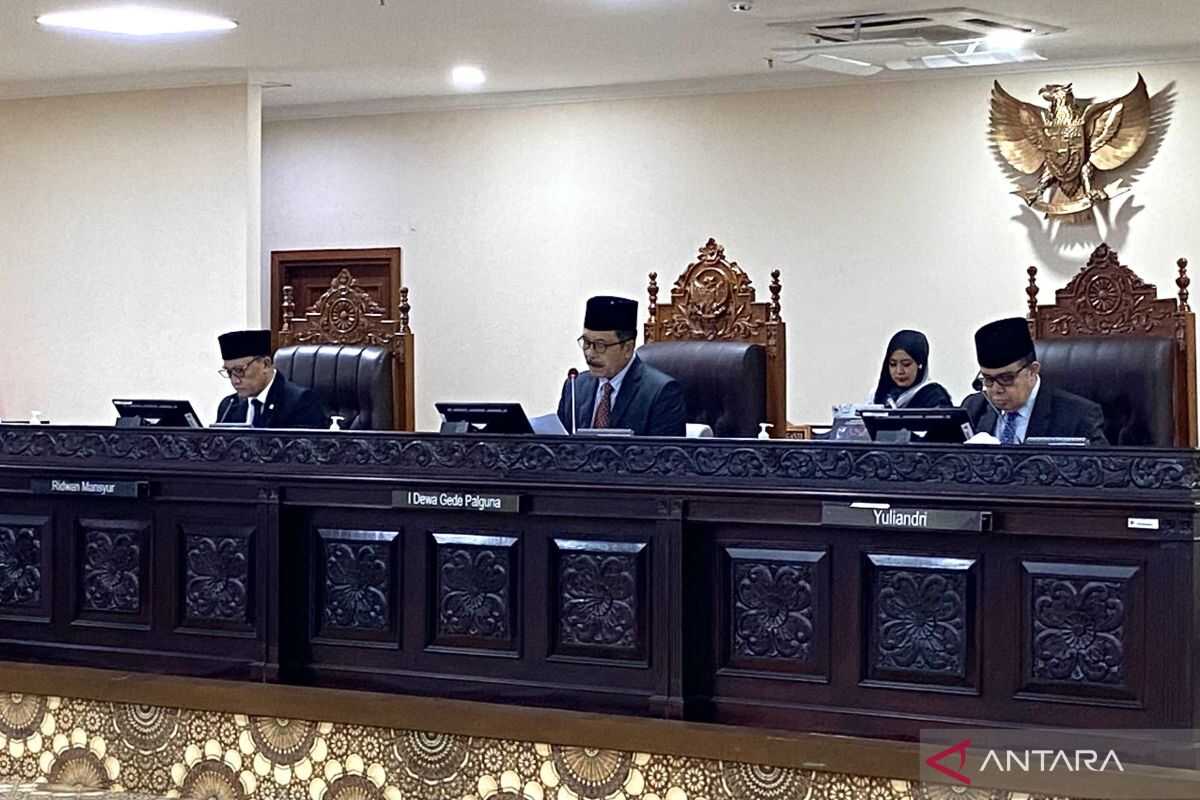
Jakarta (ANTARA) - The Honourary Board of the Constitutional Court (MKMK) has reaffirmed the boundaries of inter-institutional authority involved in reports of alleged code of ethics and conduct violations by Constitutional Judge Adies Kadir.
The statement was conveyed by MKMK member Yuliandri in the legal considerations of the ruling on report number 03/MKMK/L/ARLTP/02/2026, filed by the Constitutional and Administrative Law Society, CALS.
‘This limitation is important in order to respect the existence and authority of each state institution and to safeguard the independence of the respective institutions,’ Yuliandri said at the MK building in Jakarta, on Thursday.
CALS reported Adies Kadir on the suspicion that his nomination as a constitutional judge, proposed by the DPR, violated the code of ethics and conduct for constitutional judges and the applicable laws and regulations. In its report, CALS argued that Adies Kadir’s nomination to replace Arief Hidayat was not appropriate because it occurred after the Commission III of the DPR had selected another candidate, Inosentius Samsul.
MKMK linked the alleged violation to its authority to safeguard the honour and dignity of the MK. In this regard, the panel felt it necessary to establish a firm demarcation between the powers of the DPR and MKMK.
The 1945 Constitution and the Constitutional Court Act make clear that a constitutional judge is proposed by three branches of power: the Supreme Court, the DPR, and the President.
Yuliandri said that each state institution authorised to nominate a constitutional judge has the discretion to determine its own procedures for selection, appointment, and submission.
Once an institution has designated someone as a constitutional judge, the next step is confirmation by presidential decree. At this stage, the MKMK asserts it has no authority to intervene.
‘Though the recruitment mechanism has faced heavy and harsh criticism, the Honourary Board not only lacks authority but also finds it unethical to meddle or intervene,’ Yuliandri said.
‘Not only the Honourary Board, the MK also has no authority to involve itself in the procedural stages of the recruitment of that constitutional judge,’ he added.
He further stated that in the procedural stages of selecting and appointing someone as a constitutional judge, the MK does not participate institutionally. The MK is positioned as the body that receives whoever has been chosen and appointed as a constitutional judge.
Therefore, according to the MKMK, the institutional relationship between the nominating state bodies and the MK in the context of filling a constitutional judge’s post is not an overlap but merely a ‘point of overlap’.
‘If in the process of filling a constitutional judge’s post, the MK, as an institution, does not have overlapping powers with the body authorised to nominate a constitutional judge, then likewise the authority of the Honourary Board,’ he said.
Nevertheless, Yuliandri stressed that this stance does not mean the MKMK closes itself off or ignores reports circulating in the public regarding Adies Kadir’s selection process.
Therefore, the MKMK emphasised that the Constitutional Court Act essentially provides guidelines to the nominating state bodies to observe transparent and participatory principles in nominating constitutional judges.
In its ruling, the MKMK stated it is not competent to examine, prosecute, and rule on the report alleging violations of the code of ethics and conduct by Constitutional Judge Adies Kadir, submitted by CALS.
Additionally, the MKMK stated it is not competent to adjudicate two other related reports concerning Adies Kadir, namely report number 01/MKMK/L/ARLTP/02/2026 filed by lawyer Syamsul Jahidin and report number 02/MKMK/L/ARLTP/02/2026 filed by lawyer Edy Rudyanto.