
MITA Coaching Clinic 2026: Customs Strategy to Turn Audit Findings into a Guidance Instrument
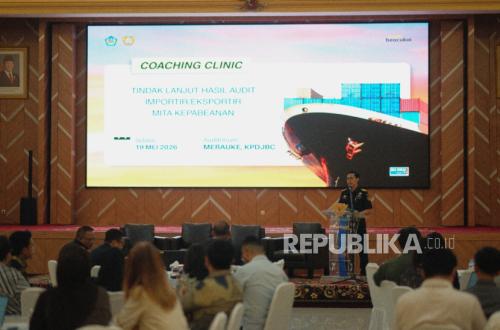
Bea Cukai, through the Directorate of Customs and Excise Audit, held the MITA Coaching Clinic on the 2026 Audit Results for MITA Companies on Tuesday 19 May 2026. The activity serves as a forum for guidance, coordination, and two‑way communication between Customs and MITA (the main partner) in order to improve compliance and understanding of customs and excise regulations.
Head of the Public Relations and Education Sub‑Directorate at Bea Cukai, Budi Prasetiyo, said that this coaching clinic is a tangible manifestation of harmonisation of Customs’ functions in safeguarding state revenue (revenue collector) without neglecting the aspect of trade facilitation (trade collector).
“In this coaching clinic, Customs aims to demonstrate that audit results are not only instruments of supervision but also materials for guidance so that the business world can grow in a healthy, compliant, and competitive manner,” he said.
In its execution, the MITA Company Audit Results Coaching Clinic for 2026 brought together cross‑unit collaboration within Customs, namely the Directorate of Customs and Excise Audit, the Directorate of Customs Technical, and the Directorate of Customs and Excise Information. The forum discussed feedback on the Audit Result Report (LHA), the evaluation of audit implementation, and various issues frequently faced by importers and exporters in customs activities.
According to Budi, feedback on the LHA is an important part of building a more adaptive and educational supervisory system. He explained that audit evaluation results are not only inputs for companies, but also serve as analytical material for the Customs’ units to strengthen customs policies and services on a sustainable basis.
Launched in 2022, this year’s coaching clinic agenda covers a number of strategic topics, including understanding the business processes of customs and excise audits, revisiting customs, the most frequently found violations in audits, preparation steps and follow‑up actions for audits, strengthening the provisions MITA companies must meet, and utilisation of the E‑Audit mechanism developed by Customs to facilitate the audit process for both officers and service users.
“By utilising E‑Audit, the exchange of data and documents becomes more effective, transparent, and efficient. We hope that MITA companies will be increasingly prepared to face the audit process with a higher level of compliance,” said Budi.
Bea Cukai notes that MITA companies contributed significantly to state revenue throughout 2025. In the import sector, MITA companies contributed about 29% of total import duties and 31% of total import levy revenue (PDRI). Meanwhile in the export sector, MITA companies contributed 8 percent of total export duties.
Bea Cukai regards this figure as evidence that MITA companies have a strategic role in Indonesia’s trading ecosystem. Therefore, ongoing guidance must continue so that the quality of company compliance remains safeguarded and the potential for repeated audit findings can be minimised.
Since its first edition, the MITA coaching clinic has consistently received positive responses from stakeholders. In addition to serving as an information forum, the activity has also become a moment for giving appreciation to importers and exporters that have demonstrated compliance and good cooperation in the conduct of audits.
“Our hope is that the coaching clinic will not only strengthen regulatory understanding but also build closer ties between Customs and business actors. In this way, the harmonisation of Customs’ role as revenue collector and trade facilitator can be maintained to support national economic growth,” said Budi.