
MinyaKita Suddenly Disappears from Senen Market, Traders Announce This
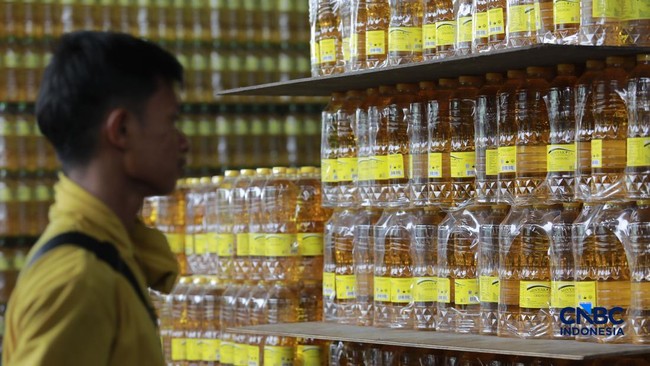
Traders at Senen Market in Central Jakarta have ceased selling MinyaKita amid ongoing rises in premium cooking oil prices. According to observations by CNBC Indonesia on Monday (11/5/2026), no traders were found offering MinyaKita; instead, only a few brands of premium cooking oil and bulk cooking oil were available for sale.
Minah, one of the traders, stated that she no longer sells MinyaKita because the requirements to do so are not straightforward. Additionally, she is unwilling to sell above the highest retail price (HET), as doing so at the HET level yields no profit.
“We don’t sell MinyaKita anymore; the reason is that it’s complicated to sell—it requires certain conditions—and we’re not brave enough to sell too far above the HET. If we sell at the HET price, we won’t make a profit,” said Minah when met by CNBC Indonesia on Monday (11/5/2026).
In addition to the challenging requirements, supply at the producer level is also quite scarce, leading her to opt out of selling MinyaKita.
“The supply that’s currently scarce is only MinyaKita, but for other cooking oils, it’s fine,” Minah explained.
Meanwhile, Bagus, another trader, revealed that the rising price of MinyaKita has made buyers more selective. The price difference between MinyaKita and other second-brand cooking oils is not significant, causing buyers to hesitate over purchasing MinyaKita.
As a result, with the number of MinyaKita buyers decreasing, he has stopped selling it.
“We no longer sell MinyaKita; its price is already close to other brands like Fitri and others. Yesterday it was around Rp20,000, so buyers are thinking twice about buying MinyaKita. Because fewer people are buying MinyaKita, I’ve stopped selling it for now,” said Bagus.
Besides the price, the limited supply and the cumbersome requirements for selling MinyaKita are other reasons why he only sells other types of cooking oil.
“It’s also scarce; last year I could get 10 units, now it’s hard,” he clarified.
Consequently, he prefers to sell other brands of cooking oil, which are much more expensive.
“I sell cooking oil that’s reliable—easy to obtain and easy to sell—even though the number of cooking oil buyers is also declining,” he said.
According to CNBC Indonesia’s investigation, MinyaKita was not found among the traders at Senen Market. Instead, traders are selling bulk cooking oil at Rp23,000 per kg and various other brands of cooking oil, as follows:
Sunco 2 litres: Rp46,000
Tropical 2 litres: Rp45,000
Tropical 1 litre: Rp24,000
Sania 2 litres: Rp43,000
Bimoli 2 litres: Rp43,000
Kunci Mas 2 litres: Rp43,000
Fitri 800 ml: Rp20,000
Bulk cooking oil 1 kg: Rp23,000.
For context, the Ministry of Trade has issued Minister of Trade Regulation (Permendag) No. 43 of 2025 on Packaged Palm Cooking Oil and Governance of People’s Cooking Oil. One of the provisions regulates that at least 35% of the realisation of domestic market obligation fulfilment must be through Bulog and State-Owned Food Enterprises.
Furthermore, Permendag 43 of 2025 sets out administrative requirements for business actors participating in the People’s Cooking Oil (MGR) programme and using the MINYAKITA brand. Business entities must have a Business Identification Number (NIB) with Indonesian Standard Industrial Classification (KBLI) codes as follows:
Producers: Must have KBLI 10437 (Palm Cooking Oil Industry) and valid business licences.
Packers: Must have KBLI 82920 (Packaging Services) and 46315 (Wholesale Trade of Vegetable Oils and Fats), or KBLI 10437 (Palm Cooking Oil Industry).
Meanwhile, the government also regulates retail-level sales to protect consumers. Retailers have three main obligations:
To sell MGR at a price at or below the Highest Retail Price (HET) of Rp15,700 per litre.
To comply with sales quantity restrictions (rationing) set by the Director General.
To display information on the HET clearly visible to consumers at the business premises.