
Ministry of UMKM Supports BKPM Acceleration of Micro-Enterprise Legalisation
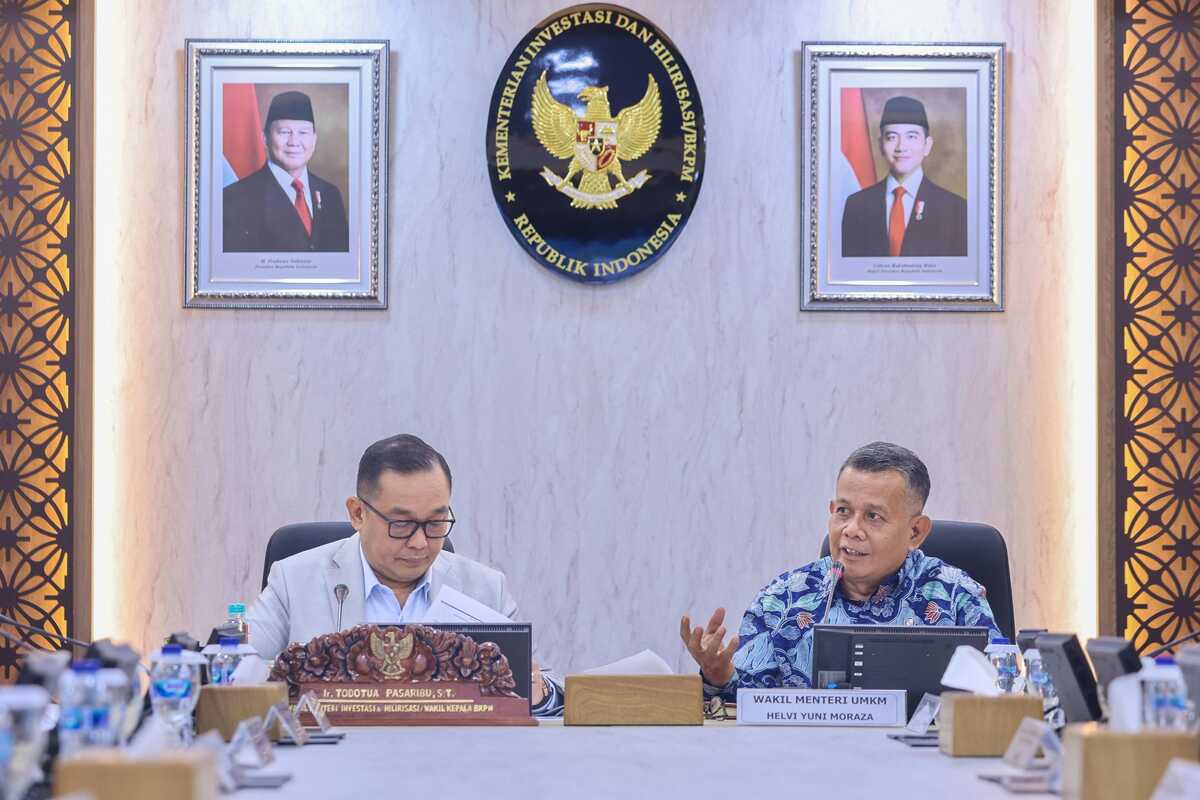
Jakarta — The Ministry of Micro, Small, and Medium Enterprises (UMKM) has endorsed a streamlining initiative by the Ministry of Investment and Downstream Processing/Investment Coordination Board (BKPM) to simplify the Business Identification Number (NIB) issuance process through the Land-Use Compliance Facilitation Policy (KKPR Darat) for micro-enterprises.
Deputy Minister of UMKM Helvi Moraza stressed that simplifying KKPR Darat is crucial to accelerating enterprise legalisation and strengthening Indonesia’s UMKM ecosystem. The more straightforward and integrated process is expected to encourage more UMKM entrepreneurs to formalise their operations.
“We strongly support the new NIB policy aimed at simplifying licensing procedures without burdening UMKM entrepreneurs,” said Deputy Minister Helvi in Jakarta on Tuesday (24 February 2026).
According to her, NIB serves as an essential business identity enabling UMKM entrepreneurs to access financing, mentoring, and various government empowerment programmes. To date, 14.9 million micro-enterprises have obtained NIB through the Online Single Submission (OSS) system, accounting for 96.9 per cent of total registered NIBs.
This achievement demonstrates strong enthusiasm among UMKM entrepreneurs to transition into the formal sector. Business legalisation is not merely an administrative obligation but a gateway to market expansion, enhanced competitiveness, and opportunities for business advancement.
According to UMKM Ministry data, Indonesia has approximately 56 million micro-entrepreneurs. However, only around 15 million have obtained NIB registration. This means roughly 40 million UMKM entrepreneurs still require facilitation for formalisation and capacity-building to ensure sustainable growth.
“This is a collective responsibility requiring collaboration to manage this tremendous potential. We must formalise and support tens of millions of UMKM entrepreneurs so they can advance and contribute more significantly to the national economy,” Helvi stated.
Deputy Minister Helvi reiterated that KKPR Darat simplification will make the enterprise legalisation process easier, faster, and more integrated whilst remaining aligned with spatial planning regulations.
Meanwhile, Deputy Minister of Investment and Downstream Processing Todotua Pasaribu explained that the ministry has issued Ministry Circular Letter No. 1.S of 2026 concerning provisions for KKPR Darat issuance for micro-enterprises.
The policy eliminates previously layered procedures, making the licensing process simpler and more efficient without compromising spatial planning principles or local government oversight functions.
“We want micro-enterprises to no longer be burdened by complex procedures. Through self-declaration via the Online Single Submission system, the process becomes faster and simpler whilst maintaining accountability. This is genuine support enabling UMKM entrepreneurs to operate legally and productively,” said Todotua.
Under the new mechanism, UMKM entrepreneurs need only complete location data comprising administrative information, full address, land area, a single coordinate point, and a photograph of the business location. Once data is completed, UMKM entrepreneurs submit a self-declaration statement confirming business location compliance through the OSS system.
This convenience still prioritises spatial planning compliance and supervision by local government, particularly for high-risk business activities.
The collaboration between the UMKM Ministry and the Investment Ministry/BKPM represents a concrete step towards building an inclusive, orderly, and competitive business ecosystem. Regulatory simplification does not mean reducing governance standards but rather ensuring regulations empower rather than hinder entrepreneurs.
With more accessible legalisation procedures, UMKM entrepreneurs are expected to gain greater confidence to expand operations and become primary drivers of the national economy.
The government continues ensuring this formalisation transformation occurs alongside mentoring and capacity-building, enabling Indonesian UMKM not merely to survive but grow and advance.