
Ministry of Transportation Prepares 814 Vessels to Transport 3.2 Million Eid al-Fitr Passengers
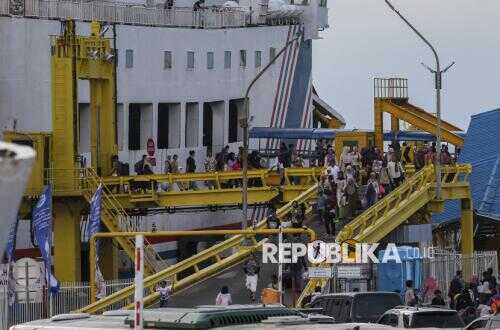
The Ministry of Transportation (Kemenhub) has prepared 841 vessels with a total transport capacity of around 3.2 million passengers for the Eid al-Fitr sea transport period of 2026. Transport Minister Dudy Purwagandhi revealed this as he opened the Eid al-Fitr 2026 Sea Transport Coordination Meeting at the Ministry’s Central Office in Central Jakarta on Wednesday (4 March 2026). “For the Eid al-Fitr sea transport operations, the government has prepared 841 vessels with a total transport capacity of around 3.2 million passengers,” Dudy said in a written statement in Jakarta, Wednesday. Therefore, Dudy continued, the government ensures readiness of fleets and port services to support smooth journeys during the Eid period. Dudy added that the sea transport mode plays a strategic role, especially in serving archipelagic, remote, outer, and border areas. He said the ministry has prepared concrete steps to guarantee sufficiency of services. Vessel seaworthiness testing has been conducted, covering passenger ships, ferries, fast boats, traditional boats, and tourist ships. “We must ensure that sea transport services during Eid al-Fitr are safe, secure, comfortable, orderly, and smooth,” Dudy said. As a form of social equity and economic stimulus, according to Dudy, the government again offers a free ticket program, with quotas of more than 66,000 passengers. Registration opens from 6 March 2026, for departures from 11 March to 6 April 2026. The government also provides a 30 percent tariff discount on all PSO Pelni economy-class routes, covering more than 445,000 tickets. He hopes this measure can ease the burden on the public while supporting a more even distribution of the mudik flow. Next, Dudy emphasised that maritime safety must be the top priority in organising Eid al-Fitr Sea Transport 2026. This aligns with the high mobility of people during the mudik and return flow this year. “For the umpteenth time, I stress there is no compromise on safety. Maritime safety is the top priority and non-negotiable,” Dudy said. He stressed that with an expected increase in passenger numbers this year, all parties must take preventive steps comprehensively. Steps include ensuring vessel seaworthiness and maritime safety through thorough inspections of fleets, safety equipment, and crew competency. Not only that, Dudy reminded, readiness of port facilities must be improved, including passenger terminals, waiting areas, health facilities, and information systems that are informative and accessible to the public. Operational smoothness must also be maintained through disciplined scheduling, capacity additions if needed, and optimisation of vessel traffic management. “On the other hand, coordination and collaboration between the government, shipping operators, and all stakeholders must continue to be strengthened,” Dudy explained.