
Ministry of Social Affairs pushes to equip village puskesos operators with complete devices
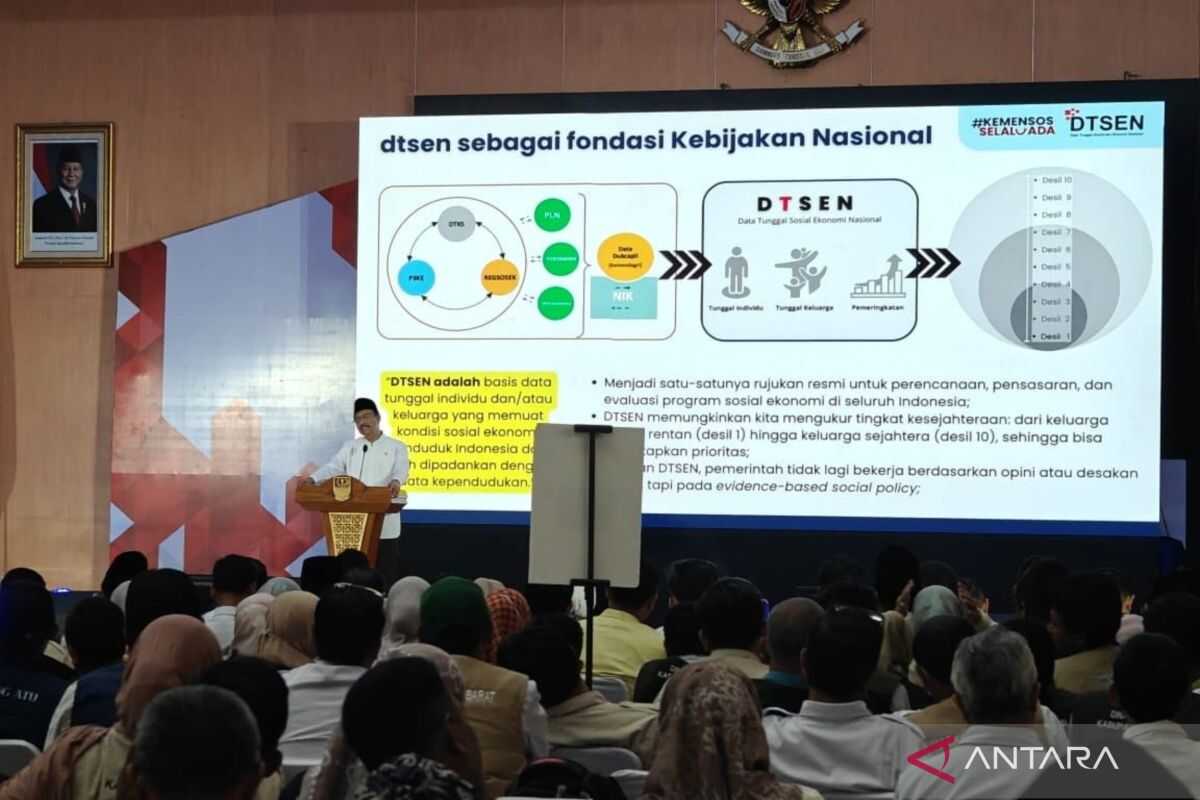
Bekasi Regency (ANTARA) - The Ministry of Social Affairs is ready to advocate for complete operating facilities such as smartphones and laptops for village welfare data operators (puskesos) to support updating the National Socio-Economic Single Data (DTSEN).
The Social Minister Saifullah Yusuf, at a press conference after the DTSEN socialisation in Bekasi Regency, West Java, on Wednesday, said that his ministry, together with related ministries, is pushing for village governments to allocate funding for village data operators through the Village Revenue and Expenditure Budget (APBDes).
“One of the measures we will push through memoranda of understanding and policy reinforcement so that APBDes can be used to support the operations of village data operators,” he said.
He explained that village puskesos operators have a strategic role in updating data via the Next Generation Social Welfare Information System (SIK-NG), which becomes the reference for DTSEN and the basis for distributing various social assistance programmes such as the Hope Family Programme (PKH), Non-Cash Food Assistance, and National Health Insurance Premium Contributions Assistance.
According to data from the Ministry of Villages, Development of Disadvantaged Regions and Transmigration, the number of villages in Indonesia currently stands at 75,266. However, not all villages have adequately resourced operators, and many are still in the status of contracted personnel with limited incentives.
In Bekasi Regency, for example, village operators on average receive an incentive of around Rp500 thousand per month.
In addition, not all operators have the required facilities such as suitably equipped devices like smartphones or laptops to reach and update resident data in their areas.
Menteri Sosial Saifullah emphasised that funding support and working tools are essential so that operators can work professionally and sustainably to obtain robust and accurate DTSEN-based data, in line with Presidential Instructions Nos. 4/2025 and 8/2025.
“Data that is accurate will help the government identify vulnerable families not yet reached by aid programmes, while also preventing targeting errors in the distribution of social assistance,” he said.