
Ministry of Social Affairs Promotes Education Infak Movement to Break the Cycle of Poverty
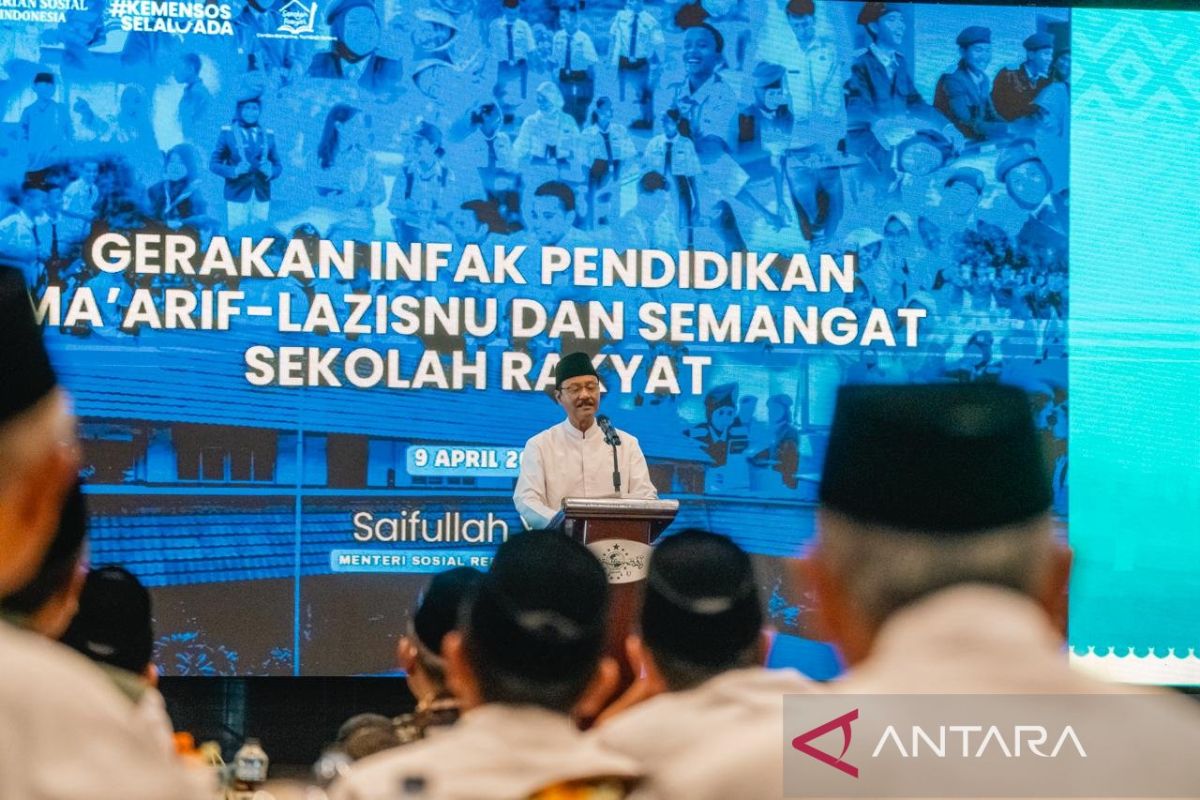
The education infak movement represents a tangible step towards building national self-reliance. Jakarta (ANTARA) - The Ministry of Social Affairs is promoting the strengthening of the community-based mutual cooperation education infak movement as a concrete solution for underprivileged families to escape the clutches of poverty, in line with the spirit of the Sekolah Rakyat programme initiated by President Prabowo Subianto. “Education is the path to breaking the chain of material poverty. The education infak movement is a tangible step towards building national self-reliance,” said Social Affairs Minister Saifullah Yusuf in a statement received in Jakarta on Thursday. This education infak movement also became the main point socialised by Social Affairs Minister Saifullah during the launch of the Nahdlatul Ulama (NU) Cares for Education Programme by PWNU Central Java in collaboration between LP Ma’arif NU PWNU Central Java, LAZISNU PWNU Central Java, and Bank Jateng Syariah. On that occasion, he highlighted data showing that 65 per cent of low-income families are at risk of producing the next generation in similar economic conditions, so the provision of scholarships must be accompanied by ongoing mentoring and evaluation to enable students to become agents of change. “Education infak ultimately builds self-reliance. If they graduate and want to go to university, we find scholarships for them. If they want to become skilled workers, we facilitate training that matches industry needs,” he said. This is in line with the initiative by LAZISNU Central Java with Bank Jateng Syariah in providing digital fund collection services. He views this collaboration positively, as even the smallest contributions from the community will have a significant impact if managed transparently. “Public trust will only grow if it is processed transparently, accountably, and on target. From there, loyalty, a sense of ownership, and collective strength will emerge to safeguard NU’s future,” he said. Sekolah Rakyat is one of President Prabowo Subianto’s priority programmes to provide free and quality education access for children from the lowest welfare level families (Deciles 1-4) in the National Socio-Economic Single Data (DTSEN). This programme is designed as an integrated poverty alleviation model because it combines various flagship government programmes such as Free Health Checks (CKG), Free Nutritious Meals (MBG), PBI-JK health insurance, Red and White Village/Urban Ward Cooperatives, as well as the 3 Million Houses Programme for beneficiary student families. As the technical implementer, the Ministry of Social Affairs reports that there are currently 166 pilot Sekolah Rakyat sites spread across 38 provinces, with a capacity of 15,900 students, supported by 2,400 teachers and more than 4,000 educational personnel at the primary, junior secondary, and senior secondary levels or equivalent.