
Ministry of Religious Affairs Isbat Session: By Hisab Calculation, 1 Ramadan Falls on 19 February
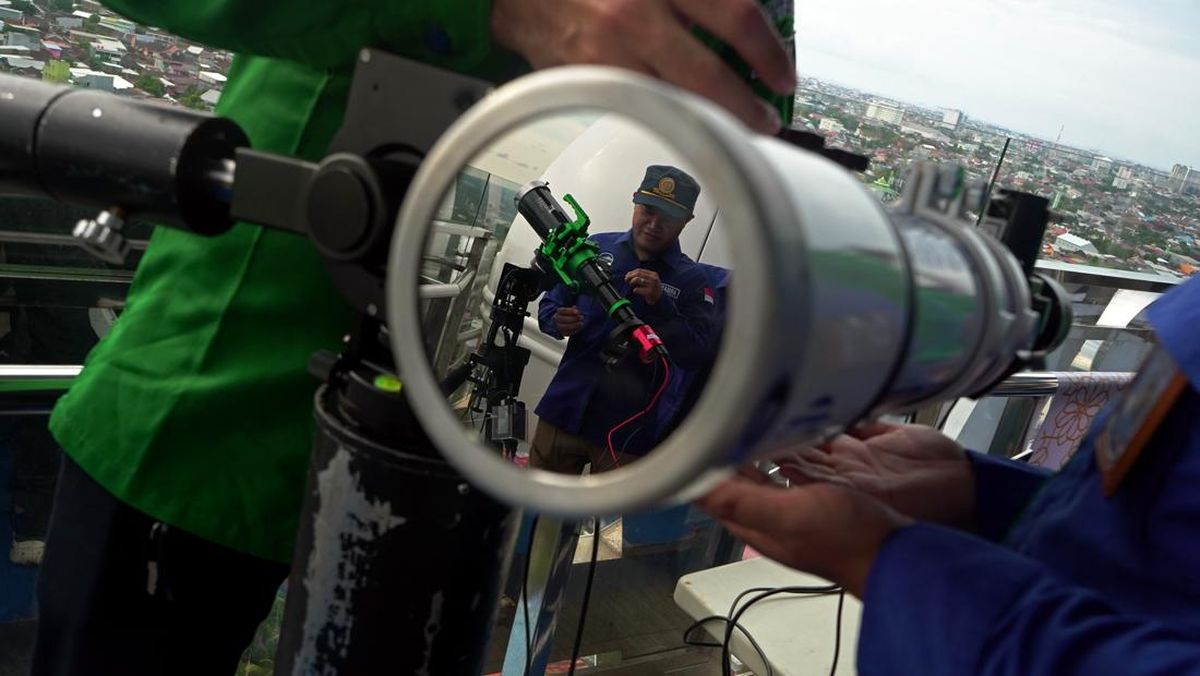
The Ministry of Religious Affairs (Kemenag) has stated that the hilal, or new crescent moon marking the beginning of 1 Ramadan 1447 Hijriah, was not visible anywhere in Indonesia on the afternoon of 17 February. The hilal’s position remained negative, or below the horizon, after sunset.
The hilal’s position did not meet the hilal visibility criteria (imkanur rukyat) used by Indonesia together with fellow MABIMS member states (Brunei Darussalam, Indonesia, Malaysia, and Singapore).
The MABIMS criteria stipulate a minimum hilal altitude of 3 degrees above the horizon at sunset and a minimum elongation (angular distance between the moon and sun) of 6.4 degrees.
“Therefore, 1 Ramadan 1447 Hijriah, according to MABIMS hisab calculation, falls on Thursday, 19 February 2026. This hisab is informative in nature — we require confirmation, and its verification is through rukyat [direct observation], which will of course serve as material for the isbat session ruling this evening,” said Cecep Nurwendaya, a member of the Ministry of Religious Affairs’ Hisab Rukyat Team, during the Isbat Session Seminar at Hotel Borobudur, Jakarta, on Tuesday (17 February).
Cecep explained the illustration of the moon and sun’s positions as observed from Central Jakarta on 17 February, noting that the moon’s daily motion lags behind the sun by approximately 12 degrees per day, or 0.5 degrees per hour.
“Sunset on 17 February 2026 occurs at 18:15:17 Western Indonesian Time, with the crescent moon’s age at 50 seconds — the hilal has not yet been ‘born’ — 45 minutes,” he said.
On the same day, sunrise occurred at 05:58 Western Indonesian Time. Meanwhile, the ijtimak — the position at which the Earth, moon, and sun align on the same astronomical longitude — took place on 17 February at 19:01, with the hilal’s age at zero hours.
Indonesia will determine 1 Ramadan 1447 through the isbat session. The determination of the hilal for the beginning of Hijriah months, including Ramadan, can be carried out through two methods: the hisab method, based on mathematical calculation, and the rukyat method, based on direct observation. The reference altitude of the hilal can also influence when Ramadan begins.
Hisab uses numerical-mathematical calculations to determine the start of Hijriah months without factual verification or hilal observation. Through hisab, Muslims can calculate the geometric positions of celestial bodies to determine scheduling on Earth, including for the lunar months associated with worship.
Rukyat, meanwhile, is a monitoring method involving direct observation of the hilal.
The Government, through the Ministry of Religious Affairs, held the isbat session for hilal observation for 1 Ramadan on the afternoon of 17 February. Religious Affairs Minister Nasaruddin Umar was to announce the results of the session.
Meanwhile, the Muhammadiyah Central Executive Board (PP Muhammadiyah) had already determined well in advance that 1 Ramadan would fall on Wednesday, 18 February 2026.
Muhammadiyah Central Executive Board Chairman Haedar Nashir urged Muslims to respond wisely and with tolerance should differences arise over the start of fasting for 1 Ramadan 1447 Hijriah.
“This is a space for ijtihad [independent reasoning], so there is certainly no need to blame one another, and no one should feel that they alone are correct,” Haedar said on Tuesday (17 February).