
Ministry of Religion and PITI Sign MoU for Procurement of Chinese-Illuminated Qurans
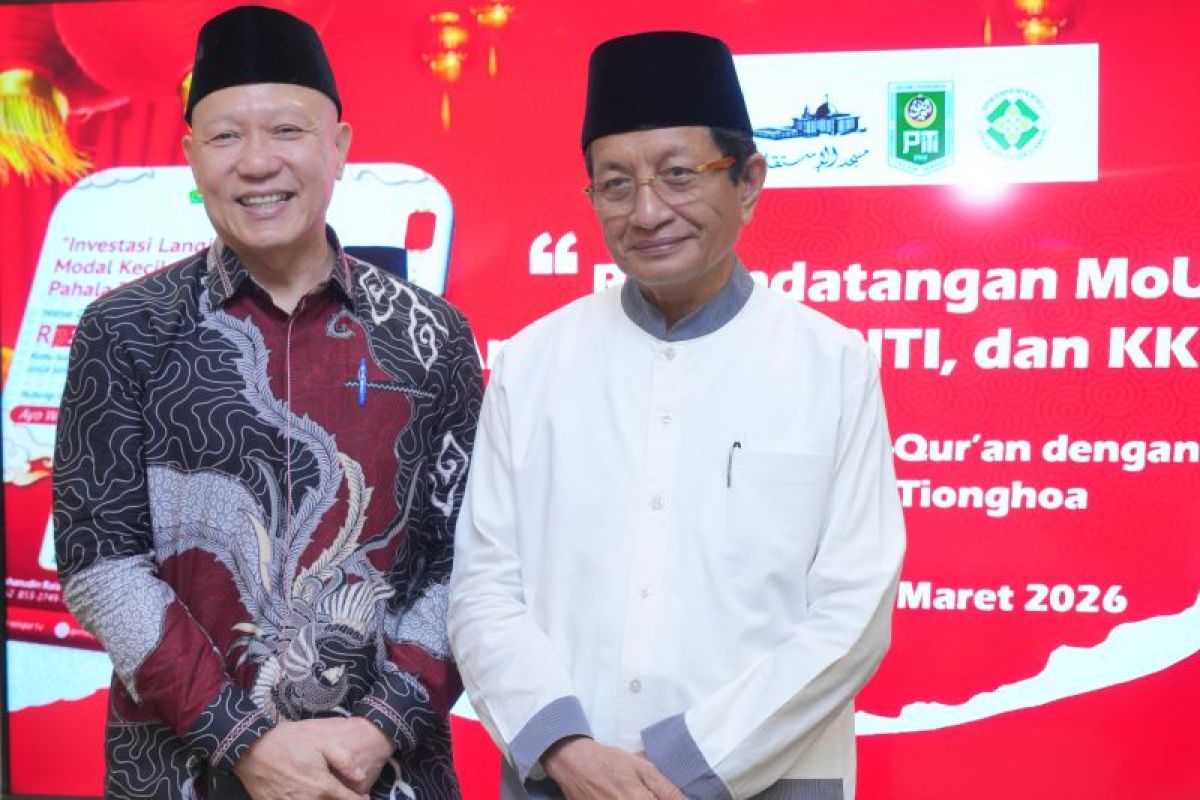
Jakarta – The Ministry of Religion and the Chinese Muslim Association of Indonesia (PITI) signed a Memorandum of Understanding (MoU) for the procurement of 100,000 Chinese-Illuminated Qurans at Istiqlal Mosque in Jakarta on Monday.
The MoU was signed directly by the Chairman of the Chinese Muslim Association of Indonesia (PITI) Serian Wijatno and the Indonesian Minister of Religion Nasaruddin Umar.
The Minister viewed the initiative not merely as the provision of a sacred text, but as a powerful symbol of harmony and the richness of Islamic artistic culture that flourishes throughout the archipelago. The collaborative effort also aims to strengthen national unity through an inclusive cultural approach. The Qurans feature decorative illumination with distinctive Chinese motifs on the page borders.
“Differences are not meant to be contested, but to embellish life. Indonesia is a beautiful painting of God that we must care for together,” he stated.
The Chinese motif touches are purely in the illumination aspect (decorative art). Illumination is the visual art on page borders and decorative elements. Meanwhile, the sacred verse text remains protected according to tashih standards and undergoes no modification to the teachings whatsoever.
PITI Chairman Serian Wijatno said the MoU marks concrete collaboration in strengthening Islamic brotherhood (ukhuwah islamiyah) and national brotherhood (ukhuwah wathaniyah), as well as evidence of the strength of historical acculturation between Islam and Chinese culture.
Furthermore, the procurement of Qurans with distinctive Chinese illumination art is viewed as concrete proof that Islam is Rahmatan lil ’Alamin – a mercy for all worlds – capable of standing in harmony with the richness of Nusantara culture.
Serian explained that the presence of Qurans with Chinese illumination design is not merely artistic innovation, but a reflection of deep history where the relationship between Islam and the Chinese ethnic community has been strongly established for centuries, long before Indonesian independence.
“The existence of Qurans with Chinese illumination design completes the long narrative of Islam from the era of Admiral Cheng Ho to the spread of Islam on the Nusantara coast, where a process of peaceful acculturation occurred. Islam does not erase cultural identity; rather, it enriches it,” Serian said.
The illumination on these Qurans displays a blend of distinctive Chinese ornaments, such as cloud motifs (megamendung), lotus flowers, and the combination of red and gold colours that harmoniously blend with Arabic calligraphy standards. This proves that Chinese aesthetics has become an integral part of the mosaic of Islamic culture in Indonesia.
“The collaboration between PITI, the Ministry of Religion, and Istiqlal Mosque in procuring Chinese-Illuminated Qurans is a tangible manifestation of cultural and religious harmony,” said Serian, who is also Treasurer General of the Central Council of Indonesian Mosques (DMI).