
Ministry of Primary and Secondary Education Revitalises Vocational Schools and Promotes Deep Digital Learning
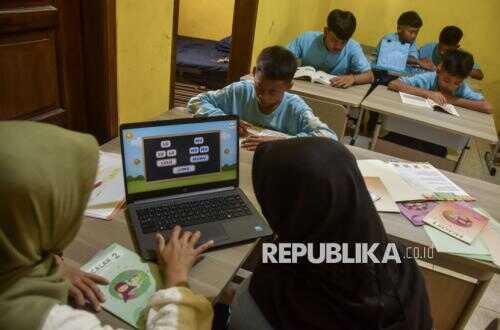
JAKARTA — The Ministry of Primary and Secondary Education (Kemendikdasmen) has adopted the Educational Unit Revitalisation and Learning Digitalisation Programme as a major strategy to improve educational access and quality across Indonesia.
“This programme is a major strategy to enhance equitable access and quality, in order to prepare a competent and competitive generation,” said Director General of Vocational Education, Special Education, and Special Services Education at Kemendikdasmen, Tatang Muttaqin, in Jakarta on Wednesday.
Since 2025, the revitalisation programme has been implemented nationally, including across eastern Indonesia (KTI). A total of 389 vocational schools in Sulawesi, Nusa Tenggara, Maluku, and Papua have received phased interventions with a combined budget exceeding 649 billion rupiah.
The programme addresses not only physical infrastructure improvements—such as student practice rooms, classrooms, sanitation facilities, and supporting amenities—but also tackles serious challenges in eastern Indonesia, including limited facilities, inadequate building conditions, difficult geography, restricted transportation, and extreme weather. The objective is to create schools that are safe, comfortable, and capable of supporting quality teaching and learning.
In parallel, the Learning Digitalisation Programme has reached 1,972 vocational schools in the same region through the distribution of Interactive Flat Panels (IFP). This technology transforms learning into more interactive, contextual, and deep experiences, enabling students to access broader learning resources and participate actively.
The principal of SMK Gotong Royong Tobelo in North Halmahera, North Maluku, Petronela Baranyanan, reported significant changes at her school. “Initially, learning was teacher-centred. After the IFP arrived, students became more enthusiastic about exploring topics, presenting results, and engaging in group discussions. They could create visuals directly on the IFP, making learning more vibrant and contextual,” she said.
A similar approach is being applied through the concept of Deep Learning, which emphasises meaningful understanding rather than mere memorisation. Deputy Minister of Primary and Secondary Education Atip Latipulhayat emphasised that deep learning provides information whilst inspiring students, enabling them to contextualise material effectively.