
Ministry of Population and Family Development Integrates Family Strengthening into AI Learning Joint Decision
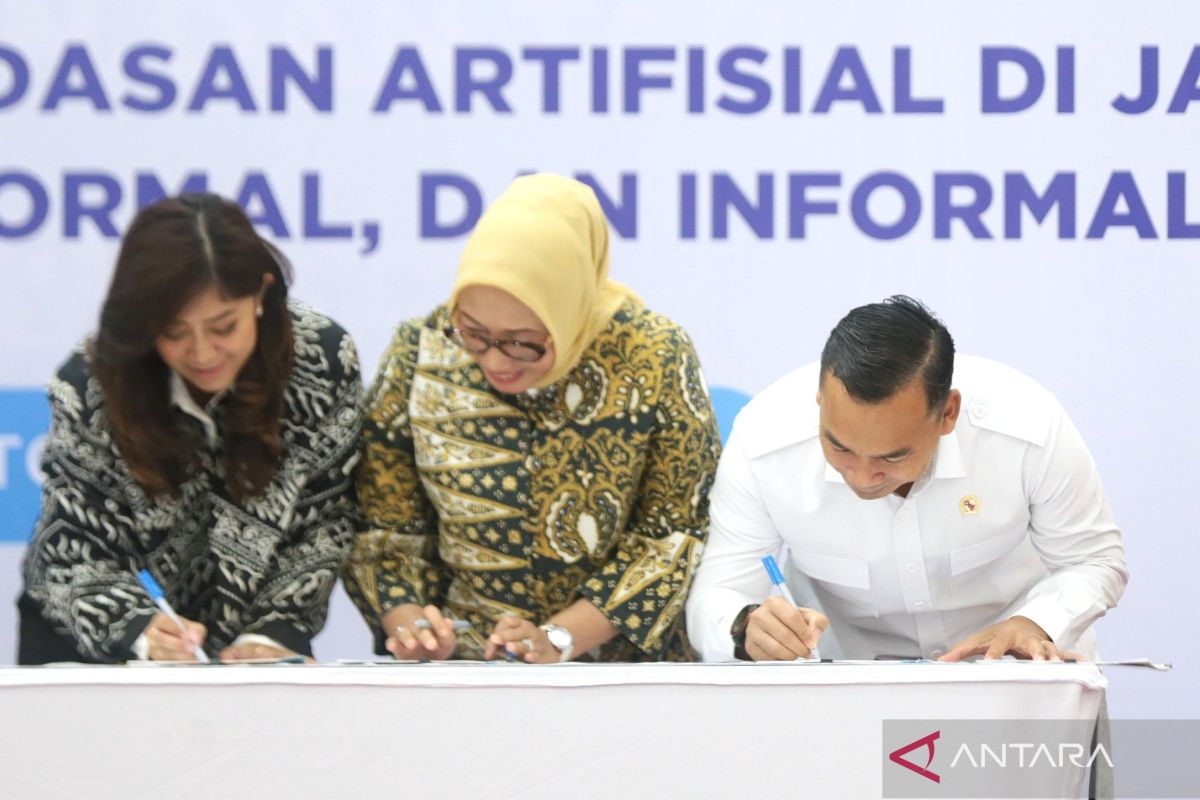
Jakarta — Indonesia’s Ministry of Population and Family Development (Kemendukbangga)/National Population and Family Planning Board (BKKBN) has committed to integrating family strengthening into a Joint Decision Letter (SKB) regarding Guidelines for the Utilisation and Learning of Digital Technology and Artificial Intelligence (AI) across Formal, Non-formal, and Informal Education.
Wihaji, Kemendukbangga/Head of BKKBN, signed the joint decision with six relevant ministers at the Office of the Coordinating Ministry for Human Development and Culture (Kemenko PMK) on Thursday, 12 March, stating that Kemendukbangga/BKKBN holds several responsibilities, including implementing family function strengthening based on life cycles in the ethical, safe, prudent, and responsible utilisation of digital technology and artificial intelligence to support childcare quality and family resilience.
Wihaji added that Kemendukbangga/BKKBN will also conduct advocacy, socialisation, and cross-sectoral coordination to strengthen family function in implementing the joint decision across all education pathways within its authority. The ministry will coordinate communication, information, and education to encourage families to engage in quality activities routinely as spaces for interaction, communication, and strengthening family function. It will also supervise and evaluate the implementation of family function strengthening aspects in the joint decision’s implementation.
“Kemendukbangga/BKKBN will also coordinate with ministries and regional governments to ensure the integration of family capacity strengthening in implementing this joint decision, and encourage synergy between educational units and families in supporting ethical, safe, prudent, and responsible digital behaviour among children,” Wihaji said.
The Kemendukbangga/Head of BKKBN signed the joint decision alongside the Ministers of Home Affairs, Religious Affairs, Basic and Secondary Education, Higher Education, Science and Technology, Communication and Digital Affairs, and Women’s Empowerment and Child Protection.
Coordinating Minister for Human Development and Culture Pratikno emphasised that the joint decision does not aim to hinder AI use, but rather to mitigate potential technology risks that may emerge in learning.
“This joint decision from seven ministers represents a commitment to creating a generation that is wise and digitally literate, using artificial intelligence,” said Pratikno.
Pratikno noted that regulation in schools alone is insufficient, requiring parental oversight, as the family is children’s first line of defence. The role of parents becomes crucial and must be strengthened, not merely through supervision but also by being active companions and mentors when children use technology and AI.
According to data from the Central Statistics Agency (BPS) in 2023, mobile phone ownership among the 15-24 age group in Indonesia reached 92.14 per cent. BPS data from 2024 also showed that 35.57 per cent of children aged 0-6 years have been exposed to the internet.
Meanwhile, a 2023 report by the United Nations Children’s Fund (UNICEF) indicated that 50.3 per cent of children in Indonesia have encountered sexual content, and 48 per cent of them have experienced cyberbullying.