
Ministry of Marine Affairs: Kebumen Shrimp Farm Production Surges to 358.97 Tonnes
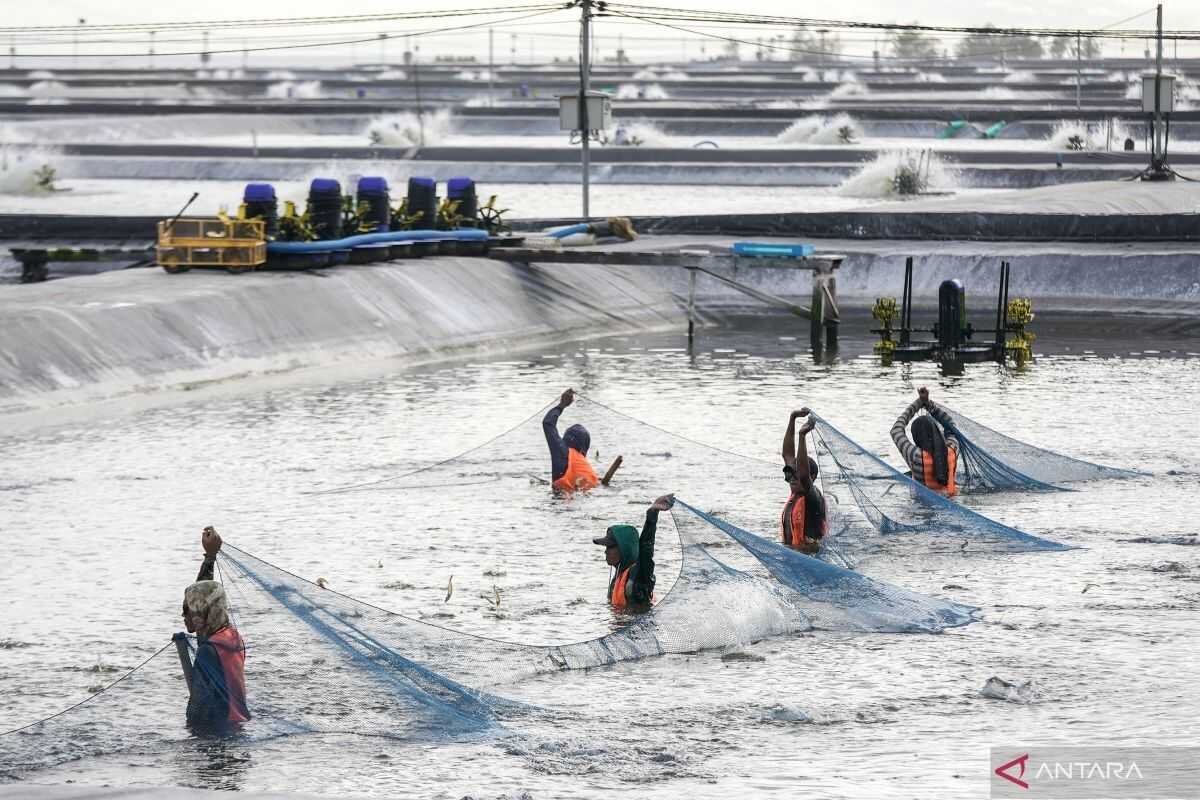
Jakarta (ANTARA) — The Ministry of Marine Affairs and Fisheries (KKP) has recorded a surge in production at the area-based shrimp aquaculture model farm (BUBK) in Kebumen Regency, Central Java, reaching 358.97 tonnes in 2025 as it enters its seventh cultivation cycle in early 2026.
KKP Director General of Aquaculture Tb Haeru Rahayu said the production increase demonstrates the effectiveness of the area-based aquaculture system implemented by the government.
“The management transition has gone well and has not disrupted production activities. In fact, farm operations are being continuously strengthened to achieve greater optimisation,” Haeru said in a statement in Jakarta on Tuesday.
KKP data show that Kebumen BUBK production stood at 200.19 tonnes in 2023 and 193.29 tonnes in 2024. In 2025, production surged significantly to 358.97 tonnes.
Entering February 2026, the KKP, through the Jepara Centre for Brackish Water Aquaculture (BBPBAP) in Central Java, resumed stocking vannamei shrimp fry, marking the start of the seventh cultivation cycle.
Haeru explained that management of the Kebumen BUBK was transferred from the Karawang Aquaculture Production Service Centre (BLUPPB) in West Java to BBPBAP Jepara to maintain efficiency and production continuity.
The change in management was carried out after BLUPPB Karawang was assigned additional duties managing the saline tilapia aquaculture model, whose area expanded from 84 hectares to 314 hectares since August 2025.
Beyond the production increase, Haeru emphasised that shrimp produced at the Kebumen BUBK are free from antibiotic residues, as the entire cultivation process strictly applies Good Aquaculture Practice (CBIB) principles.
“With the application of CBIB to standard, we are optimistic that Kebumen BUBK production and productivity will continue to increase over time until optimal production is achieved,” he said.
The Kebumen BUBK area manages approximately 65 hectares of farm land, of which 23.5 hectares constitute active production land divided into 16 clusters.
From an economic perspective, Kebumen BUBK operations also contribute to the regency’s locally generated revenue (PAD) through payment of aquaculture fish auction facility (TPI) levies. In 2024, the PAD contribution was recorded at Rp259 million, rising to Rp489 million in 2025.
According to the KKP, the Kebumen BUBK has absorbed 142 permanent local workers from surrounding villages as well as more than 100 casual daily labourers, whilst also stimulating supporting economic activities such as grocery stalls, farm supply shops, restaurants, and increased accommodation occupancy.
Minister of Marine Affairs and Fisheries Sakti Wahyu Trenggono previously stated that the development of the Kebumen BUBK model is part of the implementation of the KKP’s blue economy programme, serving as a shrimp aquaculture pilot that balances ecological, economic, and social aspects.