
Ministry of Marine Affairs and Fisheries Establishes Seagrass Emissions Database for Climate Change Mitigation
JAKARTA – The Ministry of Marine Affairs and Fisheries (KKP) is establishing a baseline for greenhouse gas emissions (GRK) from seagrass ecosystems to strengthen national blue carbon governance and enhance the marine sector’s contribution to climate change mitigation. This baseline will serve as a scientific foundation for measuring the role of coastal ecosystems in absorbing and releasing emissions.
The baseline was discussed at a Technical Workshop on Seagrass GRK Baseline Consensus and Emissions Data Management for the Marine and Fisheries Sector held recently in Jakarta. The forum brought together ministries, agencies, academics, and various partners to agree on baseline calculation methodology and strengthen the marine sector’s emissions data system.
The Director General of Marine Management Koswara stated that establishing a seagrass emissions baseline is a foundational step in strengthening national blue carbon management. According to him, this emissions baseline compilation will provide the basis for formulating climate change mitigation policies in the marine sector.
“This data will be a critical foundation for formulating climate change mitigation policies in the marine and fisheries sector whilst supporting achievement of the national emissions reduction target,” Koswara said in a written statement in Jakarta on Thursday (12 March 2026).
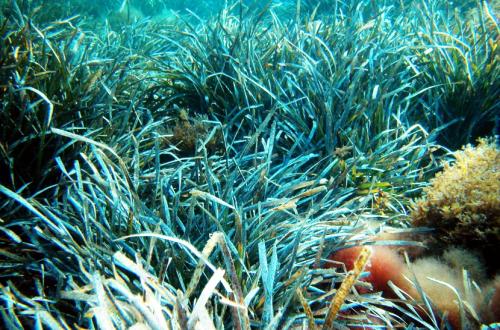
Seagrass ecosystems are an important component of coastal ecosystems capable of absorbing and storing carbon in large quantities. Together with mangroves and coral reefs, these coastal ecosystems form part of a nature-based climate mitigation strategy known as blue carbon.
The emissions baseline is being established to determine the initial condition of carbon reserves and potential emissions arising from changes or disturbances to seagrass ecosystems. This information will serve as the basis for developing emissions reduction scenarios and strengthening sustainable coastal ecosystem management policies.
The Director of Ecosystem Conservation Firdaus Agung stated that strengthening methodology and emissions data management for the marine sector is an important step to support sustainable marine development. According to him, the seagrass emissions baseline methodology is expected to make the marine sector’s emissions data system more integrated and credible.
“The development of methodology in establishing seagrass emissions baseline is expected to strengthen the management of emissions data for the marine and fisheries sector to make it more integrated and credible, whilst supporting the contribution of coastal ecosystems to the climate mitigation agenda,” Firdaus said.
Climate change expert from IPB University Rizaldi Boer assessed that a scientific approach to establishing the seagrass emissions baseline is important so that the marine sector’s contribution to climate change mitigation can be measured accurately.
The workshop also emphasised the importance of strengthening an integrated emissions data system for the marine and fisheries sector to support reporting, monitoring, and evaluation of the marine sector’s contribution to climate change mitigation in a transparent and accountable manner.
The GRK emissions baseline from seagrass ecosystems will form the foundation for developing a blue carbon system for the marine and fisheries sector. Going forward, this system will be strengthened through improved quality of activity data, development of more specific national emissions factors, and field verification to reduce data uncertainty.
As part of implementing blue economy policy, the KKP continues to promote protection of coastal ecosystems such as seagrass, mangroves, and coral reefs. The Minister of Marine Affairs and Fisheries Sakti Wahyu Trenggono previously stressed that protection of coastal ecosystems is a long-term investment for food security, climate change mitigation, and the welfare of coastal communities.