
Ministry of Hajj Inspectorate Closely Monitors All Stages of Hajj Implementation
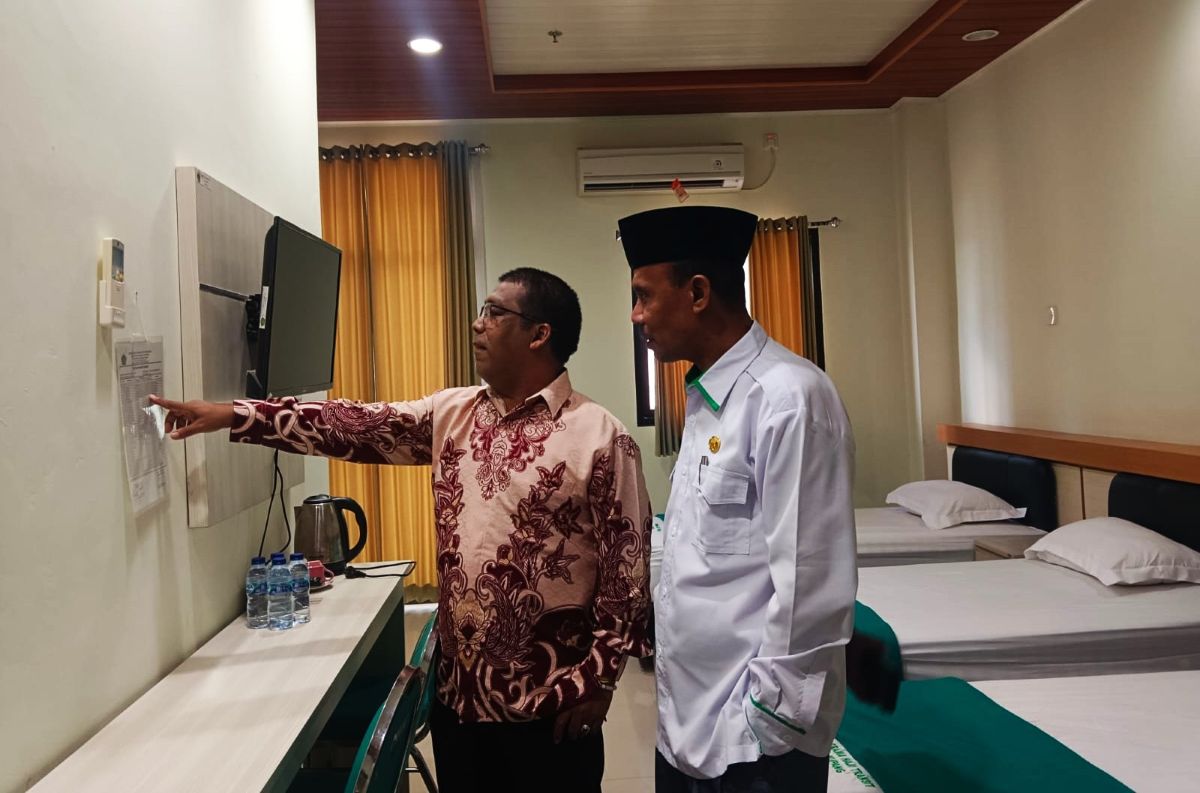
The Inspectorate General (Itjen) of the Ministry of Hajj and Umrah (Kemenhaj) is closely monitoring all stages of the Hajj implementation to ensure it proceeds successfully and provides comfort to the pilgrims.
This was stated by the Regional Inspector III of the Ministry of Hajj and Umrah, Mulyadi Nurdin, during his inspection of the Hajj Dormitory in Kupang, East Nusa Tenggara, on Monday (30/3).
Mulyadi Nurdin explained that the Inspectorate has been mandated by law to conduct oversight in the Hajj and Umrah implementation process. According to him, President Prabowo Subianto wants future Hajj implementations to be better than before, and the Ministry of Hajj and Umrah institution must be integrous and competent.
The organisation of the Hajj pilgrimage is a major mandate of the state concerning the nation’s honour, the trust of the ummah, and Indonesia’s prestige in the eyes of the international community. Therefore, all aspects related to Hajj services will be seriously monitored by the Inspectorate General, including the performance of committees, officers, and teams entrusted with carrying out Hajj and Umrah services.
“Supervision is carried out on all aspects of services, both domestically and abroad in Saudi Arabia, covering all types of services provided to Hajj pilgrims,” said the alumnus of the Indonesian National Defence Institute.
He added that the scope of domestic supervision includes planning, implementation, and reporting of service activities, including those at Hajj dormitories.
“The Hajj dormitory, as the initial gateway for pilgrims’ departure, plays an important role in the success of the Hajj pilgrimage, therefore it is our focus in overseeing to ensure everything runs according to the government’s plan,” added the alumnus of Al-Azhar University in Egypt.
Meanwhile, the aspects of overseas supervision cover all services in Saudi Arabia, namely transportation, accommodation, catering, as well as services in Arafah, Muzdalifah, and Mina. For this reason, Mulyadi Nurdin hopes that all involved parties commit to the success of the Hajj and provide the best services for the pilgrims.
He also quoted explanations from the Minister of Hajj and Umrah, Gus Irfan Yusuf, and Deputy Minister Dahnil Anzar Simanjuntak, that the government gives no tolerance or zero tolerance towards manipulation, deviation, and misuse.
In addition, officers are urged not to appear as “Hajj freeloaders”, but to be serious and sincere in serving the pilgrims. Furthermore, Regional Inspector III, Mulyadi Nurdin, also monitored the readiness of Hajj officers in providing services to the pilgrims.
According to him, Hajj officers are the spearhead and the government’s extension in providing direct services to pilgrims during Hajj operations. “Everyone must commit and work sincerely. Hajj officers must work under one command, one team, and set aside sectoral egos,” he said.
He emphasised that all preparations must be carried out seriously and not taken lightly, because officers and Hajj pilgrims are a reflection of the Indonesian nation in Saudi Arabia. His hope is that this year’s Hajj implementation runs smoothly, safely, comfortably, orderly, blessed, and leaves no issues.
Meanwhile, the Acting Head of the NTT Regional Office of the Ministry of Hajj and Umrah, Hasan Manuk, explained that the mechanism for departing Hajj pilgrims from NTT this year has undergone several adjustments.
The departure process is usually prepared about three to four days before the flight schedule. The pilgrims will enter the Hajj dormitory and stay one to two nights before being sent to Surabaya. In Surabaya, the pilgrims will also stay one night while waiting for their turn to board the flight cluster to Saudi Arabia.
“Usually, the local government facilitates the departure of pilgrims from their respective regions,” he said.
This year, the number of Hajj pilgrims from NTT is recorded at 516 people, a decrease from the previous 668 people. With the new cluster system, the distribution is around one and a half clusters.
For the departure schedule, it is planned to begin on 11 May, with a total departure period of about 12 days. The farewell and reception of pilgrims is generally carried out by the governor or deputy governor.
Hasan explained that all pilgrims will later gather in Surabaya before departing to Saudi Arabia. However, there is a change in the departure scheme, particularly for pilgrims from central and western Flores regions. “Pilgrims from those areas no longer go through Kupang, but fly directly to Surabaya, because it is more efficient in terms of cost. If through Kupang, the cost can be twice as expensive,” he clarified.
The airlines used for domestic flights to Surabaya include Lion Air and Batik Air, while from some regions, Wings Air is also used to go to Kupang first. Meanwhile, flights to Saudi Arabia use different aircraft.
He also detailed that there are eight regencies, including from the Sumba region and central and western Flores such as Ngada, East Manggarai, Manggarai, and West Manggarai, whose pilgrims go directly to Surabaya without transiting in Kupang.
Meanwhile, pilgrims from 14 other regencies and cities still enter the Hajj dormitory in Kupang before being departed. “About 60 percent of pilgrims now transit directly to Surabaya, while the rest still go through Kupang,” he added.
During the visit, Regional Inspector III also inspected all facilities at the Kupang Hajj Dormitory, starting from the secretariat room, an auditorium that can accommodate around 1,200 people, a three-storey accommodation building with 42 rooms each occupied by four people, to several rooms in other buildings with a capacity of two to three people per room.
In addition, the facilities available in each room were checked to ensure all supporting facilities are sufficient and functioning well.