
Ministry of Forestry develops Komodo conservation strategy until 2035
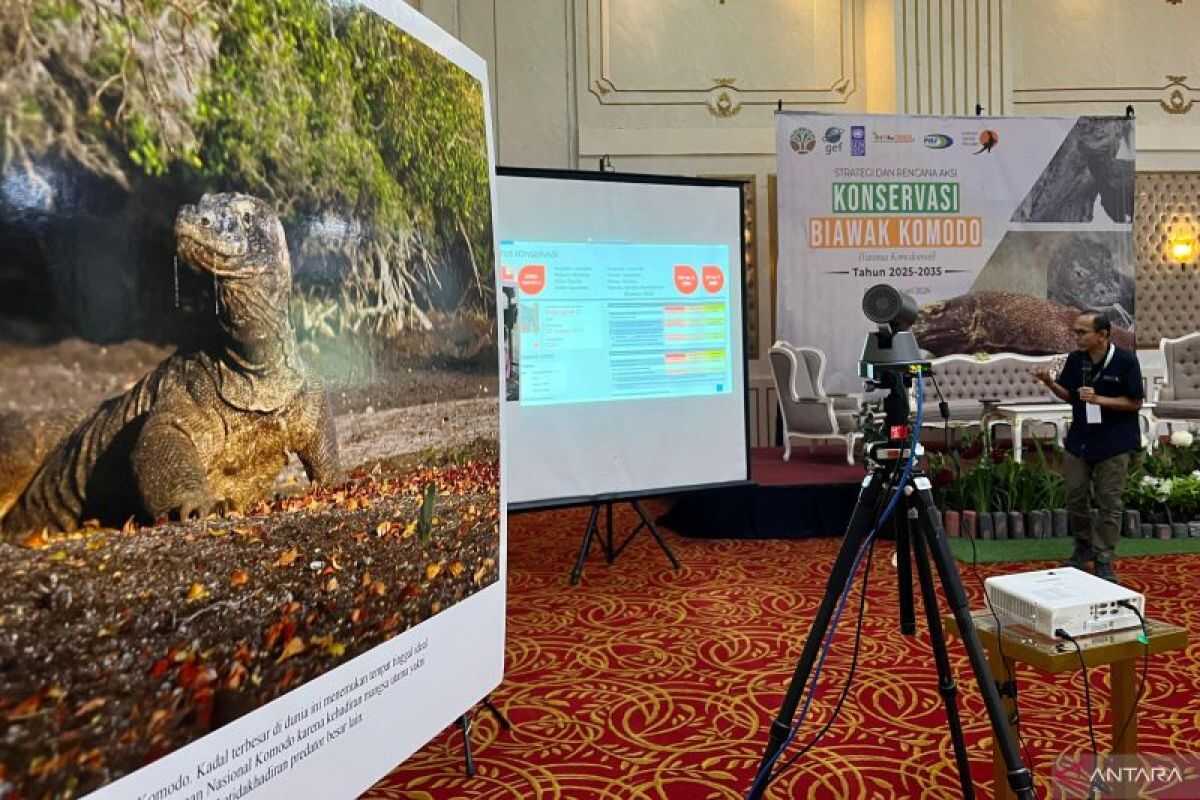
Bogor City (ANTARA) - The Ministry of Forestry is developing a Conservation Strategy and Action Plan (SRAK) for Komodo dragons as a national guideline for the protection of this Indonesian endemic species until 2035, in order to maintain the sustainability of its population and habitat in the wild.
The Director of Species and Genetic Conservation at the Ministry of Forestry, Ahmad Munawir, said that the preparation of the SRAK document is an urgent step because the Komodo dragon is an endemic species found only in Indonesia, particularly in the province of East Nusa Tenggara (NTT).
“This Komodo conservation is very urgent for all of us, including the central government, local government, the private sector, NGOs, and the community,” said Ahmad Munawir during a socialisation and dissemination event for the Komodo SRAK in Bogor City, West Java, on Thursday.
He explained that although the Komodo population in Komodo National Park is currently relatively stable, the species is still classified as endangered in the IUCN Red List, so protection efforts must continue to be strengthened.
Ahmad said that the Komodo population in Komodo National Park is currently estimated at around 3,200 individuals, based on the latest estimates, with a variation range of about 371 individuals. Meanwhile, the population outside the national park area is estimated at around 700 individuals, spread across the northern and western regions of Flores Island.
He said that the Komodo SRAK document will be valid for 10 years, from its signing in 2025 to 2035, and is being prepared through collaboration between various parties, including the Ministry of Forestry, non-governmental organisations, and conservation institutions such as the Komodo Survival Program (KSP).
“The main goal is, of course, to maintain and preserve the Komodo dragon population. In this document, there are four main programs, strategic activities, and action plans,” he said.
According to him, this condition requires support from various parties so that the Komodo habitat does not continue to shrink due to the pressure of human activities, including the development of tourism in several areas.
“If there is no mitigation or strengthening of space, it is feared that the habitat will continue to decline, population pockets will become smaller, and connectivity will decrease,” said Deni.
He said that a social approach to the community around the habitat is the key to the success of conservation, given that some residents are still sensitive to the term conservation, even though many have lived side by side with Komodo dragons for generations.