
Ministry of Environment and Forestry Reaffirms Commitment to Sustainable Forest Management
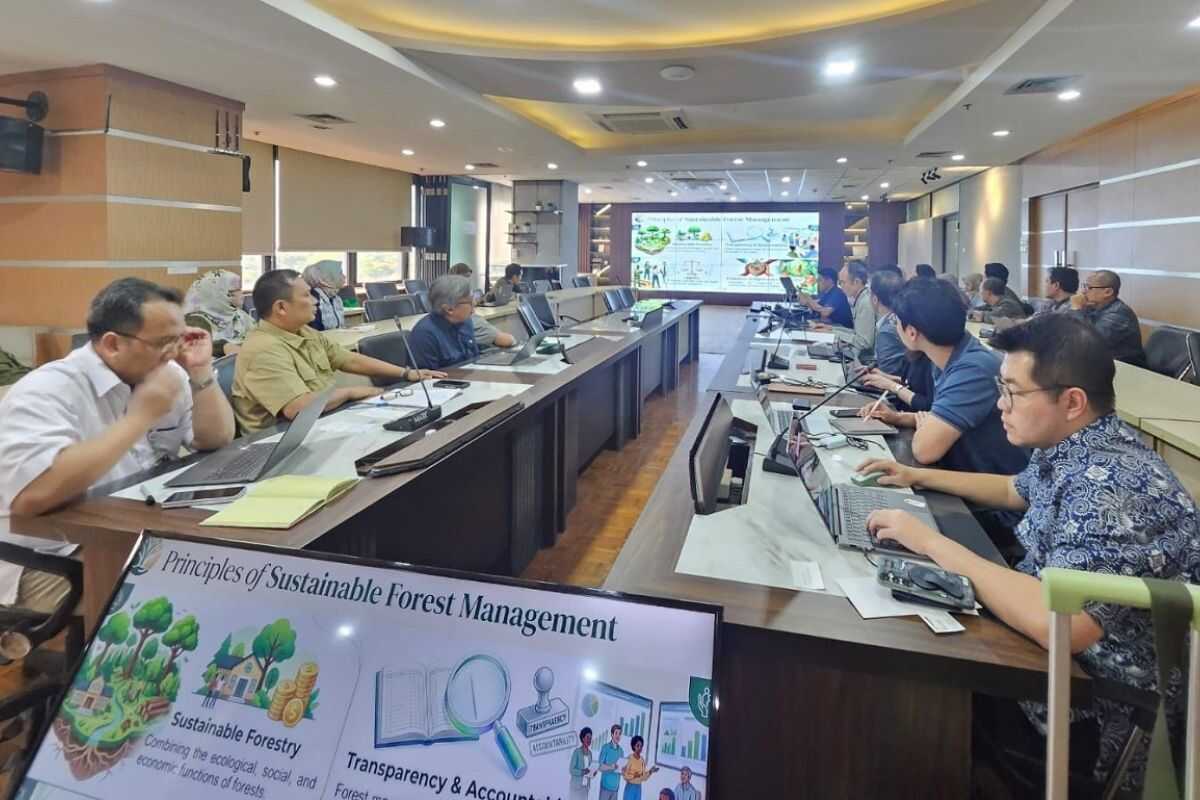
The Ministry of Environment and Forestry in Indonesia reaffirmed the government’s commitment to sustainable forest management, emphasising that forest management is conducted with due regard to ecological, social, and economic factors. ‘Therefore, we pay close attention to the issues raised by the European Union Deforestation Regulation (EUDR), as well as issues of feasibility, legality, and sustainability. These are the principles we hold in forest governance,’ said Ade Mukadi, Director of the Directorate for Processing and Marketing of Forest Products (BPPHH) at the Ministry, in a statement in Jakarta on Friday. He made the remarks while receiving an audience from two Japanese companies, Tokyo Gas Co. Ltd. and Hanwa Co. Ltd., at the Ministry of Environment and Forestry. The two firms are buyers of wood pellets produced by PT Biomasa Jaya Abadi (PT BJA), a company operating in Pohuwato Regency, Gorontalo Province. The audience was arranged following claims by several Non-Governmental Organisations (NGOs) in Japan that the development of the wood pellet industry in Indonesia has caused deforestation. During the meeting, Tokyo Gas and Hanwa asked a number of questions, particularly regarding deforestation control through the implementation of the Annual Work Plan (RKT) for forest utilisation, including aspects relating to biodiversity and the protection of flora and fauna that are rare. The head of the Sub-Directorate for Certification and Marketing of Forest Products at Kemenhut, Tony Rianto, said that forest management in Indonesia is guided by four main principles. First, sustainable forestry that balances ecological, social, and economic functions. Second, transparency and accountability to ensure that forest management can be monitored and accessed by all parties. Third, legality, ensuring that all forestry activities comply with licences and applicable regulations. Fourth, protection of the rights of communities, particularly indigenous peoples and local communities who rely on forests. To guarantee legality and sustainability, Indonesia has established and implemented the Timber Legality and Sustainability Verification System (SVLK). This system is an instrument to ensure that timber products from Indonesia are harvested, transported, processed, and traded from legal and sustainable sources and fully comply with Indonesian law. ‘SVLK covers the entire supply chain of timber products. This comprehensive coverage ensures full traceability from forest to market,’ he said. He explained that verification involves independent verification bodies conducting audits across the upstream, downstream, and market actors. The audit results ensure that products entering domestic or international markets meet legality and sustainability requirements. Ade added that the Ministry of Environment and Forestry continues to refine SVLK policies, especially to meet EUDR demands. Regarding the RKT, he explained, it is an operational planning document mandatory for forestry companies in Indonesia, prepared annually as part of the long-term Business Plan (RKU). This document serves as a tool to control deforestation by limiting logging to areas and volumes that are allowed and ensuring forest sustainability by integrating the utilisation of forest products and ecosystem services. ‘Indonesia is highly committed to environmental preservation, business sustainability, community protection, and protection of flora and fauna,’ Ade said. The audience of Tokyo Gas and Hanwa at the Ministry of Environment and Forestry followed a meeting with the Pohuwato Regency Government on Monday (2/3). In that meeting, Pohuwato Regent Syaiful A. Mbuinga emphasised that PT BJA is an investor that has met all licensing requirements and operates legally under applicable regulations. Additionally, the company has made a significant contribution to the regional economy through job creation that, to date, exceeds 1,500 people and contributes around 9 percent to local economic growth. Investment by PT BJA in Pohuwato Regency has complied with existing regulations. The government consistently conducts strict oversight of investment activities in the region, including those involving PT BJA,’ said Regent Syaiful A. Mbuinga.