
Ministry of Agriculture Prepares Implementing Regulations for Subsidised Fertiliser Management
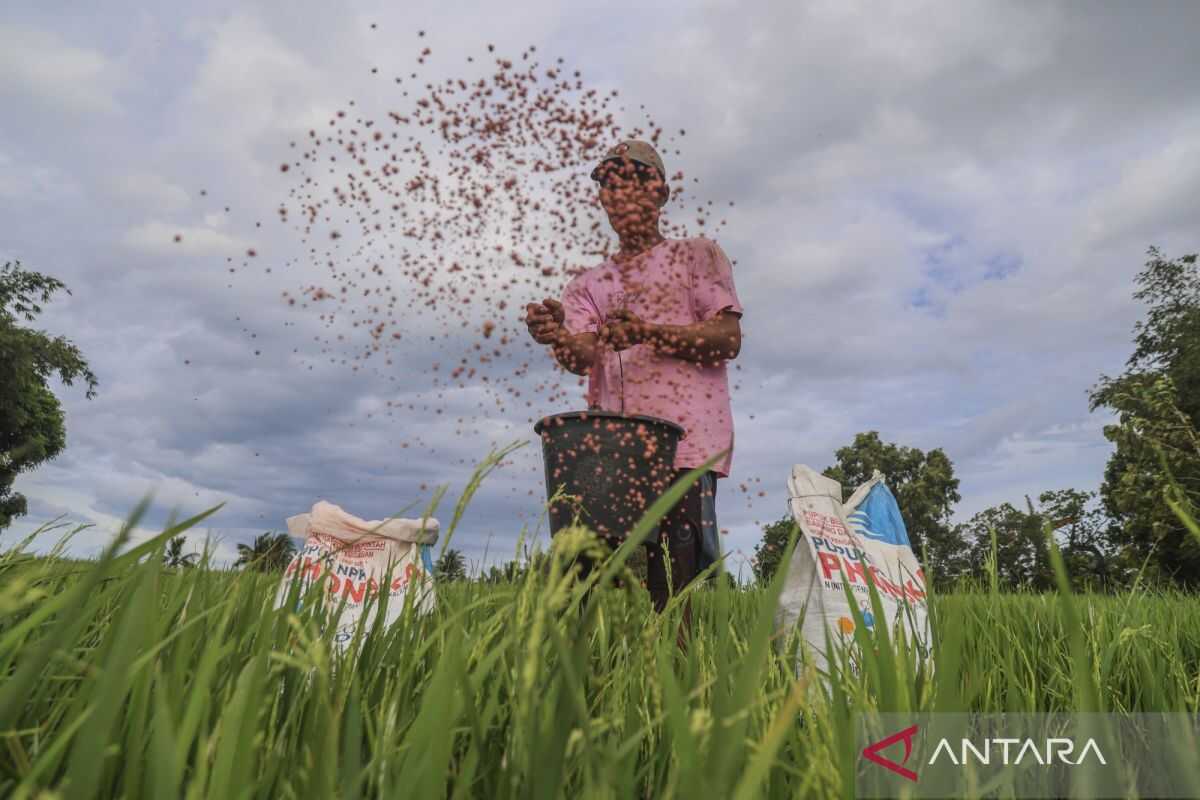
We are continuously refining and improving the management of subsidised fertiliser so that it can be well received by farmers.
Jakarta (ANTARA) – The Ministry of Agriculture is currently preparing implementing regulations for Presidential Regulation (Perpres) No. 113 of 2025, which is a revision of Perpres No. 6 of 2025 concerning the Management of Subsidised Fertiliser.
Head of the Subsidised Fertiliser Section, Directorate of Fertiliser, Directorate General of Infrastructure and Facilities (PSP) of the Ministry of Agriculture, Sry Pujiati, stated that the government has issued regulations regarding subsidised fertiliser, namely Perpres No. 113 of 2025, which will take effect from 1 January 2026.
As a follow-up to the Presidential Regulation, she added in Jakarta on Wednesday, implementing regulations are needed as a basis for the technical implementation of the changes in subsidised fertiliser policy (Ministerial Regulations and Regulations of the Minister of Finance).
The Ministry of Agriculture is currently discussing a Ministerial Regulation as an implementing regulation for Perpres No. 113 of 2025.
“We are continuously refining and improving the management of subsidised fertiliser so that it can be well received by farmers. With these implementing regulations, it is hoped that the scheme for managing subsidised fertiliser will be more perfect and detailed,” she said.
However, she continued during a webinar discussing Perpres No. 113 of 2025, these changes do not alter the redemption of fertiliser, but only the payment scheme for Pupuk Indonesia’s subsidised fertiliser.
“With this new payment mechanism, it is hoped that the fertiliser industry can revitalise its factories and support increased fertiliser production,” she said.
Meanwhile, SVP of Sales Strategy and Customer Service at PT. Pupuk Indonesia, Asep Saepul Muslim, added that since the government improved the management of fertiliser, there has been a positive response from farmers, with fertiliser absorption increasing by 20 per cent from 22 October to the present, and subsidised fertiliser can now be redeemed from 1 January 2026.
Compared to the previous three years, Asep said that fertiliser distribution in 2025 reached 8.11 million tons, or 96.35 per cent of the 8.42 million tons contracted, and 84.99 per cent of the allocation provided by the Ministry of Agriculture.
Professor at the Faculty of Economics and Management, IPB University, A. Faroby Falatehan, assessed that the improvement of Perpres No. 6 of 2025 is to address the results of the evaluation by the Supreme Audit Agency (BPK) regarding the inefficiency of the fertiliser industry, where there have been several problems with fertiliser subsidies.
These include inefficient subsidy management, both in terms of production cost inefficiencies, delays in subsidy payments, and weak supervision and high fiscal burdens.
Similarly, when production costs increase, fertiliser subsidies also increase, which has an impact on prices for farmers, and subsidy payments are delayed until the following year.
He said that the government is improving fertiliser management with Perpres No. 6 of 2025 and further refining it with Perpres No. 113 of 2025.
Meanwhile, Chairman of the West Java Farmers and Fishermen Association (KTNA), Otong Wiranta, assessed that the issuance of Perpres No. 113 of 2025 complements the previous policy and is an innovation in the way of thinking to calculate government and PT. Pupuk Indonesia subsidies, which is very helpful in efficiency because the system for distributing subsidised fertiliser is better.
With the new policy on the management of subsidised fertiliser, there are several benefits for farmers. For example, the allocation of subsidised fertiliser has doubled. If previously it was only around 4 million tons, now it reaches 9 million tons.
The elimination of bureaucratic rules in the distribution of subsidised fertiliser, which used to be complicated, he added, now with the signature of the governor or head of the agricultural department, the fertiliser allocation can be submitted immediately.
“Other benefits include a 20 per cent decrease in the price of subsidised fertiliser, and updates to the e-RDKK (definitive group needs plan) can be done every 4 months, compared to once a year previously,” he said.