
Ministry of Agriculture, Higher Education-Science-Technology Ministry and BRIN strengthen agricultural value chain integration through research collaboration
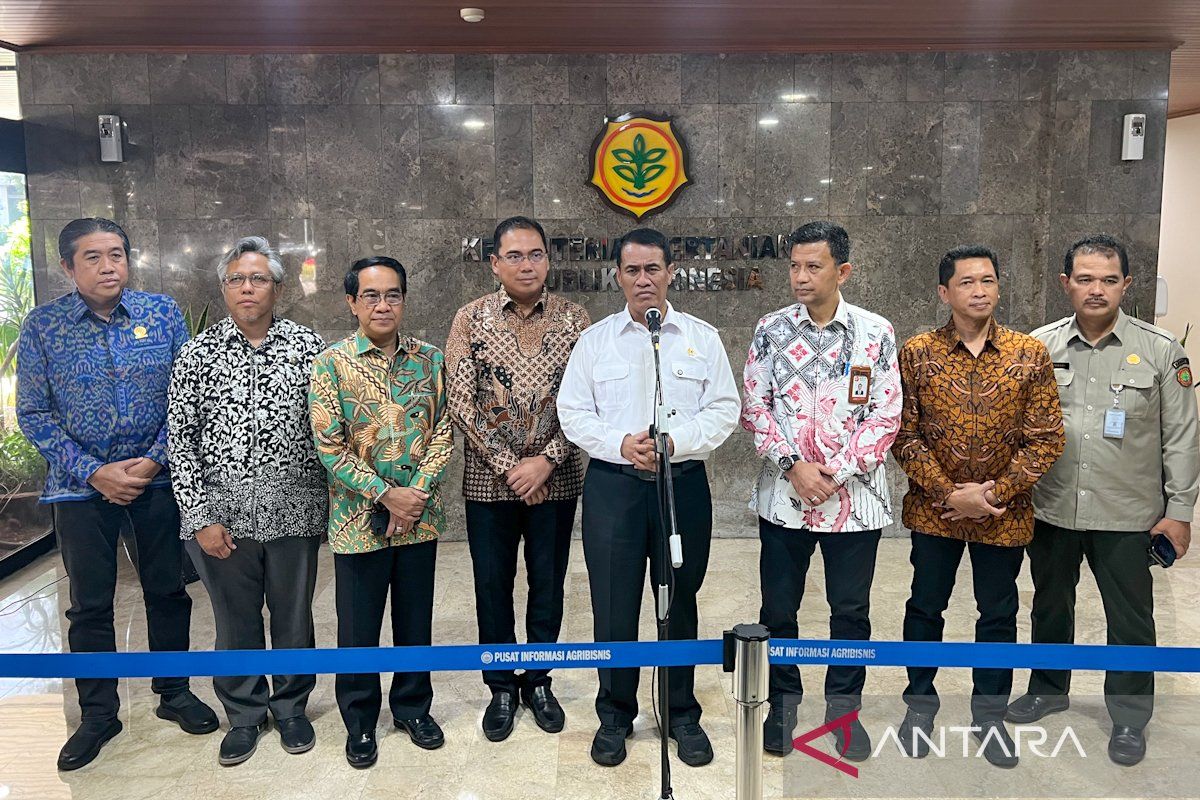
Food agriculture cannot advance without innovation
Jakarta - The Ministry of Agriculture, together with the Ministry of Higher Education, Science and Technology (Kemendiktisaintek) and the National Research and Innovation Agency (BRIN), has forged a research and innovation partnership to strengthen the value chain integration of agricultural commodities and increase the value added of national products.
Agriculture Minister Andi Amran Sulaiman stated that the agricultural sector cannot develop without strong support from research and innovation involving government, academia, and industry to benefit society.
“Food agriculture cannot advance without innovation,” the Minister said following the signing of a joint agreement with Higher Education, Science and Technology Minister Brian Yuliarto and BRIN Head Arif Satria on research and innovation synergy to support sustainable food self-sufficiency and agricultural commodity value chain integration in Jakarta on Thursday.
He conveyed that the agreement represents a strategic step to strengthen collaboration amongst government, research institutions, and universities in generating innovations that can be directly implemented in the agricultural sector whilst promoting the strengthening of industries based on national food commodities.
He emphasised that cooperation amongst government, academia, and industry is vital so that research results do not merely culminate in academic publications but genuinely benefit society.
“There are many excellent studies at universities, but if they are not converted into policy and do not enter industry, they remain only on paper,” said the Minister.
According to him, the synergy between research and policy can produce significant impact on national agricultural development.
He cited various strategic agricultural policies that emerged from ideas and innovations, which the government then translated into regulations and concrete programmes.
“When innovation enters government and is translated into policy, the impact can be very significant for society. This is what we wish to promote together through this collaboration,” he said.
Higher Education, Science and Technology Minister Brian Yuliarto stressed that the collaboration represents an important opportunity for universities to contribute more meaningfully in supporting the national food self-sufficiency programme.
He noted that many research results at universities have thus far failed to penetrate the market owing to insufficient collaboration with industry and government.
“More than 90 per cent, or even nearly 99 per cent, of research results in the academic world fail to enter the commercial market. Therefore, collaboration with government and industry has become extremely important so that innovation can truly be utilised,” he said.
He also stated that his ministry will consolidate universities in Indonesia to focus on developing research on strategic commodities supporting national food self-reliance.
Meanwhile, BRIN Head Arif Satria stated that the agricultural sector constitutes an important foundation for national civilisation and thus requires strong research and technology support.
He said BRIN has prepared a national food research roadmap so that innovation development between research institutions and universities can proceed coherently without overlap.
Currently, BRIN has generated 188 food patents and various innovative products in the food sector ready for industrial use.
“BRIN is ready to support the acceleration of innovation value chain integration in the food sector,” he explained.
The joint agreement amongst the Ministry of Agriculture, Kemendiktisaintek, and BRIN, which was signed, encompasses coordination and synchronisation of research and innovation programmes on various strategic commodities such as rice, corn, soya beans, wheat, sorghum, and garlic.
Subsequently, palm oil, coconut, coffee, cocoa, gambier, pepper, nutmeg, poultry, as well as agricultural machinery and equipment, fertiliser, post-harvest processing, and other commodities supporting sustainable food self-sufficiency and agricultural commodity value chain integration.
Additionally, the cooperation encompasses research, development, agricultural technology engineering, the strengthening of modern agriculture, and the shared utilisation of research facilities and infrastructure.
The agreement, which involves at least 18 universities in Indonesia, also targets improvements in human resource capacity in agriculture, data and information exchange, and the utilisation of research results to accelerate value chain integration and increase the value added of national agricultural commodities.
Through this synergy, the government hopes agricultural innovation and technology can develop more rapidly, strengthen national food self-reliance, and enhance the value added and competitiveness of Indonesian agricultural commodities at the global level.