
Ministry of Agriculture Emphasises Tobacco Commodity's Contribution to State Foreign Exchange
Tobacco: a farmer community crop from regional areas, not merely foreign exchange, but also an economic driver for villages from upstream to downstream production
Jakarta (ANTARA) – The Ministry of Agriculture (Kementan) has emphasised that the tobacco commodity plays an important role in contributing to state foreign exchange and supports government revenue and regional economies in production-centre areas.
Yudi Wahyudi, Head of the Annual Crop Group at the Directorate General of Plantations under Kementan, stressed that tobacco is not merely an ordinary commodity; beyond generating foreign exchange, the sector also serves as a driver of rural economic growth.
“In terms of state revenue, the contribution from tobacco product excise tax can reach approximately 280 trillion rupiah. Tobacco is a farmer community crop from regional areas, not just about foreign exchange, but also an economic driver for villages from upstream to downstream,” said Yudi during a statement in Jakarta on Saturday.
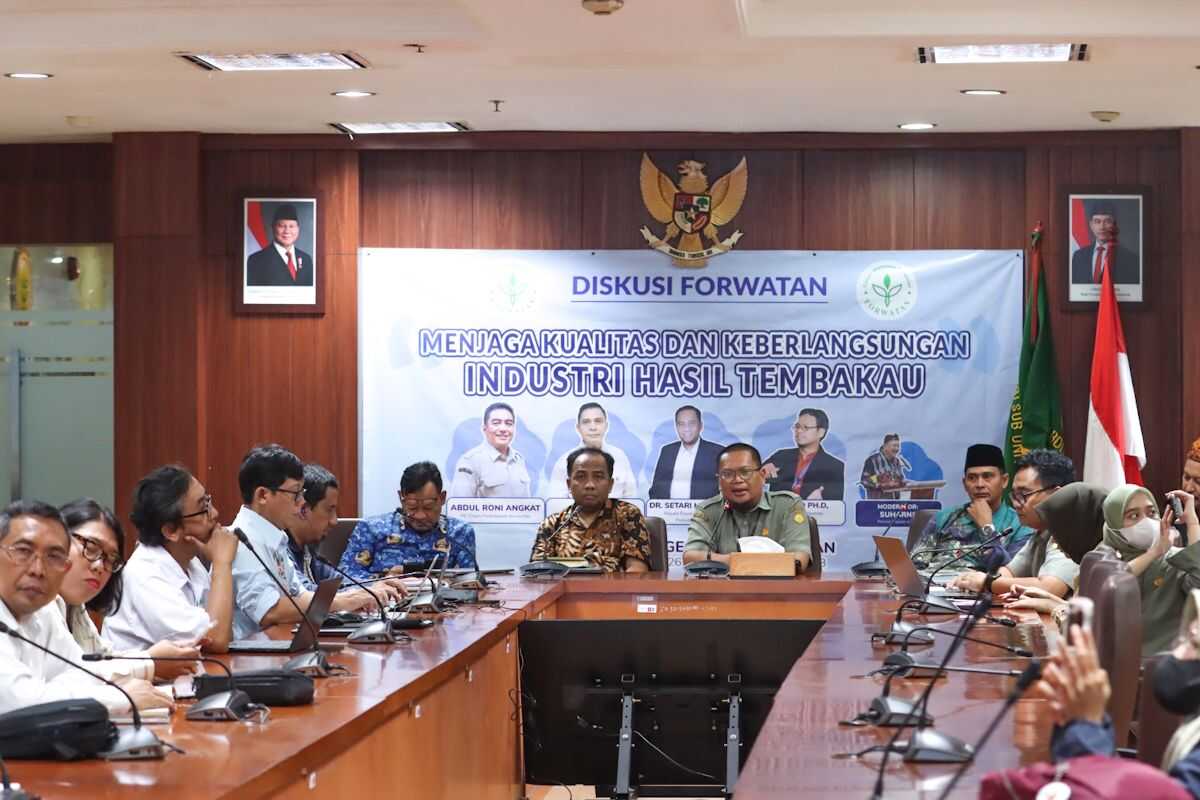
He emphasised this point at a discussion forum titled “Maintaining Quality and Sustainability of the Tobacco Products Industry” at the Ministry of Agriculture, which highlighted the need for balance between public health interests and the economic sustainability of the tobacco sector.
Amid its contribution of hundreds of trillions of rupiah in excise revenues and millions of jobs, the tobacco products industry faces regulatory pressure such as increased excise taxes, restrictions on tar content, plain packaging requirements, and sales limitations.
According to Yudi, regulatory impacts surrounding tobacco, ranging from standardisation pressure on packaging (plain packaging) and restrictions on tar-nicotine content currently gaining attention, will significantly affect farmer productivity absorption.
He noted that most local tobacco varieties do not possess nicotine content below 1 mg. For example, Kemloko varieties contain 3–8 per cent, Mole 1.3–8.36 per cent, and Madura 1–4 per cent.
“Therefore, the impact of tar-nicotine restrictions will be disruptive. The tobacco products industry cannot absorb the productivity of tobacco farmers,” explained Yudi.
Looking at 2025, Yudi continued, tobacco cultivation area is estimated to approach 200,000 hectares with production nearly 300,000 tonnes. However, current average productivity has declined to approximately 1.3 tonnes per hectare.
Ministry of Agriculture data noted that tobacco production centres remain concentrated on the island of Java, with Central Java accounting for approximately 50,000 hectares producing 56,000 tonnes, whilst West Java has 8,600 hectares producing approximately 8,000 tonnes.
Nationally, there are approximately 571,257 tobacco farming families. If one family consists of four people, then roughly 4 million people depend directly on this sector, and this could reach 6 million people when calculated from upstream to downstream production.
Given the vital importance of tobacco production in Indonesia, the government is working to promote increased yields to ensure the industry remains economically sustainable.
Setiari Marwanto, Head of the Plantation Crop Research Centre at the Indonesian Research and Innovation Agency (BRIN), stated that the agency is focusing on strategies to accelerate local tobacco production through plant breeding to enhance resistance to weather anomalies and disease attacks.
“At BRIN we are focusing on developing varieties adaptive to climate change. The future challenge is not merely about markets, but also how these plants can survive amid increasingly unpredictable weather conditions,” he said.
He explained that his team had developed tobacco varieties with resistance to La Niña weather anomalies that could potentially cause flooding.
“Our research aims to obtain tobacco strains or varieties tolerant to high soil moisture stress whilst maintaining good quality shredded leaf. So it is not only resistant to flooding, but its quality also remains compliant with industry standards,” he explained.
He stressed that tobacco quality acceptable to the market must meet several parameters. The market requires tobacco with specific aroma content, appropriate leaf thickness, and good elasticity.
Meanwhile, Mudi, Secretary General of the Indonesian Tobacco Farmers Association (APT), stated that sales restrictions, pressure for plain cigarette packaging, and plans to restrict nicotine and tar content could have direct impacts on raw material absorption.
“Our tobacco varieties average nicotine content of 3 to 8 milligrams. Varieties with content below 1 milligram are very rare and generally sourced from overseas. If this restriction is implemented without thorough study, factories could switch to imports,” he said.
He raised concerns about regulatory impacts stemming from Government Regulation Number 28 of 2024. If the planned nicotine and tar content restrictions are enacted, he argued, 90 per cent of tobacco could become unabsorbable.
“Farmers cannot plant, factories cannot produce. This could be a devastating blow to our tobacco products industry,” he stressed.
He reminded stakeholders that with the contribution of hundreds of trillions of rupiah in excise revenues and the dependence of millions of people, policy must be cautious, as farmers only benefit from approximately eight per cent of total excise revenues.