
Ministry of Agriculture affirms palm oil industry implements sustainability principles
Jakarta (ANTARA) - The Ministry of Agriculture (Kementan) has affirmed that the palm oil industry in Indonesia has implemented sustainability principles and is environmentally friendly, in line with global market demands for plantation commodities.
Director of Plantation Product Downstreaming at the Directorate General of Plantations, Ministry of Agriculture, Kuntoro Boga Andri, stated that palm oil land is not deforestation because palm oil industry players are required to obtain Indonesian Sustainable Palm Oil (ISPO) certification in accordance with Ministry of Agriculture Regulation Number 33 of 2025, which regulates environmental aspects and legal land governance.
“The standards we provide can be recognised by other countries. As the world’s largest palm oil producer, we essentially have the same universal sustainability values. The environmentally friendly palm oil that we are promoting has a positive impact on the environment and sustainability,” he said in his statement in Jakarta on Friday.
He mentioned the strong contribution of palm oil to energy and food, especially as Indonesia will enter B50, namely the use of 50 percent palm oil for biofuel or biodiesel, in July 2025.
In the global context, he added, Indonesian palm oil contributes 62 percent to the world’s palm oil supply and more than 54 percent compared to the world’s vegetable oils because palm oil’s productivity is 5-10 percent greater than other vegetable oils.
Meanwhile, data from the Directorate General of Plantations, Ministry of Agriculture statistics publication, indicates that Indonesia has the world’s largest palm oil plantation area of 16.83 million hectares (2025 and 2026 data).
In addition to being the largest contributor to non-oil and gas foreign exchange with a value of around Rp 440 trillion in 2024, the palm oil industry has provided jobs for 16 million people and serves as a driver of local economic growth through entrepreneurship based on plantation commodities.
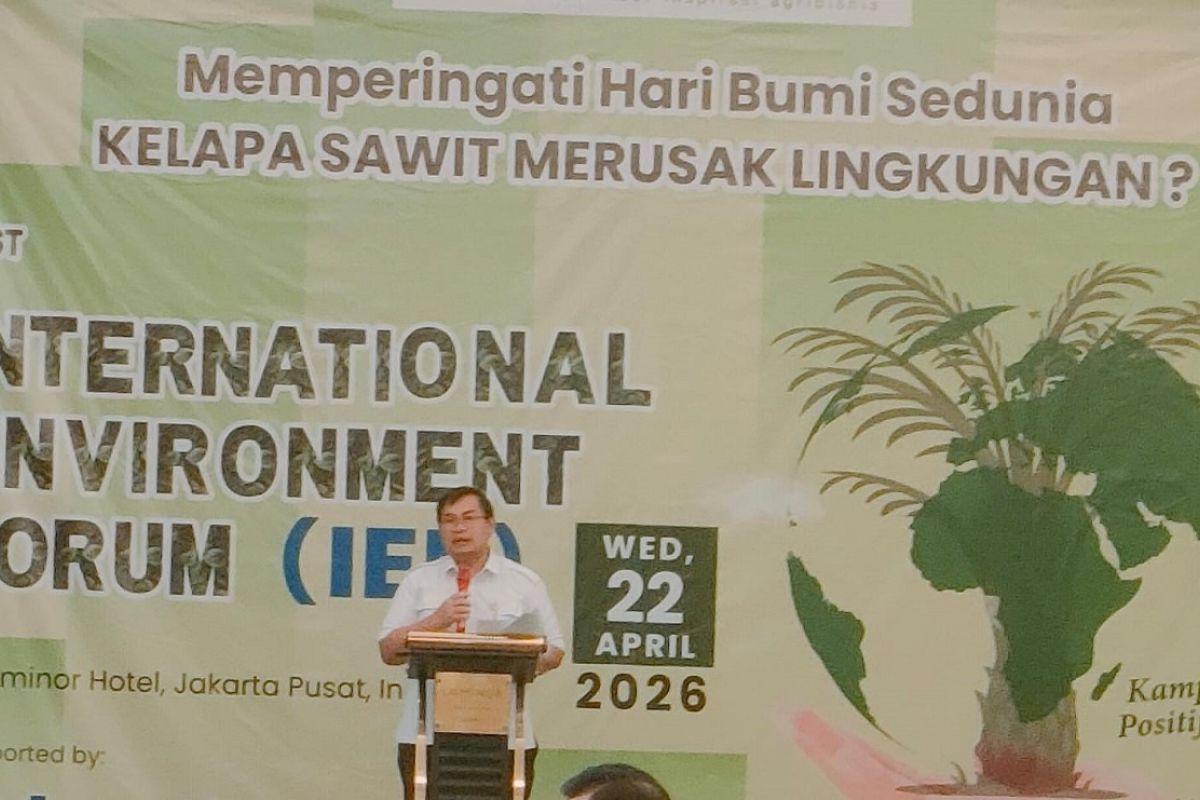
“So palm oil is a national strategic commodity that provides significant contributions to Indonesia’s economy, not only for food but also for energy,” he said while delivering a presentation at the “1st International Environment Forum 2026: Does Palm Oil Damage the Environment?”.
Meanwhile, the Secretary General of the Council of Palm Oil Producing Countries (CPOPC), Musdhalifah Machmud, emphasised that various accusations against the palm oil industry are often not accompanied by a complete understanding and data-based evidence.
Data from the World Wide Fund for Nature United Kingdom indicates that global palm oil plantations only use around 6-11 percent of the total land used for world vegetable oil production.
“Currently, the use of palm oil land in the world is 28.85 million hectares but it can produce 80 million tons of vegetable oil. Palm oil’s contribution to meeting the world’s food needs is around 34 percent using only 7 percent of the world’s land,” she said.
According to her, palm oil’s productivity in producing oil is very high, and it is efficient in land use compared to other vegetable oils.
“In fact, land use for vegetable oil, for example soybean, is 100-200 million hectares but its contribution is only around 15-20 percent,” she said.
She emphasised that if palm oil production were replaced by other commodities such as soybeans or sunflowers, land requirements would increase dramatically; even to replace the same volume, the world would need hundreds of millions of additional hectares of new land.
Looking ahead, Musdhalifah affirmed that the palm oil industry must continue to strengthen sustainability, increase productivity, and improve global communication.