
Ministers Meet with BPJS Kesehatan and BPS to Discuss Health Insurance Subsidy Data Transition
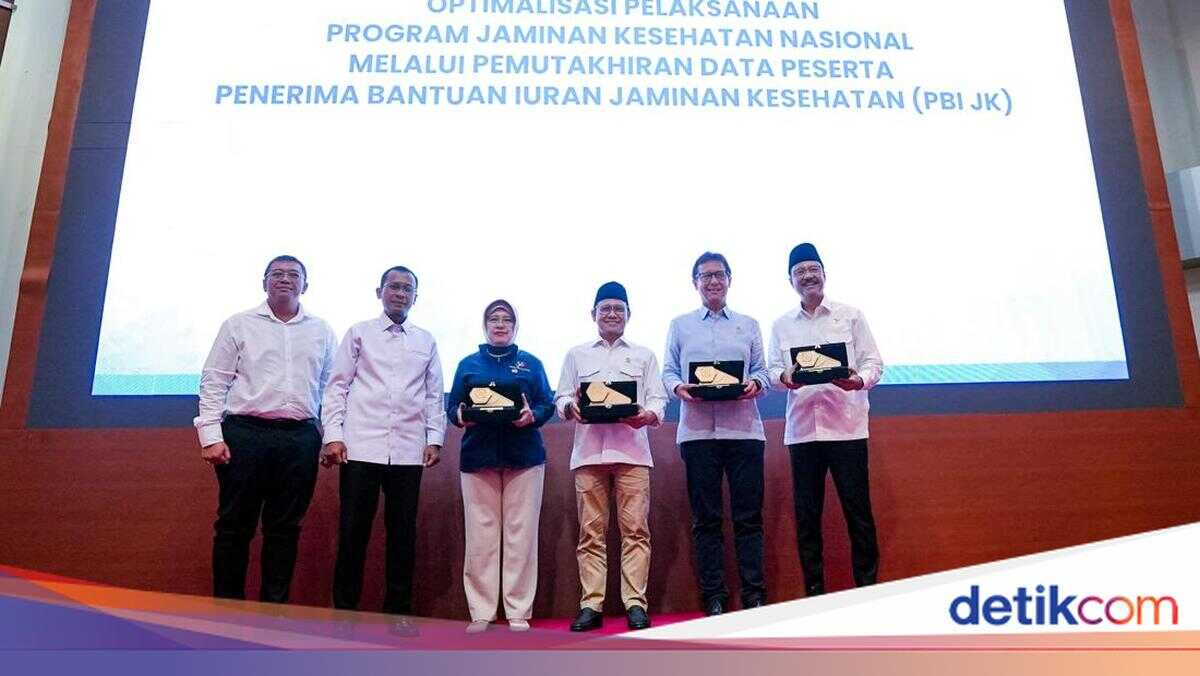
BPJS Kesehatan President Director Major General (Ret.) Prihati Pujowaskito convened a meeting with several ministers and agency heads to discuss the transition of the National Health Insurance (JKN) programme through the updating of Subsidised Health Insurance Contribution Recipients (PBI JK) data, aiming to ensure the data restructuring proceeds without disrupting public healthcare services.
The meeting, held at BPJS Kesehatan’s offices on Monday (23 February), was attended by Coordinating Minister for Community Empowerment Abdul Muhaimin Iskandar (Cak Imin), Health Minister Budi Gunadi Sadikin, Social Affairs Minister Saifullah Yusuf (Gus Ipul), Central Statistics Agency (BPS) Head Amalia Adininggar Widyasanti, and officials from related ministries and agencies.
“We fully support the development of this transition mechanism so that the PBI JKN data updating process can proceed in an orderly and accountable manner. The principle is that services to participants must continue and healthcare facilities must receive certainty of funding throughout the transition period,” Prihati said in a written statement on Monday (23 February 2026).
Cak Imin affirmed that the deactivation of PBI participants is part of the data restructuring transition process. “The deactivation of subsidy recipients is a transition process whereby those who are already financially capable should prepare themselves. Those who are already capable are not entitled to receive PBI and should get ready,” he explained.
He stressed that over the past month the government has strengthened coordination to ensure the national health insurance system continues to function well amid the data updating dynamics.
Cak Imin further explained that PBI is a key pillar of social security, meaning data updates must be carried out honestly and accurately, particularly by field assistants. He noted that based on welfare classifications, households in deciles 1 to 5 of the National Socio-Economic Data Registry (DTSEN) are categorised as underprivileged, whilst those in deciles 6 and 7 are classified as financially capable. Currently, more than 50 per cent of Indonesia’s population are subsidised contribution recipients.
Health Minister Budi Gunadi Sadikin said that the PBI scheme within JKN operates based on the demand for public healthcare services. “PBI JKN, which is a healthcare business process, exists because of demand, not supply, and therefore requires an appropriate flow in service fulfilment,” he said. Consequently, administrative and financing procedures must be designed precisely so that healthcare facilities can continue to serve patients without obstacles.
Social Affairs Minister Gus Ipul disclosed that more than 11 million participant records are being updated, with approximately 106,000 participants suffering from chronic illnesses having been automatically reactivated. PBI recipients will be re-verified by BPS officers, social workers, and local governments over the next two months.
“The results will form the basis for us to determine whether beneficiaries will remain as subsidised health insurance recipients or be advised to become independent participants,” he said.
He affirmed that the data update is part of the transformation towards a unified National Socio-Economic Database managed by BPS. The PBI budget, Gus Ipul continued, has neither been reduced nor reallocated.
To address concerns from healthcare facilities regarding the financing of participants whose status is being processed, the government is drafting a circular letter or joint decree that will regulate a transition period of two to three months before deactivation takes effect. This will provide time for socialisation as well as financing certainty for healthcare facilities.
“This is the mechanism we have been developing over the past few weeks. The important thing is that services keep running. No member of the public should be turned away from healthcare facilities or hospitals,” Gus Ipul stressed.
Through this transition mechanism, the government is ensuring that data updating proceeds simultaneously with the continuity of services, so that the public’s right to healthcare access remains protected.