
Minister of Religious Affairs Nasaruddin Umar Apologises for Statement on Abandoning Zakat
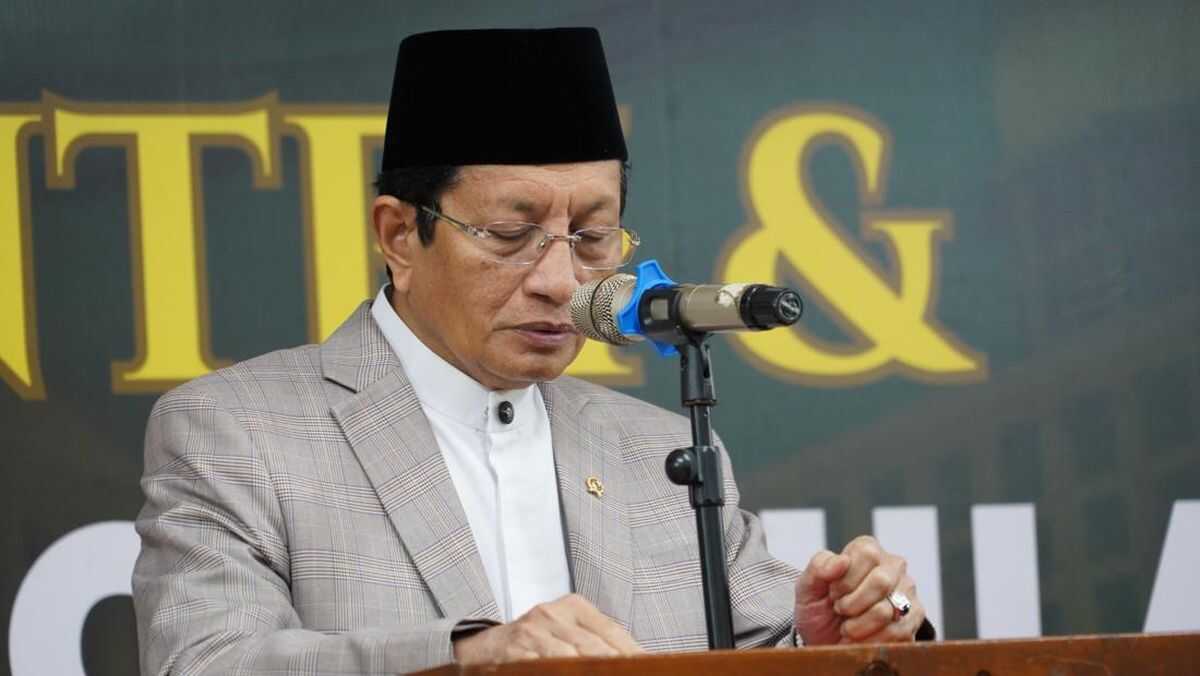
Indonesia’s Minister of Religious Affairs Nasaruddin Umar has issued an apology for his statement calling on Muslims to abandon zakat if they wish to advance.
Through the official account of Indonesia’s Ministry of Religious Affairs (Kemenag RI), Nasaruddin emphasised that zakat is a fardhu ’ain, or fundamental religious obligation for all Muslims.
“I, Nasaruddin Umar, apologise for my statement regarding zakat which may have caused misunderstanding among some people,” he said on Sunday (1 March).
According to Nasaruddin, his remarks about zakat at the 99th Islamic Economics Forum (Sarasehan 99 Ekonomi Syariah) were actually an appeal to ensure that community fundraising management is no longer solely oriented towards zakat.
He stated that Indonesia should learn from Middle Eastern countries such as Qatar, the United Arab Emirates, and Kuwait, which no longer rely exclusively on zakat.
“They rose without depending only on zakat, right? It is actually waqf that is most productive and has the widest reach,” he said.
In these countries, he noted, waqf has become an important instrument in development. He expressed his desire to adopt the same approach in Indonesia.
“This is the model we wish to adopt to accelerate the progress of the Indonesian Muslim community. This is my explanation. Thank you,” Nasaruddin said.
Nasaruddin’s controversial statement urging Muslims to abandon zakat was made during the 99th Forum on Thursday (26 February). According to him, if Muslims wish to progress, they must be willing to abandon zakat.
He argued that zakat is unpopular, even in the Qur’an, and was not popular during the time of Prophet Muhammad.
“If we wish to progress as a community, we must abandon zakat. Zakat is not popular. The Qur’an does not particularly promote zakat. During the Prophet’s time, zakat was not popular. During the companions’ time, it was also not popular. What was popular? Charity (sadaqah),” he said.
As an alternative, Nasaruddin called for Indonesia to begin implementing community financing schemes from other sources, namely sadaqah.
He highlighted the comparison of Islamic financing mechanisms, noting that mudarabah and musyarakah profit-sharing rates can reach 6, 8, or even 9 per cent, whereas zakat is only 2.5 per cent.
“If our only expenditure is zakat, we are being too stingy,” he said.