
Minister of Religious Affairs, 2.5 Percent Zakat, and Modern Spirituality
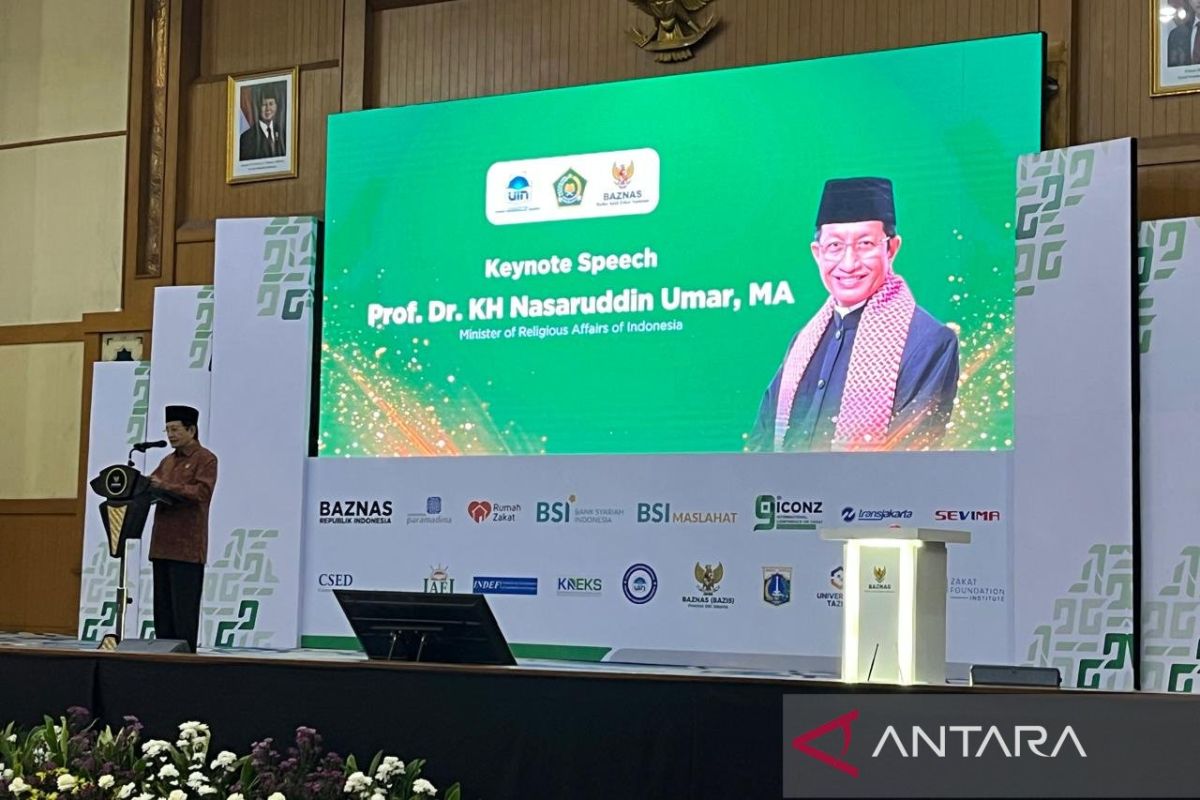
So, piety in digital information during the month of Ramadan is also important as part of “modern spirituality”, which makes the Indonesian nation happy from this world to the hereafter. Jakarta (ANTARA) - “Abandon Zakat if Muslims want to advance.” That is the narrative from a viral video clip referring to the figure of the Minister of Religious Affairs Prof. Dr. Nasaruddin Umar, who explained this at the 99 Sharia Economists Gathering in Jakarta on 26 February 2026.
Of course, this call contradicts Islamic Sharia, which mandates zakat as part of the pillars of Islam. But, is it true that a Minister of Religious Affairs does not understand the Pillars of Islam? In other words, that video clip needs to be sought in its full context.
Thus, the digital era that relies on short videos often gets trapped in judgement/ghibah, which, when traced in its full context, can have a different meaning, like the video clip from the statement “pork is allowed” when the full context is “pork is allowed in emergency conditions, which are pressing and there is no other food”.
So, the clip and the context (full video) are very different, right? There is a funny example, namely a video clip from the statement “smoking does not invalidate fasting” when the full context is “smoking does not invalidate fasting if smoking is done after Maghrib”. Funny and a fatal difference, right?
Now, what is the actual context of “Abandon Zakat” from the original source, namely the Minister of Religious Affairs? The full context was delivered by the Minister of Religious Affairs during the Subuh Sermon at the National Mosque Al-Akbar Surabaya/MAS (7/3/2026).
“Do not blame people through sermon clips; perhaps we have not yet reached what the preacher meant. It is like the Sufi Al-Hallaj (858-922 AD) who was executed to death because he was considered deviant, but the blood flowing from his body finally formed ‘la ilaha illallah’ to indicate that he was right,” he said.
In the sermon in front of the Head of the Executive Body Manager (BPP) MAS Dr KHM Sudjak MAg, also attended by around 1,000 male and female Subuh congregants at Al-Akbar Mosque, the Minister of Religious Affairs explained that the viral snippet of his statement was not him considering zakat non-obligatory.
Another example from Qatar, Kuwait, and the United Arab Emirates, which through the Ministry of Waqf are able to collect religious social funds up to 25-40 percent for community empowerment to be more productive and sustainable socially and economically.
In other words, increasing piety in digital information during the month of Ramadan is also important, because the Al-Quran is a miracle that descended in the month of Ramadan, which contains guidance on piety/taqwa.
The philosopher Aristotle emphasised that truth is the correspondence between perception and reality/fact. In other words, information circulating on social media still needs to be aligned with reality. If it has not been checked or does not match reality, it means it is still merely perception that is not necessarily true. Especially if the information is only a snippet (doubtful).
Moreover, true information or correct information in the Al-Quran and Hadith is highly prioritised, even becoming a determinant of whether we are among the people of paradise or hell.
“O you who have believed, avoid much suspicion. Indeed, some suspicion is sin. And do not spy or backbite each other. Would one of you like to eat the flesh of his brother when dead? You would detest it. And fear Allah; indeed, Allah is Accepting of repentance and Merciful.” (QS al-Hujurat 49:12)
“O you who have believed, let not a people ridicule [another] people; perhaps they may be better than them; nor let women ridicule [other] women; perhaps they may be better than them. And do not insult one another and do not call each other by [offensive] nicknames.” (QS. al-Hujurat: 11)
“Whoever believes in Allah and the Last Day - let him speak good or keep silent.” (HR. Muslim). Or another Hadith: “When Muadh asked the Prophet: are we questioned about our speech? ‘Woe to you, indeed most of the people whose faces are thrown into the fire of hell because of their speech’.” (HR. At-Turmudzi)
Another Hadith is even “harsher”, namely “The bankrupt of my ummah is the one who comes on the Day of Resurrection bringing (rewards of) prayer, fasting, and zakat, but (in the world) he has insulted and (falsely) accused others, consumed wealth, shed blood, and beaten others (without right). Then, those people will be given rewards from their good deeds. If their good deeds are exhausted, their sins will be imposed on him, then he will be thrown into hell” (HR. Muslim).