
Minister of Public Works Exchanges Greetings with Staff During Halalbihalal Event
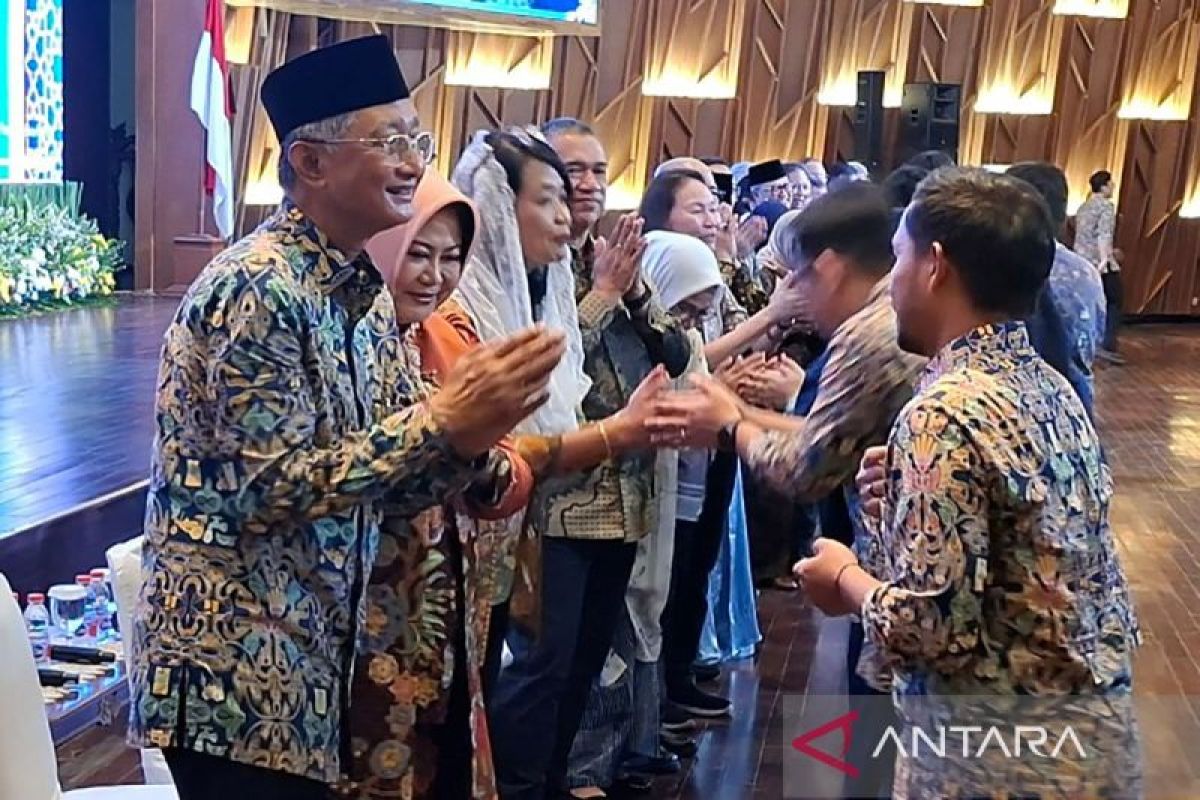
Jakarta (ANTARA) - Minister of Public Works (PU) Dody Hanggodo exchanged greetings with the ministry’s staff during a halalbihalal event in Jakarta on Wednesday.
“It’s just a matter of exchanging greetings among us all,” said Dody Hanggodo when met at the Ministry of PU in Jakarta on Wednesday.
The Ministry of PU held the halalbihalal event for the extended family of the Ministry of PU at the Ministry’s Auditorium in Jakarta.
The halalbihalal event was organised in commemoration of Eid al-Fitr 1447 Hijriah.
Many Ministry of PU employees were observed enthusiastically queuing to exchange greetings with the Minister of PU and other senior ministry officials since the event began at 10:00 WIB.
In addition to being attended by Minister of PU Dody Hanggodo, the halalbihalal event was also attended by Deputy Minister of PU Diana Kusumastuti, Secretary General of the Ministry of PU Wida Nurfaida, and several other senior ministry officials.
For information, the momentum of exchanging greetings and halal bihalal after Eid al-Fitr is regarded as an important tradition in strengthening brotherhood and cleansing human relations.
Lecturer at UMS Suwinarno, S.Ag., M.Pd.I, views this tradition not merely as a social culture but also as a spiritual means to improve relationships after performing Ramadan worship.
According to Suwinarno, halal bihalal essentially provides space for society to mutually ask for and give forgiveness.
He explained that this tradition has developed strongly in Indonesia because its society has a rich cultural character with symbols and social rituals.
“Indonesia is a cultural country. Especially Javanese society, almost every activity has a ceremony, entertainment, and event,” he said.
He added that this pattern is also evident in various social activities, from weddings to religious celebrations.
In his view, halal bihalal serves as a forum that facilitates society to strengthen ties of silaturahmi while cleansing mutual mistakes.
This tradition also allows every individual to repair relationships that may have become strained in social life.
Suwinarno exemplified how Javanese society often expresses these values through cultural symbols, such as the tradition of sending food ahead of Lebaran.
“Javanese people are inseparable from symbols and meanings, like kupat, lepet, or apem that are exchanged as signs of mutual remembrance and maintaining relationships,” he said.
Nevertheless, he conveyed that the practice of halal bihalal should still be carried out proportionately.
As long as it does not contain excessive elements or wastefulness, the event is considered good in maintaining harmony and societal cohesion.