
Minister of Cooperatives Urges Consolidation of Community Funds for Productive Industries
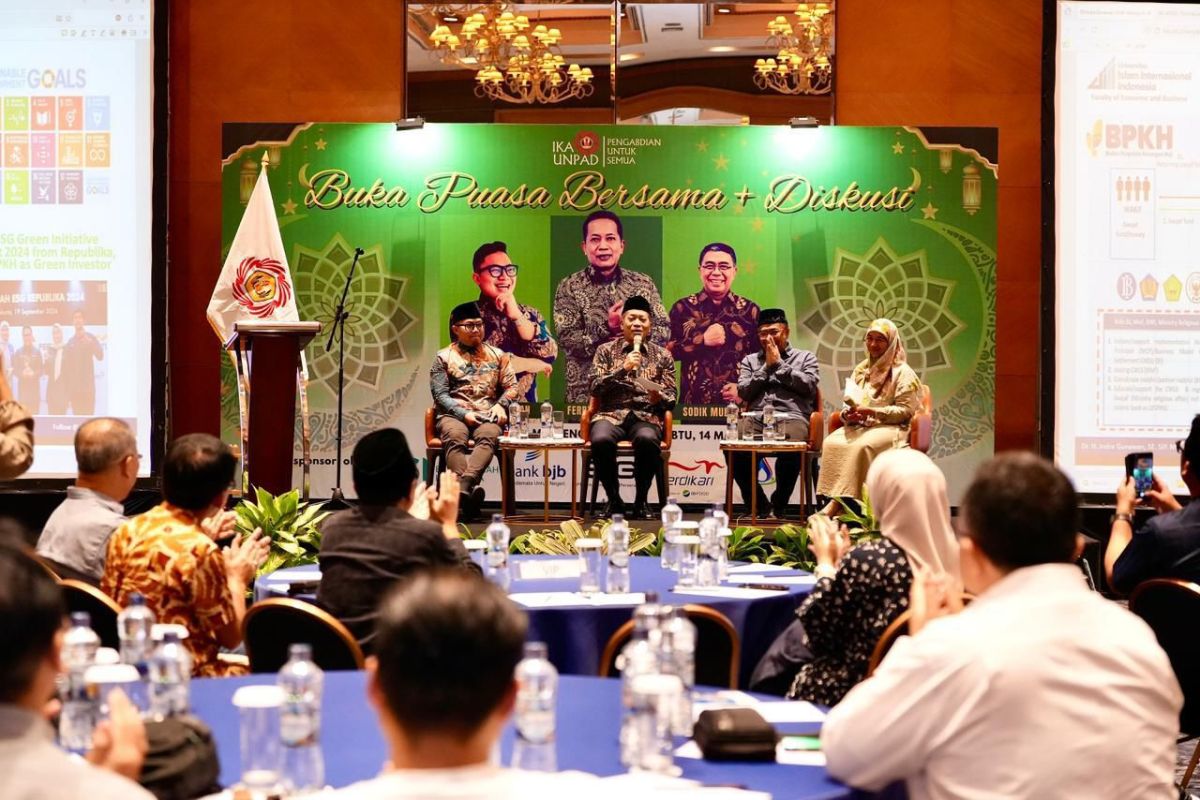
Jakarta – Indonesia’s Minister of Cooperatives Ferry Juliantono has called for community funds, including zakat, infaq, sedekah, and waqf (ziswaf), to be consolidated for industrial development, including the construction of factories that produce essential goods, to support public welfare improvement programmes.
According to him, the management of community funds must be directed towards productive purposes through an integrated Islamic financial ecosystem, so that the benefits return to the community and increase welfare.
At a public discussion event hosted by the Alumni Association of Padjadjaran University (IKA Unpad) in Jakarta on Saturday, 14 March 2026, Juliantono noted that the potential of national zakat reaches over 320 trillion rupiah annually, whilst productive waqf is approximately 180 trillion rupiah.
“It would be very beneficial if these community funds were consolidated to develop industries that produce various products needed by the community. These products would be ready for distribution through thousands of red-and-white village cooperative outlets,” he stated in a press statement.
Juliantono, who also serves as Chairman of the Islamic Economy Society (MES), emphasised the need for professional, transparent, and productive management of community funds.
He added that MES serves as a strategic forum to accelerate the implementation of Islamic economic systems in Indonesia, involving government, financial institutions, academia, and business actors.
“We at MES are pushing to enter the real sector. We must not only be customers, but also borrowers from Islamic banks or financial institutions to finance the construction of factories,” he said.
However, he acknowledged that numerous challenges remain in optimising the management of these community funds, such as low levels of public financial literacy, public trust, professional management standards, coordination between institutions, and fund distribution that remains largely consumptive rather than productive.
Additionally, Juliantono mentioned the progress of red-and-white village and community cooperative (kopdes/kel) development, which has reached 32,000 units nationally, with approximately 2,000 units completed at 100 per cent capacity.
He valued village cooperatives as distribution networks for products generated from community funds managed in a productive manner.
In the same forum, Chairman of the Indonesian National Zakat Agency (Baznas) Sodik Mujahid acknowledged that the potential of national zakat is very substantial, yet actual collection realisation stands at only approximately 8 to 10 per cent annually.
According to him, if the hundreds of trillions of rupiah in zakat potential that could be collected were realised, opportunities to accelerate public welfare improvement programmes could be implemented.
He considered the expansion of zakat collection unit networks (UPZ) and the integration of corporate social responsibility (CSR) programmes with Baznas social initiatives as important agenda items to optimise zakat potential.
“The beneficiaries who need to be empowered are particularly strategic, and the potential and opportunities that exist in Indonesia are enormous. Therefore, the task ahead is public education and the improvement of community financial literacy,” he said.